
Kite Realty Group Trust: Retail Real Estate Strengthened by Diversification and Leasing Execution
Kite Realty Group Trust operates a large and diversified portfolio of open-air, grocery-anchored shopping centers in high-growth U.S. markets. Recent results show solid leasing activity and positive rent spreads but also reveal net losses and sector headwinds, raising questions about long-term earnings resilience and capital allocation in a changing retail landscape.
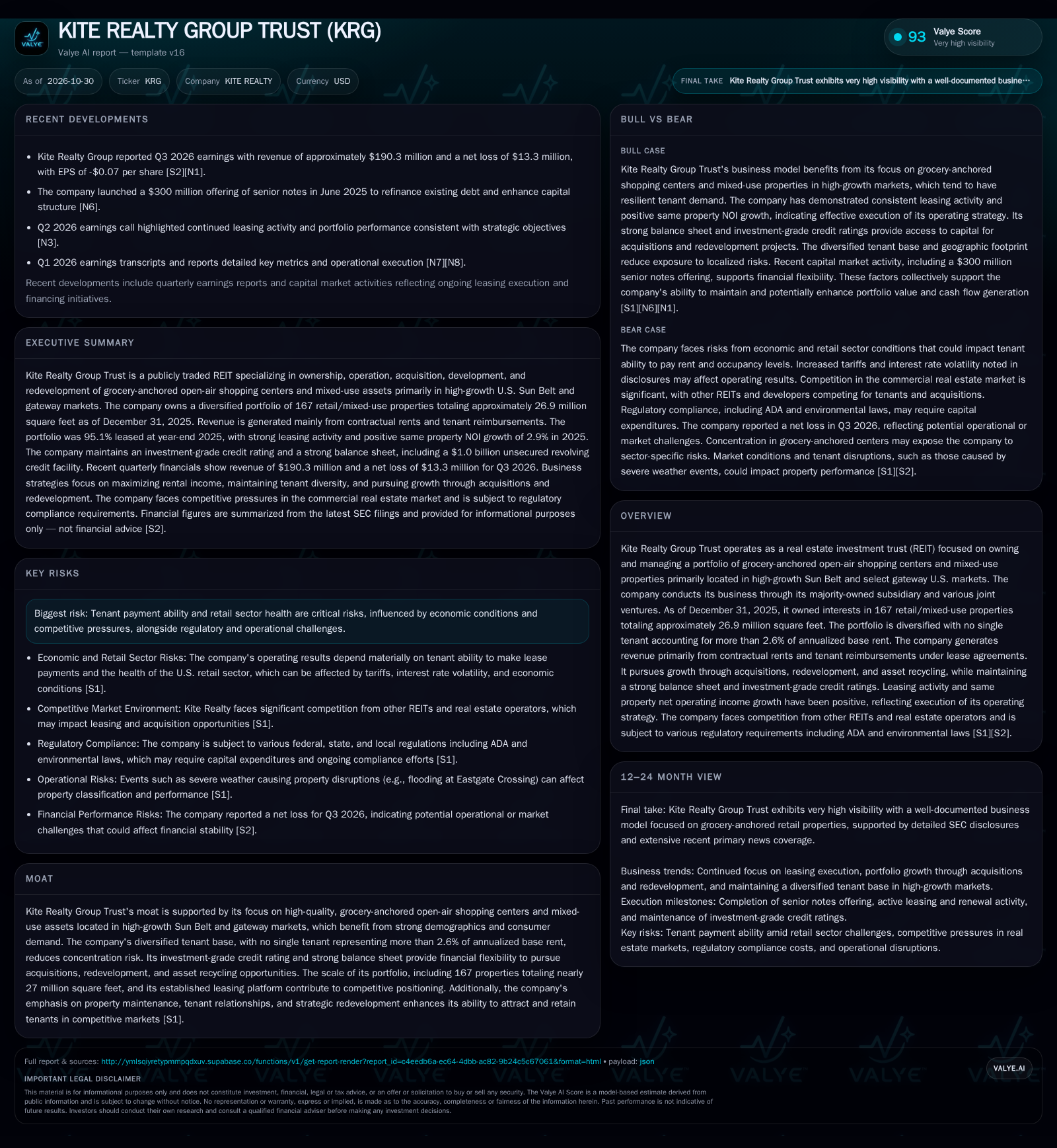
Kite Realty Group Trust reported a 95.1% leased portfolio and positive leasing spreads, reflecting strong execution in high-growth markets. However, a Q3 2026 net loss and ongoing sector challenges highlight the importance of tenant quality, capital discipline, and portfolio strategy as the company seeks to maintain growth and financial stability. Monitoring leasing spreads, tenant health, and capital allocation will be critical for assessing future performance. [S1] [S2]
Kite Realty Group Trust stands out among retail-focused REITs for its emphasis on grocery-anchored, open-air shopping centers and mixed-use assets in economically vibrant Sun Belt and gateway markets. With a portfolio that is both large and highly leased, the company has demonstrated consistent operational execution, especially in lease renewals and rent growth. However, recent net losses and sector-specific risks—including tenant health and evolving retail trends—underscore the need for ongoing vigilance around capital deployment, portfolio mix, and exposure to macroeconomic volatility. The company’s future performance will depend on its ability to navigate these cross-currents while leveraging its scale and tenant diversification.
Recent Leasing Wins and Financial Highlights
Kite Realty Group’s latest operating snapshot reveals a 95.1% leased portfolio across 167 properties, with anchor tenants at 96.7% and small shops at 92.3% occupancy as of December 31, 2025. The company executed 683 new and renewal leases in 2025, achieving a strong blended cash leasing spread of 13.8% for 501 comparable deals. Same property NOI increased by 2.9% year-over-year, driven by contractual rent growth and positive leasing spreads, though partially offset by higher bad debt expense. Despite these operational wins, the company reported a net loss of $13.3 million for Q3 2026, on revenue of $190.3 million, with diluted EPS of -$0.07. This juxtaposition of strong property fundamentals and a quarterly net loss highlights the complex interplay between leasing momentum, non-cash charges, and broader sector pressures. [S1] [S2]
Leasing Dynamics, Rent Growth, and Capital Structure Impact on Earnings
Kite Realty’s revenue model is anchored in contractual rents and tenant reimbursements, which provide a relatively predictable cash flow base. The positive 13.8% blended cash leasing spread on renewals and new leases suggests an ability to mark rents to market in high-demand locations, supporting organic income growth. The company’s leasing success, especially in grocery-anchored centers, likely reflects both tenant demand and the defensive appeal of necessity-based retail.
Operating leverage in this REIT model is driven by fixed property expenses (taxes, insurance, maintenance) and variable components tied to leasing activity and tenant turnover. High occupancy rates help maximize NOI, but persistent sector headwinds—such as tenant bankruptcies or retail consolidation—can introduce earnings volatility via bad debt expense and re-leasing costs. The company reported cash and liquidity metrics for the period; these figures do not by themselves establish operating runway, investment capacity, financial flexibility, or financing capacity. [S1] [S2] [N6]
Tenant Mix, Location Strength, and Competitive Landscape in Retail REITs
Kite Realty competes in a crowded field of retail REITs and local developers, where location, tenant mix, and property quality are critical differentiators. The company’s portfolio is geographically weighted toward high-growth Sun Belt and select gateway markets, which have historically demonstrated better demographic tailwinds and lower retail vacancy rates. Its focus on grocery-anchored centers provides a degree of resilience, as these tenants tend to have more stable foot traffic and lower e-commerce substitution risk than discretionary retailers.
A key advantage is tenant diversification: no single tenant accounts for more than 2.6% of annualized base rent, and the top 25 tenants comprise just 25.5% of ABR. This reduces exposure to single-tenant defaults and sector-specific disruptions. However, competition for high-quality assets and tenants remains intense, and success will depend on the company’s ability to maintain property quality, execute timely redevelopments, and secure favorable lease terms. Regulatory compliance and property maintenance also remain cost centers, particularly with evolving ADA and environmental standards. [S1]
Potential NOI and Valuation Gains from Leasing Momentum and Market Support
A favorable scenario for Kite Realty involves continued strong leasing volumes and positive rent spreads, supported by demographic growth in Sun Belt markets and the relative strength of grocery-anchored retail. If the company can consistently renew leases at double-digit cash spreads and maintain high occupancy, same property NOI could accelerate, especially if bad debt expense normalizes or declines.
Confirmation of this scenario would come from sustained or rising leasing spreads, sequential increases in same property NOI, and evidence of successful redevelopments or accretive acquisitions. A reduction in net losses, or a return to GAAP profitability, would further validate execution and portfolio resilience. Conversely, a drop in occupancy or a sharp uptick in tenant defaults would challenge the upside narrative. [S1] [S2]
Stable Performance Expectations Amid Evolving Retail Market Conditions
The most plausible outlook is for Kite Realty to maintain high occupancy and moderate leasing spreads, offsetting sector pressures with disciplined asset management and selective growth. Same property NOI growth is likely to remain in the low single digits, driven by contractual rent bumps and periodic lease mark-to-market opportunities, but tempered by ongoing bad debt expense and property-level capex needs.
Capital recycling—disposing of non-core assets and reinvesting in higher-growth locations—could support incremental NOI growth, provided market conditions remain stable. The net loss in Q3 2026 may reflect non-cash items or timing effects, but persistent GAAP losses would raise questions about recurring earnings power. Evidence supporting this base case would include stable or slightly improving occupancy, recurring positive leasing spreads, prudent capital deployment, and maintenance of investment-grade credit metrics. [S1] [S2]
Risks from Tenant Challenges, Economic Shocks, and Rising Expenses
Adverse developments could include a spike in tenant bankruptcies, especially among smaller shops or discretionary retailers, leading to higher vacancy and rising bad debt expense. Macro shocks—such as a sharp downturn in consumer spending, rising interest rates, or regional disruptions—could suppress leasing activity and erode rent spreads. If redevelopment projects underperform or capital markets tighten, the company may face constraints on growth or even refinancing risk, despite its current investment-grade status.
Evidence for this scenario would include deteriorating occupancy rates, a reversal of positive leasing spread trends, a spike in bad debt expense, or adverse changes in credit ratings. [S1] [S2]
Assessing Resilience and Growth Prospects for Kite Realty Group
Watch for quarterly blended cash leasing spreads on comparable deals—continued double-digit spreads would signal pricing power.
Monitor changes in portfolio occupancy rates, especially for small shop space, as a leading indicator of tenant health and demand.
Track same property NOI growth relative to peers and historical averages to assess underlying rent and expense dynamics.
Evaluate the pace, scale, and returns of redevelopment and acquisition activity—evidence of capital discipline and value creation.
If disclosed, analyze tenant health metrics and rent collection rates to gauge credit risk and potential bad debt exposure.
Follow credit rating updates and changes in borrowing capacity, as these affect capital access and cost of debt.
Assess the mix and duration of lease expirations over the next 24 months, as high rollover risk may pressure rent growth or occupancy.
Monitor regulatory or environmental compliance costs, especially if new standards require material capex or affect property operations.
Disclaimer: This is research-only, informational analysis and not investment advice. It may include AI-generated interpretation and general industry context. Always verify important details using primary sources.

Comments