
Sandisk’s Datacenter Growth: AI-Driven Gains, Supply Discipline, and Momentum Sustainability
Sandisk’s record-breaking quarterly profits highlight the transformative impact of AI and datacenter demand on storage hardware economics.
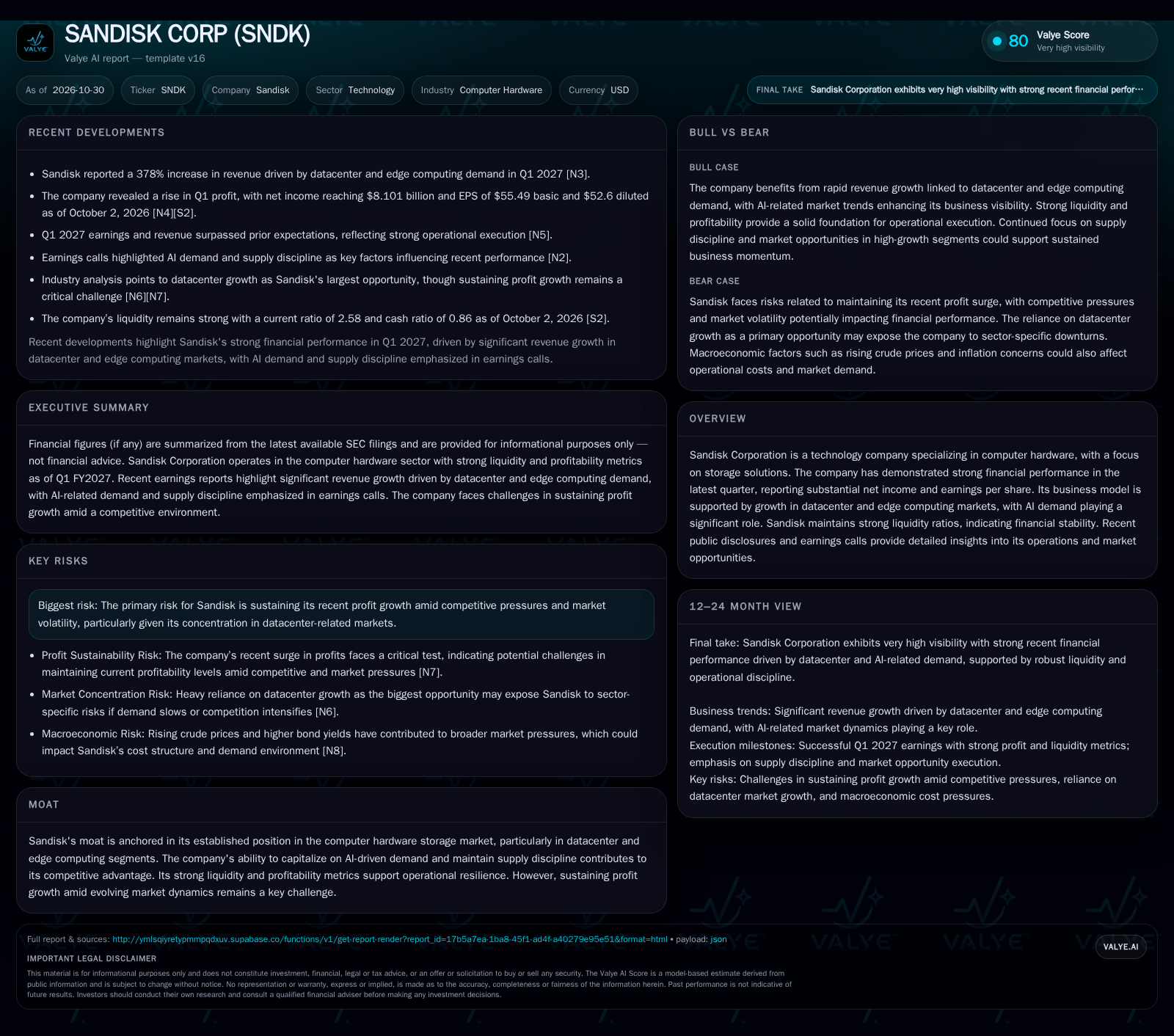
Sandisk reported a dramatic profit surge in Q1 FY2027, fueled by datacenter and AI-related demand, with $8.1B in net income and reported liquidity position. The company’s ability to sustain this momentum will depend on continued datacenter growth, competitive pressures, and macroeconomic factors such as inflation and energy costs. Supply discipline and operational execution remain central to its near-term outlook. [S2] [N2] [N4]
Sandisk Corporation’s most recent quarter marks a defining moment for the legacy storage hardware leader. Surging demand from datacenter and AI applications has translated into record profits, with net income exceeding $8 billion and earnings per share at multi-year highs. As the storage market undergoes a fundamental shift, Sandisk’s next challenge is to prove that these results are not merely cyclical but represent a new baseline for growth and profitability.
AI-Driven Profit Spike and Liquidity Strength Define the Current Landscape
Sandisk’s Q1 FY2027 results capture a transformative moment: net income reached $8.101 billion, with basic EPS of $55.49 and diluted EPS of $52.6 [S2] [N4]. This outsized profitability is attributed to a surge in demand from datacenter and AI workloads, as highlighted in recent earnings calls [N2] [N3]. The company’s liquidity position is reflected in $5.136 billion in cash and a current ratio of 2.58 as of October 2, 2026 [S2]. Management has emphasized supply discipline as a critical factor in sustaining margins during this period of heightened demand [N2]. These developments set the stage for both opportunity and risk: while Sandisk is benefitting from secular tailwinds, the exceptional results raise the bar for future performance and introduce questions about the sustainability of these drivers.
Storage Hardware Economics: Volume Leverage, Mix Shifts, and the AI Effect
Sandisk’s core business monetizes high-performance storage hardware—primarily solid-state drives (SSDs) and flash memory—sold to datacenter operators, cloud service providers, and increasingly, AI infrastructure builders. The current profit surge likely reflects a favorable mix shift toward higher-value, higher-margin enterprise products tailored for AI and edge computing workloads. In this environment, average selling prices can rise as customers demand greater speed, endurance, and density, while volumes benefit from both secular data growth and the capital cycle of hyperscale datacenters.
The company’s fixed-cost base—anchored in fabrication, R&D, and design—enables significant operating leverage: incremental sales of premium storage products can disproportionately boost margins and net income. At the same time, variable costs tied to memory chip inputs and supply chain complexity require careful management, especially as industry pricing is historically cyclical.
The company reported cash and liquidity metrics for the period; these figures do not by themselves establish operating runway, investment capacity, financial flexibility, or financing capacity. The balance between supply discipline (to protect pricing) and capacity investment (to capture growth) will be a central tension as the market evolves.
Defending Share in a Consolidating and Innovation-Driven Market
Sandisk’s competitive position is built on brand recognition, broad product portfolio, and established relationships with major datacenter and cloud customers. In the current cycle, its ability to deliver high-performance, reliable storage at scale is a differentiator, particularly as AI workloads demand new levels of throughput and endurance.
However, the storage hardware market remains highly competitive and subject to rapid technological substitution. Key competitor categories include other global NAND and SSD manufacturers, integrated semiconductor giants, and new entrants leveraging alternative memory or storage-class technologies. Price competition is fierce, and innovation cycles are accelerating as customers seek solutions optimized for AI, edge, and real-time analytics.
Switching frictions exist due to integration requirements and qualification processes, but these are not insurmountable—large customers can and do dual-source or shift vendors in response to price, performance, or supply concerns. Sandisk’s moat is meaningful but not unassailable; continued investment in product leadership and operational reliability is required to preserve share.
If AI and Edge Demand Remain Relentless, Margin Expansion Could Persist
In a favorable scenario, secular demand for AI and datacenter storage continues to outpace expectations, driving sustained volume growth and enabling Sandisk to maintain premium pricing on its most advanced products. Supply discipline holds, preventing industry-wide overcapacity and price erosion.
Evidence that would confirm this scenario includes: continued growth in enterprise and cloud storage shipments, stable or rising average selling prices for high-end SSDs, and management commentary emphasizing order visibility and tight supply. Additionally, market data showing persistent under-supply of advanced memory products, or new AI-driven storage use cases emerging, would further support the bullish case.
Conversely, this scenario would be challenged if hyperscale customers begin to slow procurement, if new supply comes online too rapidly, or if alternatives (such as in-memory computing or new storage architectures) begin to erode demand for traditional NAND and SSDs.
Normalization of Growth and Margins as Cyclical Tailwinds Fade
The most plausible path forward is that Sandisk’s extraordinary Q1 results represent a cyclical high, with growth and profitability normalizing as supply chains stabilize and the initial wave of AI infrastructure buildout matures. In this scenario, storage demand continues to rise, but at a more measured pace, and industry pricing becomes more competitive as additional capacity enters the market.
Margins may compress modestly from peak levels, but Sandisk’s scale, reported balance sheet position, and supply discipline allow it to defend core profitability. Continued investment in next-generation products and customer relationships sustains relevance, even as the pace of growth moderates.
Confirmation would come from sequential moderation in revenue and earnings growth, more intense pricing competition in industry reports, and management signaling a return to historical margin ranges. However, sustained outperformance in premium segments or unexpected stickiness in AI-driven demand could tilt the outcome more positively.
Profitability Under Pressure: What If Growth Drivers Reverse?
A negative scenario emerges if AI and datacenter demand proves more cyclical or front-loaded than expected, leading to inventory corrections and weaker order flow. In this case, industry capacity additions could overshoot demand, triggering price declines and margin compression across the sector. Competitive intensity might rise as manufacturers seek to defend share through aggressive pricing or customer incentives.
Sandisk’s exposure to large enterprise and cloud customers could amplify the impact of any procurement pause or technology transition. At the same time, macroeconomic shocks—such as rising energy prices or a sharp slowdown in IT spending—could exacerbate the downturn.
Evidence supporting this scenario would include: sequential declines in revenue or margins, management guidance pointing to order weakness or inventory build, industry reports of falling NAND and SSD prices, and commentary from major cloud providers about slowing capex or changing technology preferences.
Signals That Will Define Sandisk’s Post-Surge Trajectory
Trends in average selling prices and gross margins for enterprise and AI-optimized storage products would help clarify the sustainability of Sandisk’s recent profitability.
Quarterly volume growth in datacenter and edge storage shipments—if disclosed—would be a direct indicator of underlying demand strength.
Updates on customer concentration and contract structure (e.g., multi-year agreements, renewal rates) would provide visibility into revenue durability and switching risk.
Capital expenditure guidance and commentary on manufacturing capacity plans will signal management’s confidence in future demand and approach to supply discipline.
Competitive developments—such as new product launches or pricing moves by other major NAND and SSD providers—could reshape the profit pool.
Macroeconomic data points, including energy costs and inflation trends, should be monitored for potential impacts on both Sandisk’s cost structure and customer budgets.
Management’s outlook on AI and datacenter market trends, especially any shift in order patterns or technology adoption curves, will be critical for scenario validation.
Disclaimer: This is research-only, informational analysis and not investment advice. It may include AI-generated interpretation and general industry context. Always verify important details using primary sources.

Comments