
Bioceres Crop Solutions: Patent Moat, Licensing Leverage, and the Real Stakes of Financial Constraint
Bioceres is betting on proprietary HB4 traits, licensing, and global manufacturing to carve a niche in competitive agricultural biotech.
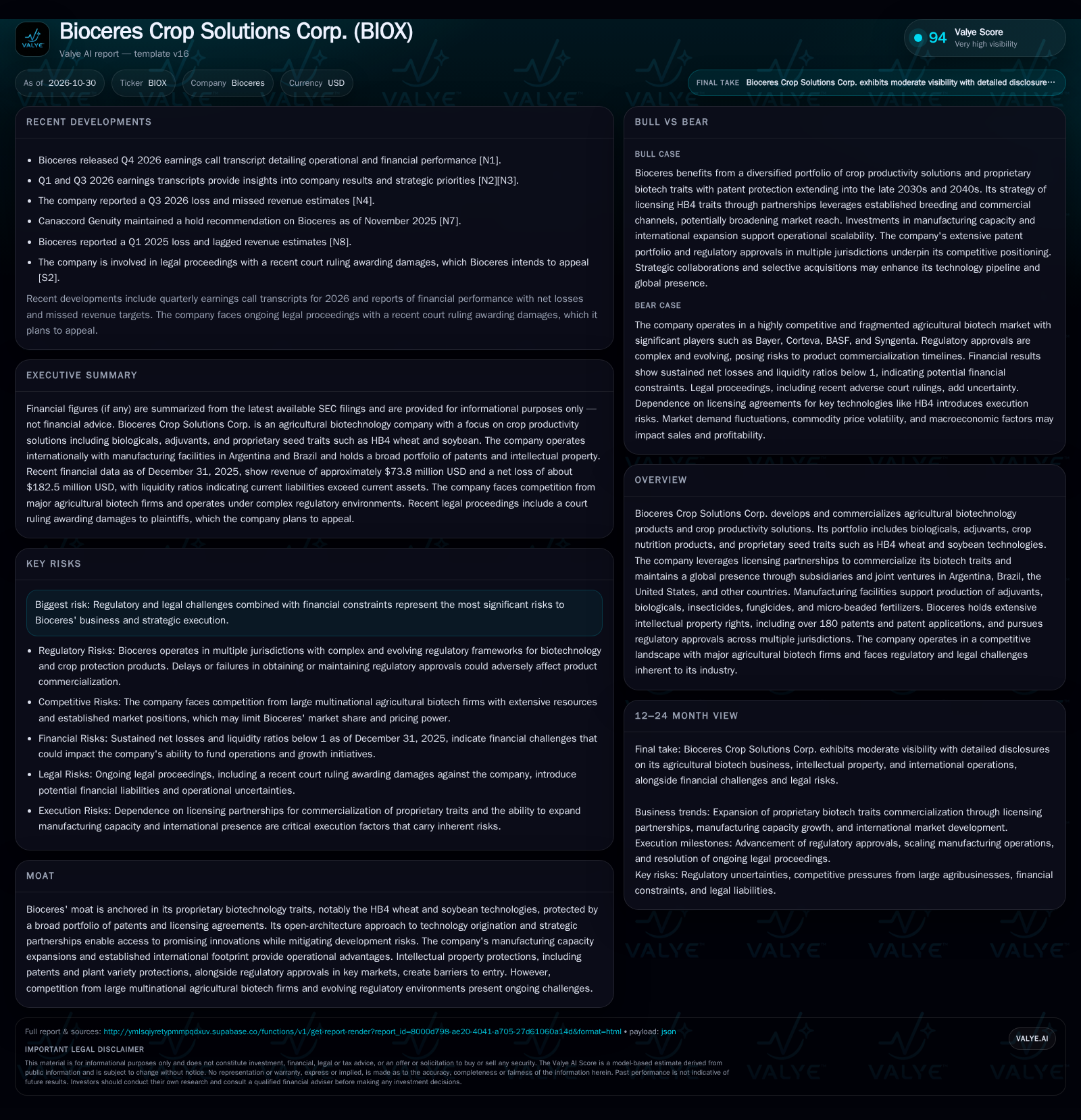
Bioceres Crop Solutions is an agricultural biotech innovator focused on proprietary seed traits and crop productivity products, with an international presence and strong patent portfolio. Despite strategic licensing partnerships and manufacturing expansion, the company faces ongoing net losses, liquidity pressures, and recent legal setbacks. The viability of its HB4 trait commercialization, regulatory advances, and ability to fund growth amid competition from industry giants will shape its trajectory over the next two years. [S1] [S2] [N1] [N4]
Bioceres Crop Solutions stands at a crossroads: its proprietary HB4 wheat and soybean traits offer a differentiated value proposition in agricultural biotechnology, supported by a robust international patent portfolio and global manufacturing footprint. However, the company’s most recent financials underscore a persistent net loss and liquidity ratios that may constrain its ability to pursue growth and defend its IP in court. As Bioceres seeks to leverage licensing partnerships and expand into new markets, the core question is whether it can realize the commercial promise of its technology before financial and legal pressures force strategic retrenchment.
Recent Financials and Legal Rulings Frame an Urgent Execution Challenge
As of December 31, 2025, Bioceres reported revenue of approximately $73.8 million and a substantial net loss of $182.5 million. The company reported cash and liquidity metrics for the period; these figures do not by themselves establish operating runway, investment capacity, financial flexibility, or financing capacity. [S1]
The company is also navigating ongoing legal proceedings, including a recent court ruling that awarded damages against Bioceres. Management has indicated an intention to appeal, but the outcome and potential financial impact remain uncertain. [S2] This legal overhang compounds operational risk and could further constrain potential financial flexibility.
Operationally, Bioceres continues to invest in international manufacturing capacity, with facilities in Argentina and Brazil, while advancing regulatory approvals for its HB4 biotech traits. However, recent earnings transcripts and news indicate that the company has missed revenue estimates and reported losses in multiple quarters throughout 2026. [N1] [N4]
Licensing, Manufacturing, and Intellectual Property: Where the Economics Could Work—Or Break
Bioceres’ core economic engine is the commercialization of proprietary seed traits—especially HB4 wheat and soybean—primarily through licensing agreements with seed companies and breeders. This model aims to generate high-margin royalty streams, leveraging intellectual property and regulatory approvals to extract value from broader industry adoption. However, the scale of recurring royalties depends on the pace of trait adoption, acreage penetration, and the terms of licensing contracts, which are not fully disclosed.
In addition to trait licensing, Bioceres manufactures and sells biologicals, adjuvants, and crop nutrition products, with facilities in key agricultural markets. Manufacturing scale offers potential operating leverage if volumes increase, but also introduces fixed costs and working-capital needs. The company’s expansion ambitions—especially internationally—require significant ongoing investment, which could be challenging given current liquidity constraints.
The economics are further complicated by the need for continuous R&D to innovate new traits and formulations, as well as to maintain regulatory compliance across multiple jurisdictions. These activities are capital intensive and subject to uncertain returns, especially given the long product development and regulatory timelines typical in agricultural biotech.
If Bioceres succeeds in driving broad adoption of HB4 traits under favorable royalty terms, the business could transition to positive operating leverage as fixed costs are spread over higher revenues. Conversely, slow adoption or regulatory delays could leave the company unable to cover its cost base, forcing reliance on external financing or asset sales.
Moats, Multinationals, and Market Share: Bioceres in the Shadow of Industry Giants
Bioceres’ competitive positioning derives from its proprietary HB4 wheat and soybean traits, protected by a web of patents extending into the late 2030s and 2040s. This intellectual property, combined with regulatory approvals in major markets, creates a moderate barrier to entry for direct trait competitors. However, the company faces formidable competition from multinational firms such as Bayer, Corteva, BASF, and Syngenta, which possess deeper R&D pipelines, established customer relationships, and greater financial resources. [S1]
Bioceres’ strategy of open-architecture technology origination and partnerships enables it to access external innovations and distribute its traits via established channels, potentially accelerating adoption. Yet this also introduces dependence on third-party execution and exposes the company to partner risk—if large seed companies deprioritize HB4, commercialization could stall.
Substitution risk is also material: farmers can choose among a variety of biotech traits, crop protection products, and management practices, many of which are bundled by larger competitors with broad product portfolios and financing solutions. Price competition, shifting regulatory standards, and evolving farmer preferences all threaten to erode Bioceres’ market share and margin potential.
Unlocking Value: If HB4 Adoption Accelerates and Legal Risks Abate
The most favorable trajectory for Bioceres would see rapid adoption of HB4 wheat and soybean traits in core markets, driven by regulatory tailwinds, demonstrable yield or resilience advantages, and successful execution of licensing partnerships. As more acreage is planted with HB4 varieties, royalty income could scale, supporting reinvestment in R&D and manufacturing.
The upside is reinforced if Bioceres is able to resolve its current legal proceedings on favorable terms and avoid additional liabilities, freeing up capital and management bandwidth for growth initiatives. Expansion into new geographies—particularly the U.S. and Brazil—would further boost volume, while successful capacity ramp-up in manufacturing could yield operating leverage and margin improvement.
Evidence that would confirm this scenario includes: sequential growth in licensing revenue, disclosure of significant new acreage planted with HB4 traits, positive regulatory developments, and a clear resolution or reversal of adverse legal rulings. Improved liquidity metrics and narrowed losses on future earnings calls would also indicate progress.
Stretched but Not Broken: Navigating Financial Constraints and Incremental Growth
The most plausible near-term path for Bioceres involves incremental growth in trait licensing and product sales, but continued financial strain due to high fixed costs, slow regulatory cycles, and intense competition. While the company’s IP and regulatory approvals may enable steady but modest adoption of HB4 traits, the pace is likely insufficient to cover operating losses in the next 12-24 months.
Manufacturing expansion proceeds cautiously, limited by available capital. International growth is opportunistic rather than transformative, as Bioceres prioritizes markets with existing approvals and channel partners. Legal proceedings remain unresolved, creating periodic headline risks and potential for adverse financial surprises.
Confirmation of this scenario would come from sustained net losses, flat or modestly rising revenues, continued liquidity pressures, and limited disclosure of major new licensing wins or acreage penetration. Ongoing legal uncertainty and a lack of material regulatory breakthroughs would reinforce the base case.
When Financial and Legal Pressures Constrict Strategic Options
In a more adverse scenario, Bioceres’ financial constraints intensify: working capital shortfalls impede manufacturing and R&D, while the company is forced to curtail investments or divest assets to meet obligations. Regulatory delays or setbacks in key markets stall HB4 adoption, eroding royalty projections and triggering partner defections.
Legal liabilities from the recent court ruling or additional proceedings could require significant cash outlays, further straining the balance sheet. If the company is unable to secure new financing, it may face restructuring, asset sales, or unfavorable dilution to raise capital.
This scenario would be confirmed by sharp declines in reported cash and equivalents, negative working capital trends, missed debt or supplier payments if disclosed, and public statements about cost-cutting or restructuring. Regulatory or legal setbacks, such as the upholding of adverse rulings or new litigation, would further validate the downside case.
Testing the Commercialization Thesis: Evidence to Track for Bioceres
Sequential licensing revenue growth and disclosure of new HB4 trait acreage—if reported—would test whether commercial adoption is accelerating.
Updates on the status and financial impact of ongoing legal proceedings, including appeals and any new litigation, will be critical to assess legal overhang.
Regulatory approval progress for HB4 traits and other proprietary technologies in key markets (e.g., U.S., Brazil, China) would signal future addressable market expansion.
Manufacturing capacity utilization rates and operational disclosures—if provided—would help gauge whether plant investments are translating into scalable volumes.
Quarterly cash flow and liquidity metrics, including any new financings or working capital trends, should be monitored for signs of financial stress or improvement.
Announcements of new or expanded licensing partnerships, especially with major seed companies, would validate channel leverage and potential for scaling adoption.
Evidence of major competitor responses—such as pricing moves, new trait launches, or regulatory lobbying—could signal intensifying industry countermeasures.
Disclaimer: This is research-only, informational analysis and not investment advice. It may include AI-generated interpretation and general industry context. Always verify important details using primary sources.

Comments