
Northrim BanCorp: Regional Expansion, Merger Integration, and the Economics of Community Banking in Transition
With the pending merger with PBCO Financial Corporation set to push Northrim BanCorp beyond $4 billion in assets and into new markets, the company faces both the promise of scale and the challenge of integration. Recent earnings volatility, evolving regulatory expectations, and the Alaskan economic backdrop test the resilience of Northrim’s core banking, mortgage, and specialty finance model.
Northrim BanCorp is Alaska’s third-largest bank and is poised to expand into Oregon through an all-stock merger with PBCO Financial Corporation. While the deal could boost scale and diversify earnings, it introduces regulatory and integration risks. Recent quarterly results have been mixed, highlighting the importance of credit quality, cost control, and merger execution for future value creation. The company’s diversified segments—community banking, mortgage lending, and specialty finance—provide multiple levers, but success hinges on managing loan risk and realizing merger synergies.
Northrim BanCorp, a leading regional bank based in Anchorage, is at a strategic inflection point as it prepares to expand beyond Alaska by merging with PBCO Financial Corporation. This move will boost Northrim’s scale, diversify its geographic footprint, and potentially enhance its earnings power. Yet, the transition brings integration, regulatory, and credit quality risks to the fore, especially against a backdrop of recent earnings volatility and the unique economic dynamics of its home market. The company’s ability to manage these intertwined challenges will shape the next phase of its growth and value proposition.
Merger with PBCO: Asset Scale and Regulatory Overhang
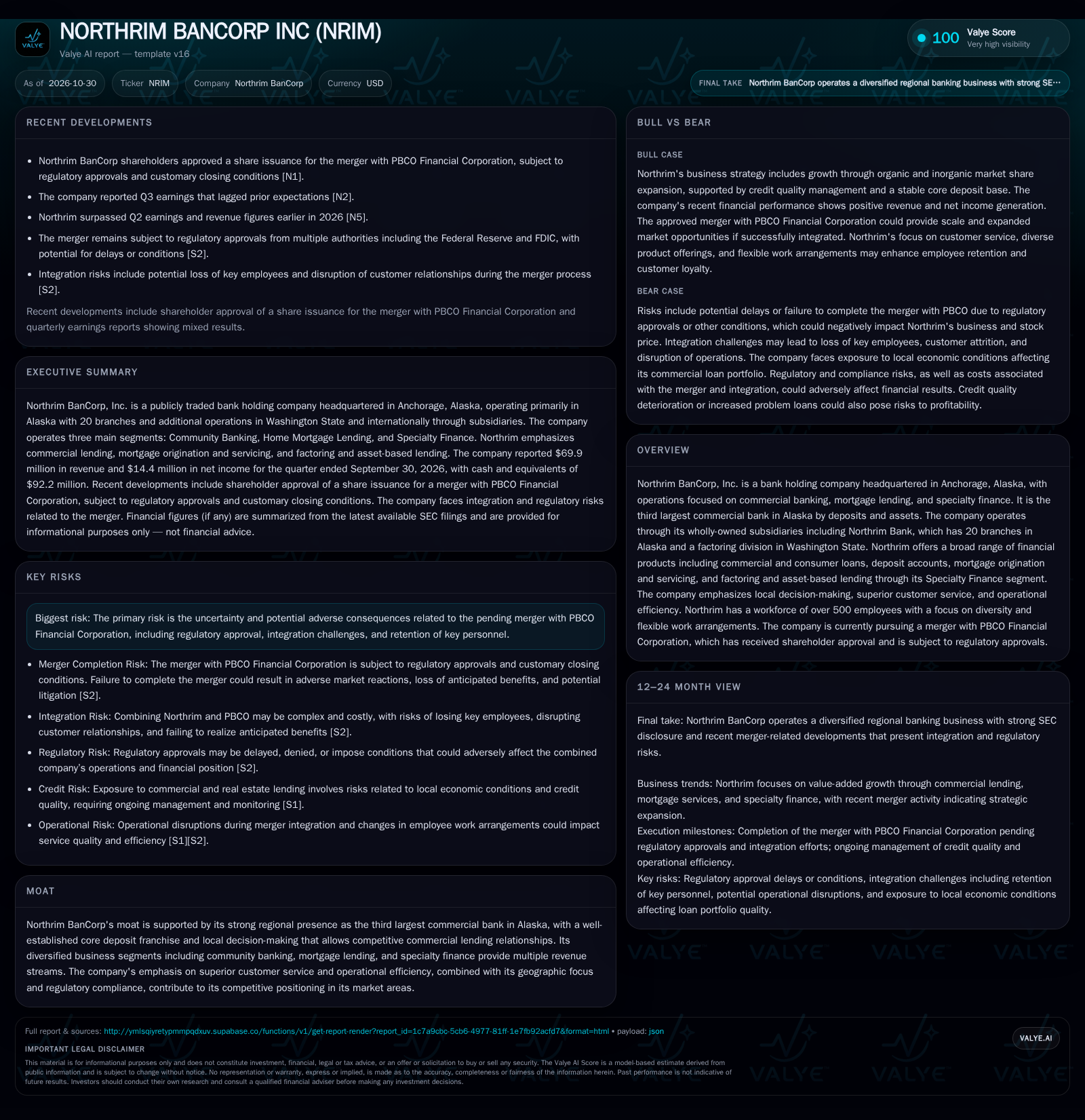
Northrim BanCorp has secured shareholder approval for an all-stock merger with PBCO Financial Corporation, a transaction that will increase Northrim’s asset base to roughly $4.2 billion and expand its banking footprint into Oregon, subject to final regulatory approvals [S2] [N1]. The deal’s closing is targeted for early 2027 but remains contingent on multiple regulatory bodies, including the Federal Reserve and the FDIC, clearing the transaction. This expansion is the most material strategic development for Northrim, signaling a move from a predominantly Alaska-focused institution to a more regionally diversified player.
Recent financial performance has been mixed: Q3 2026 earnings came in below expectations, following a Q2 that had exceeded estimates [N2] [N5]. As of September 30, 2026, the company reported $69.9 million in revenue and $14.4 million in net income for the quarter, with a cash and equivalents balance of $92.2 million [S2]. These results frame the company’s current position as it enters a period of integration risk and operational change.
Core Banking Economics and the Dynamics of Diversification
Northrim’s business model is built on three reportable segments: Community Banking (commercial and real estate lending, core deposits), Home Mortgage Lending (origination and sale/servicing of residential mortgages), and Specialty Finance (factoring and asset-based lending) [S1]. The core economic engine is the spread between interest earned on loans and the cost of funds from deposits, with fee income from mortgage origination and specialty finance lending providing incremental diversification.
Community Banking is typically the most stable segment, benefiting from Northrim’s strong core deposit franchise in Alaska—a market with relatively limited banking competition. The company’s focus on small and medium-sized businesses and a broad offering of deposit products suggest a relationship-driven approach that could help defend margins in the face of rate competition. Mortgage lending offers higher fee income but is highly sensitive to interest rates and housing activity, while specialty finance (factoring and ABL) introduces higher-yielding but potentially riskier revenue streams.
Operating leverage is a key consideration: branch and personnel costs are largely fixed, while loan growth and asset expansion can drive incremental earnings if credit quality holds. The pending merger could deliver scale economies, but only if integration is managed efficiently and cost synergies are realized. The capital intensity of banking, combined with regulatory capital requirements, constrains growth and necessitates careful risk management—especially as the company expands into new geographic and credit markets.
Regional Strength Meets New Market Uncertainty
As Alaska’s third-largest commercial bank by deposits, Northrim benefits from strong brand recognition, a reputation for local decision-making, and a well-established core deposit base [S1]. This regional strength provides a moat in its home state, where competition is limited and switching costs for business customers can be high due to relationship lending. However, expansion into Oregon through the PBCO merger introduces exposure to new competitors, including larger regional and superregional banks as well as fintech lenders.
The company’s specialty finance arm, operating beyond Alaska and into the US, Canada, and UK, adds a layer of diversification but also exposes Northrim to broader competitive and credit dynamics. In these markets, competition is more intense and pricing power may be weaker, making risk-adjusted returns harder to sustain. The ability to maintain service quality, defend core relationships, and integrate new geographies will be central to Northrim’s competitive position post-merger.
If Integration Delivers: Scale, Efficiency, and Earnings Accretion
A favorable outcome for Northrim hinges on smooth regulatory approval and successful integration of PBCO, resulting in an expanded asset base, broader customer reach, and operational synergies. If the merger is completed without major disruption, Northrim could realize cost savings through branch consolidation, shared technology platforms, and back-office efficiencies. The larger balance sheet may also improve funding costs and enable more competitive loan pricing.
Earnings accretion would likely come from both revenue growth (cross-selling, new market penetration) and expense reduction. Confirmation of this scenario would include timely regulatory clearance, minimal customer or employee attrition, and early evidence of cost synergies in post-merger financials. Falsification would be signaled by prolonged integration delays, unexpected regulatory conditions, or significant one-time costs that erode projected benefits.
Navigating Integration with Earnings Volatility and Credit Vigilance
The most plausible scenario is that Northrim completes the PBCO merger with moderate integration friction, encountering some transitional costs and limited early synergies. Revenue growth from the expanded footprint may offset incremental expenses, but earnings could remain volatile as the company manages credit quality across a larger, more diverse loan portfolio. The Alaskan and Oregon economic environments may diverge, requiring tailored risk management and underwriting standards.
Evidence supporting this scenario would include successful merger closing in early 2027, stable core deposit and loan balances, and manageable credit costs in the first few quarters post-integration. Signs of strain—such as rising non-performing loans, higher-than-expected merger expenses, or customer attrition—would suggest greater downside risk.
Integration Stumbles and Credit Deterioration Could Erode Value
The adverse scenario involves regulatory delays or conditions that postpone or jeopardize the merger, combined with operational missteps that lead to loss of key personnel, customer attrition, and elevated integration costs. If credit quality weakens—due to economic shocks in Alaska or new exposures in Oregon—Northrim could face rising loan losses and compressed profitability.
Downside confirmation would come from failed or protracted merger integration, negative trends in credit metrics (such as non-performing assets or loan loss provisions), and persistent earnings shortfalls relative to expectations. Falsification of this scenario would require evidence of smooth integration, defended credit quality, and early realization of merger benefits.
What Will Determine Northrim’s Success in Regional Expansion and Integration?
Regulatory approval timeline and any conditions imposed on the merger closing.
Quarterly trends in non-performing loans, charge-offs, and loan loss provisions—especially as the loan book diversifies geographically.
Retention rates of key personnel and customer relationships in both Alaska and newly acquired Oregon markets.
Realization and disclosure of cost synergies or merger-related expense overruns in post-merger financials.
Core deposit growth and stability as a measure of franchise value in both legacy and acquired markets.
Net interest margin trends, particularly as funding costs and loan yields shift with the expanded asset base.
Fee income contribution from mortgage and specialty finance segments as a buffer against margin pressure.
If disclosed, customer satisfaction or Net Promoter Scores in both legacy and newly acquired branches to gauge service disruption risk.
Disclaimer: This is research-only, informational analysis and not investment advice. It may include AI-generated interpretation and general industry context. Always verify important details using primary sources.

Comments