
United States Lime & Minerals: Margin Strength, Capital Intensity, and the Cycles of Industrial Demand
Despite a recent decline in quarterly earnings, United States Lime & Minerals Inc. maintains a robust margin profile and extraordinary liquidity. The company’s heavy asset base and capital-intensive model create both barriers to entry and exposure to commodity and regulatory cycles, making future performance dependent on industrial demand, price discipline, and cost management.
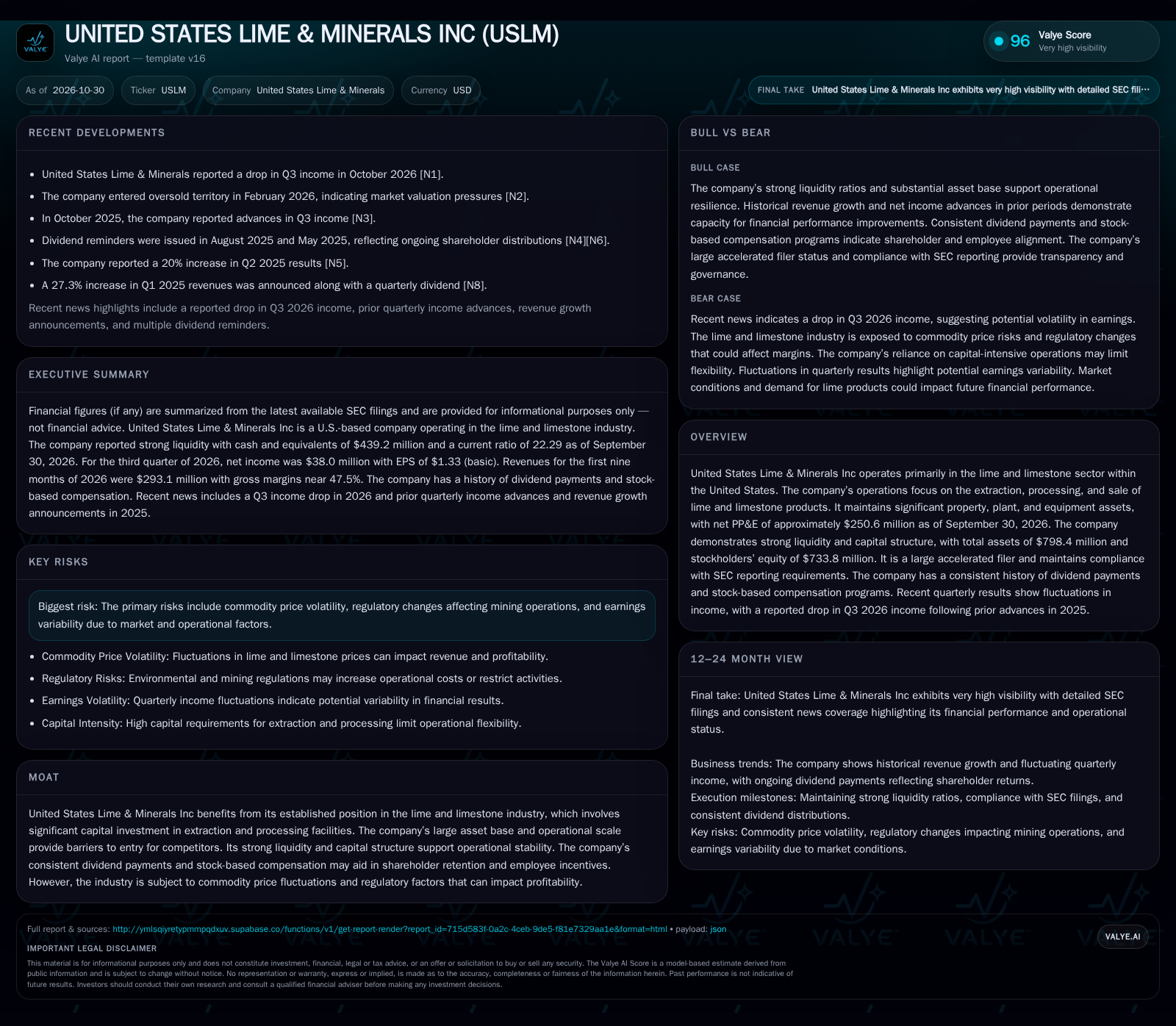
United States Lime & Minerals reported Q3 2026 net income of $38.0 million on $293.1 million in nine-month revenues, with gross margins near 47.5% and a current ratio over 22. While a recent income drop highlights earnings volatility, the company’s exceptional liquidity and asset base reinforce its ability to withstand market shocks. The core challenge remains navigating commodity price swings and regulatory pressures in a capital-intensive sector. [S2] [N1]
United States Lime & Minerals Inc. sits at the intersection of commodity cycles, industrial demand, and capital-heavy operations. In Q3 2026, the company reported a notable drop in income after several quarters of strong growth, underscoring the sector’s inherent volatility. Yet, with a gross margin near 47.5% and a current ratio exceeding 22, United States Lime & Minerals remains one of the most financially fortified players in its field. The company’s ability to generate high margins from its lime and limestone operations, combined with a substantial cash war chest, positions it to outlast cyclical downturns. However, the path forward depends not just on operational resilience but on how effectively the company manages pricing power, regulatory risk, and the capital costs intrinsic to its business model. [S2] [N1]
Recent Results Reveal Margin Resilience and Earnings Volatility
United States Lime & Minerals reported net income of $38.0 million for Q3 2026, with basic EPS of $1.33 and diluted EPS of $1.32. Revenues for the first nine months of 2026 were $293.1 million, and the company maintained a gross profit margin around 47.5% and an operating margin of roughly 41.3% [S2]. Despite these strong profitability metrics, news in October 2026 highlighted a drop in quarterly income, reversing the advances seen in 2025 [N1] [N3] [N8].
The company’s balance sheet is unusually strong, with cash and equivalents of $439.2 million, total current assets of $543.3 million, and current liabilities of just $24.4 million, resulting in a current ratio of 22.29 and a cash ratio of 18.02 [S2]. Net PP&E stood at $250.6 million, reflecting the capital-intensive nature of its operations. The cited source reports dividend-related activity; that disclosure alone does not establish dividend-policy continuity, management confidence, or a material constraint on capital flexibility. [S2] [N4] [N6]
How Capital Intensity and Margins Shape Lime Industry Economics
United States Lime & Minerals’ revenue model is built on the extraction, processing, and sale of lime and limestone products—core inputs for industries such as construction, steel, chemicals, and environmental remediation. Pricing in this sector is influenced by both commodity cycles and customer concentration, with volume contracts often tied to industrial activity and infrastructure spending.
The company’s reported gross margin near 47.5% and operating margin above 40% are unusually high for a basic materials business, suggesting either favorable pricing, operational efficiency, or a mix that includes higher-value specialty products [S2]. Fixed costs are substantial due to the required investment in mining rights, plant, and processing equipment (net PP&E of $250.6 million), but once scale is achieved, incremental volumes can deliver strong operating leverage. Variable costs (mainly fuel, labor, and transportation) rise with output, but the high margin profile implies disciplined cost control or advantageous geographic positioning.
Capital needs remain significant. Ongoing maintenance, regulatory compliance, and periodic upgrades to extraction and processing facilities demand continuous reinvestment. The company reported cash and liquidity metrics for the period; these figures do not by themselves establish operating runway, investment capacity, financial flexibility, or financing capacity.
Barriers to Entry and the Dynamics of Regional Competition
The lime and limestone industry is characterized by high barriers to entry: capital requirements for extraction, processing, and environmental compliance are steep, and permitting new operations is time-consuming. United States Lime & Minerals benefits from an established asset base, which can deter new entrants and buffer against smaller competitors.
However, competition among existing players remains intense, especially in regions with overlapping customer bases or where transport costs erode price advantages. The market also faces substitution risk from alternative materials or process innovations that reduce lime intensity in end markets.
Regulatory scrutiny—especially regarding emissions, land use, and reclamation—can create both a moat (for those with legacy permits and compliance infrastructure) and a risk (if standards tighten or enforcement becomes more stringent). The company’s scale and liquidity may offer a strategic edge in absorbing regulatory costs or investing in cleaner technologies, but these advantages are not insurmountable if industry-wide costs rise.
Margin Expansion Through Price Discipline and Industrial Recovery
The most favorable outcome for United States Lime & Minerals would be a combination of sustained high margins and renewed volume growth driven by a rebound in construction, infrastructure, and industrial activity. If the company can maintain or increase pricing power—perhaps by focusing on specialty lime products or leveraging long-term contracts—while keeping cost inflation in check, operating leverage could drive further earnings expansion.
Expansion into higher-margin specialty niches or successful pass-through of cost increases to customers would further support the thesis.
Confirmation would come from reported revenue and income advances, margin stability or growth in subsequent quarters, and commentary on strong demand or improved pricing environments. Falsification would be visible in margin compression, flat or declining volumes, or customer pushback against price increases.
Earnings Fluctuate Within a Stable, Asset-Heavy Framework
The most plausible path is that United States Lime & Minerals continues to deliver solid, if cyclical, financial performance. Margins may remain above industry averages due to operating discipline and a favorable customer/product mix, but earnings will likely fluctuate in response to industrial demand cycles, commodity prices, and regulatory costs.
This scenario would be confirmed by periodic swings in quarterly income (as recently observed), maintenance of high liquidity ratios, and a steady cadence of dividend payments. It would be falsified by a sustained decline in margins, unexpected regulatory penalties, or a major operational incident impacting production or cash flow.
Commodity Price Decline and Regulatory Headwinds Squeeze Returns
In a more adverse scenario, a combination of falling lime prices, rising input costs (energy, labor), or stricter environmental regulations could compress margins and erode profitability. Industrial end-market weakness—such as a construction slowdown or reduced steel production—would further pressure volumes and pricing.
The capital-intensive nature of the business means fixed costs remain high even as revenue falls, amplifying the impact of unfavorable cycles. If regulatory changes require significant new investment or restrict extraction/processing activities, the company could face elevated capex or even stranded assets.
This scenario would be confirmed by declining revenues and margins over multiple quarters, reduced or suspended dividends, and commentary about regulatory or market headwinds. Falsification would require evidence of cost flexibility, successful price increases despite weak demand, or rapid recovery in end markets.
Factors That Will Determine if USLM’s Margin and Cash Strength Endure
Quarterly trends in gross and operating margins—persistent margin compression would indicate loss of pricing power or cost inflation.
Revenue growth rates by segment (if disclosed), especially any shift toward higher-value specialty lime products.
Updates on capex levels and the nature of capital projects—are investments aimed at maintenance, regulatory compliance, or growth?
Regulatory disclosures or commentary on new environmental or mining rules that could affect operational costs or production limits.
Evidence of volume growth or contract wins in core industrial end markets such as construction, steel, or environmental remediation.
Any material changes in customer concentration or the structure of major supply agreements (if disclosed).
Disclaimer: This is research-only, informational analysis and not investment advice. It may include AI-generated interpretation and general industry context. Always verify important details using primary sources.

Comments