
Digital Realty Trust in 2026: Data Center Scale, Debt Structure, and the Stakes of Platform Demand
Digital Realty Trust’s recent profit advances highlight the potential of its global data center platform, but its substantial debt load and exposure to macroeconomic headwinds demand close scrutiny. The company’s ability to capture AI-driven leasing demand while managing interest rate and asset impairment risks will shape its next phase.
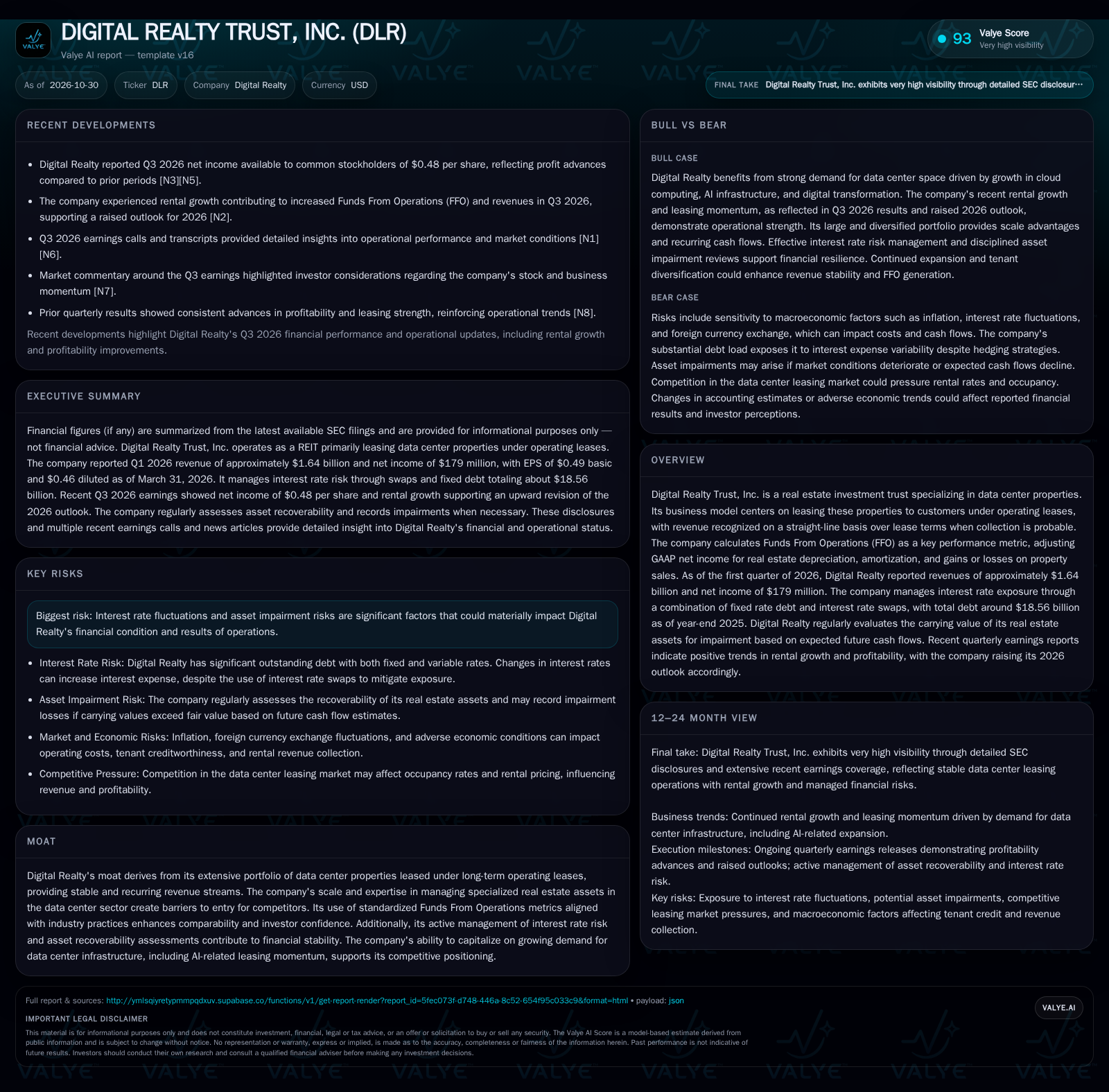
Digital Realty Trust reported Q3 2026 net income available to common stockholders of $0.48 per share, continuing a trend of profit growth. With $1.64 billion in Q1 revenue and $18.56 billion in total debt, the company’s future hinges on its ability to balance rapid data center demand expansion with prudent capital management and risk mitigation. The outcome will depend on execution in leasing, development, and financial discipline as digital infrastructure needs accelerate [S2] [N3] [N5].
Digital Realty Trust, Inc. enters late 2026 with a mix of tailwinds and structural challenges. The company’s scale in data center real estate positions it to benefit from surging cloud and AI infrastructure demand, as evidenced by recent profit growth and robust leasing activity. Yet, its significant debt load and exposure to interest rate fluctuations make capital efficiency and risk management central to its outlook. The next phase for Digital Realty will be defined by its ability to grow recurring revenues while navigating the complex realities of financing, development, and intensifying competition.
Recent Operating Results Signal Momentum but Spotlight Leverage
Digital Realty reported net income available to common stockholders of $0.48 per share for Q3 2026, marking another period of profit advancement [N3] [N5]. Revenue for Q1 2026 stood at approximately $1.64 billion, with net income of $179 million and diluted EPS of $0.46 [S2]. The company’s cash and cash equivalents were reported at $2.43 billion, while total outstanding debt reached $18.56 billion at year-end 2025 [S1] [S2]. These figures point to healthy top-line growth and ongoing profitability, but also highlight Digital Realty’s substantial financial leverage. The company’s continued reliance on both fixed and variable rate debt heightens sensitivity to interest rate movements—an issue that remains front and center given macroeconomic volatility.
How Digital Realty Monetizes Scale: Lease Structure, Capital Intensity, and FFO
Digital Realty’s core business model revolves around leasing data center space, power, and interconnection solutions to enterprise and hyperscale customers under operating lease agreements. Revenues are typically recognized on a straight-line basis, which smooths out cash flow but can mask underlying changes in rental rates or occupancy on a period-to-period basis [S2]. The company’s value proposition is built on offering secure, redundant, and high-connectivity environments, which allows for premium pricing relative to generic real estate.
The economics are capital-intensive: data center development requires large upfront investment in land, electrical and cooling infrastructure, security, and network connectivity. Once operational, however, data centers exhibit strong operating leverage, as incremental revenue from new leases can deliver high margins after fixed costs are covered. Funds From Operations (FFO) is the preferred performance metric for REIT investors, as it adjusts for non-cash depreciation and one-time gains/losses, offering a clearer view of cash-generating power.
Debt is a necessary component of the model due to the scale and duration of investments. Interest rate swaps and fixed-rate instruments are used to manage risk, but the magnitude of total debt ($18.56 billion) means that even modest rate increases can have a significant impact on cash flow and FFO. Asset impairment reviews are a further economic safeguard, but also a potential source of volatility if cash flow estimates deteriorate.
Scale, Network Effects, and the Challenge from Cloud-Led Rivals
Digital Realty’s competitive edge comes from its global platform of strategically located, highly interconnected data centers. This scale enables it to serve both multinational cloud providers and enterprise tenants, offering cross-regional solutions and facilitating customer stickiness through interconnection services. The breadth of its portfolio creates barriers to entry for smaller players, while tenant diversification reduces concentration risk.
However, the company faces persistent competition from other global REITs, specialized data center operators, and increasingly, from the direct infrastructure deployments of hyperscale cloud providers who may choose to build rather than lease. The risk is that as cloud majors internalize more capacity, pricing leverage and occupancy rates in third-party data centers could come under pressure. Additionally, as AI and high-density computing workloads proliferate, there is a premium on facilities capable of supporting advanced power and cooling requirements—a domain where Digital Realty’s ability to invest at scale could either reinforce its leadership or strain its balance sheet if not managed prudently.
Capturing the AI and Cloud Wave: What a Bullish Outcome Would Require
A favorable scenario for Digital Realty sees sustained—and potentially accelerating—demand for data center capacity, driven by cloud expansion, AI workloads, and digital transformation across industries. If the company successfully signs long-term leases with blue-chip cloud and enterprise tenants at attractive rental rates, recurring revenue visibility could increase, supporting higher FFO and enabling further development without excessive dilution or leverage.
Key confirming evidence would include: a rising proportion of pre-leased development projects, consistently high occupancy rates, upward rental rate revisions on renewals, and FFO growth outpacing debt service costs. Additional indicators would be public disclosures of major AI/cloud-related leasing wins and the company’s ability to finance new developments with a mix of retained cash flow and attractively priced capital. A decline in reported impairment charges would further reinforce the bullish chain.
Sustaining Growth Amid Capital Constraints and Market Competition
The most plausible trajectory is for Digital Realty to maintain steady, moderate growth in rental revenues and FFO, punctuated by periodic capital market activity to fund new development. The company’s scale and tenant mix should allow it to capture a meaningful share of ongoing digital infrastructure demand, but revenue growth may be partially offset by refinancing costs as existing debt matures in a changing rate environment.
Evidence for this scenario would include stable to modestly rising occupancy, modest rental rate increases, continued use of interest rate hedging instruments, and controlled asset impairment activity. The company’s ability to roll over debt without material increases in average interest expense, or to tap equity markets without significant dilution, would be critical confirming signals. Conversely, a spike in vacancy rates, downward rental repricing, or a meaningful uptick in impairment losses would argue for a more cautious outlook.
How Adverse Macro Shocks or Execution Missteps Could Derail the Model
A negative outcome for Digital Realty could be triggered by a combination of macroeconomic shocks—such as sustained high interest rates or a sharp downturn in enterprise IT spending—and internal execution risks, such as overbuilding or tenant defaults. Under this scenario, higher debt service costs would erode FFO, while competitive pressure could force rental concessions or lead to rising vacancy in secondary markets.
Confirming evidence would include a sequential decline in occupancy rates, negative rental rate trends, a spike in asset impairments, or guidance cuts on FFO. Difficulty refinancing debt at acceptable rates, or the need to issue equity at depressed prices, would further signal stress. A material deterioration in tenant credit quality, as reflected in delayed rent collections or increased bad debt expense, would reinforce downside risk.
Milestones That Will Shape Digital Realty’s Capacity to Deliver Durable Growth
Quarterly FFO per share trends, as reported in earnings releases, will be a primary gauge of underlying cash-generating performance.
Occupancy rates across the global portfolio—if disclosed—will reveal demand strength and the company’s ability to fill new and existing capacity.
The proportion of development pipeline that is pre-leased versus speculative would help test the sustainability of future revenue growth.
Changes in average rental rates on lease renewals or new signings—if reported—will provide insight into pricing power and competitive dynamics.
Interest expense as a percentage of revenue, and the effective average interest rate on outstanding debt, will indicate sensitivity to macro rate movements.
Frequency and magnitude of asset impairment charges will signal the health of the property portfolio and the realism of management’s cash flow assumptions.
Tenant concentration—particularly exposure to the largest cloud or hyperscale customers—would help assess counterparty risk and revenue resilience.
The company’s ability to access capital markets on favorable terms, as reflected in new debt or equity issuance announcements, will be crucial for funding growth without excessive dilution or leverage.
Disclaimer: This is research-only, informational analysis and not investment advice. It may include AI-generated interpretation and general industry context. Always verify important details using primary sources.

Comments