
FLEX LTD.: AI Infrastructure Ambitions, Acquisition Leverage, and the Stakes of SpinCo Execution
FLEX’s $4.4 billion EPC Power acquisition and intensified push into AI infrastructure signal a strategic pivot—but the company’s capital structure and future liquidity are tightly linked to the successful spin-off of SpinCo. The interplay between operational upside and debt obligations will define FLEX’s next chapter.
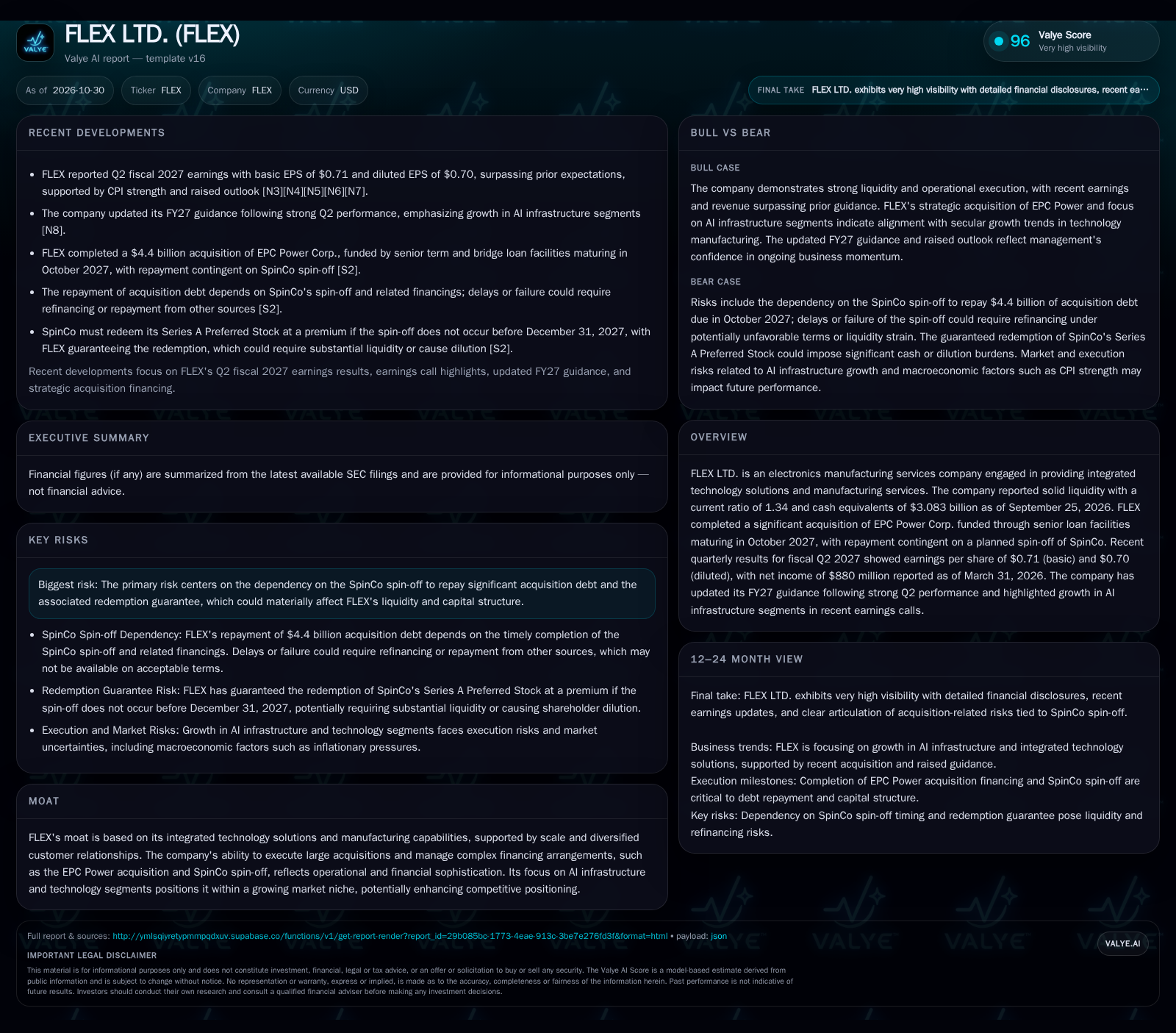
FLEX’s future hinges on its ability to integrate EPC Power, capitalize on AI infrastructure growth, and execute the SpinCo spin-off to manage $4.4 billion in acquisition debt. Delays or failure in the spin-off could force costly refinancing or trigger substantial cash outflows or dilution, making execution risk a central theme for investors and operators alike. [S2] [N8]
FLEX LTD. sits at a pivotal crossroads: the company’s $4.4 billion acquisition of EPC Power marks a bold bet on electrification and AI infrastructure, but it brings a complex web of contingent liabilities and refinancing risks. The operational promise of deeper vertical integration and exposure to secular growth in data center and power solutions is counterbalanced by the absolute necessity of executing the SpinCo spin-off, which underwrites FLEX’s ability to manage its enlarged debt load. Over the next 12-24 months, FLEX’s fortunes will be shaped as much by capital markets and transaction execution as by operational delivery.
Acquisition, Debt, and SpinCo: The Critical Facts Shaping Near-Term Risk
FLEX completed the $4.4 billion acquisition of EPC Power Corp., funded with a $3.3 billion senior term loan and a $1.1 billion senior bridge term loan, both maturing in October 2027. The repayment of these loans is explicitly tied to the successful spin-off of SpinCo and related financing events. If the spin-off is delayed or fails, FLEX must find alternative sources to repay or refinance the $4.4 billion, which may not be available on acceptable terms. Additionally, if the spin-off is not completed by December 31, 2027, SpinCo is required to redeem its Series A Preferred Stock at a premium, with FLEX guaranteeing this obligation—potentially demanding substantial liquidity or forcing dilution. As of September 25, 2026, FLEX held $3.083 billion in cash and equivalents, a current ratio of 1.34, and had not repurchased shares during the quarter. Recent earnings calls have highlighted a focus on AI infrastructure growth and updated FY27 guidance following strong Q2 performance. [S2] [N8]
How FLEX’s Model Creates—and Constrains—Value in the Post-Acquisition Era
FLEX generates revenue through electronics manufacturing services (EMS) and integrated technology solutions spanning design, supply chain, and manufacturing for a broad set of industries, including data centers, communications, automotive, healthcare, and industrial infrastructure. The company’s business model typically relies on high-volume, low-margin contracts, with profitability driven by scale, operational efficiency, and vertical integration.
The EPC Power acquisition is intended to deepen FLEX’s exposure to power electronics and AI infrastructure—sectors with potentially higher growth and margin profiles compared to legacy contract manufacturing. If successfully integrated, EPC Power could enhance FLEX’s ability to offer bundled power and cooling solutions to data center and cloud customers, capturing more value per deployment and improving pricing leverage.
However, the funding of this acquisition introduces substantial fixed obligations: $4.4 billion in debt with near-term maturities and a contingent redemption guarantee. Unless the SpinCo spin-off is completed, FLEX may face increased debt service costs, pressure on free cash flow, and possible equity dilution if new capital must be raised under duress. The company’s liquidity as of September 2026 is significant in absolute terms but must be viewed relative to these large upcoming obligations. Operating leverage could improve if AI and electrification segments outperform, but high fixed costs and refinancing risk increase downside sensitivity if growth or execution falters. [S2]
Integrated Solutions and Scale: FLEX’s Strategic Edge and the Limits of Moat
FLEX’s competitive position rests on its ability to deliver end-to-end solutions at global scale, serving a diversified customer base across regulated and technology-driven sectors. Its core strengths include design and engineering expertise, supply chain orchestration, and the capacity to integrate manufacturing with advanced power and cooling solutions. The EPC Power acquisition and investments in AI infrastructure are intended to move FLEX higher up the value chain, away from pure commoditized EMS toward more differentiated, higher-margin offerings.
However, the EMS industry is structurally competitive, with major global players and regional specialists capable of undercutting on price or offering niche capabilities. Customer switching costs are moderate—while integration and reliability matter, large customers can dual-source or shift production. In the AI infrastructure and power electronics space, FLEX will face competition from both incumbent OEMs and emerging specialists. Its ability to maintain or expand share will depend on successful integration of EPC Power’s technology, execution in fast-evolving end markets, and continued investment in R&D and customer relationships.
The company’s scale and breadth confer some protection, enabling it to absorb shocks and invest in new capabilities, but these same attributes increase complexity and the risk of execution missteps, particularly during major transactions and spin-offs.
If SpinCo Succeeds and AI Demand Accelerates, FLEX Could Unlock Margin Expansion
In a favorable scenario, FLEX successfully completes the SpinCo spin-off, repays acquisition-related debt on schedule, and avoids the costly redemption of SpinCo’s preferred stock. Integration of EPC Power proceeds smoothly, enabling FLEX to deliver higher-value, bundled solutions to data center, cloud, and industrial customers, capturing a greater share of the rapidly growing AI infrastructure market.
Confirmation of this scenario would require clear evidence of: (1) regulatory and transactional progress toward the SpinCo spin-off; (2) successful refinancing or repayment of the $4.4 billion debt without distress; (3) margin improvement in the Cloud and Power Infrastructure segment; and (4) rising order volumes or wallet share from AI and electrification customers, as evidenced in segment disclosures or new contract wins. [N8]
Operational Progress, but Capital Structure Remains a Source of Uncertainty
The most plausible path is one where FLEX executes on operational priorities—integrating EPC Power, growing its AI infrastructure and power solutions business, and maintaining core EMS volumes—while facing a protracted or uncertain SpinCo spin-off process. Debt service remains manageable in the near term given existing liquidity and cash generation, but refinancing risk grows as the 2027 maturity approaches.
In this scenario, FLEX’s financial results reflect incremental growth in higher-margin segments, but capital allocation is constrained by the need to preserve liquidity and avoid triggering dilution via the SpinCo preferred stock guarantee. The company may be forced to accept higher refinancing costs or partial equity raises if capital markets tighten or the spin-off timeline slips. Confirmation would come from steady operating performance but continued references in filings and calls to the unresolved status of the spin-off and related obligations.
Delayed SpinCo or Market Shocks Could Expose FLEX to Costly Refinancing or Dilution
The principal risk is that the SpinCo spin-off is delayed or fails, forcing FLEX to refinance the $4.4 billion acquisition debt under unfavorable conditions, or to fund the redemption of SpinCo’s Series A Preferred Stock at a premium. If capital markets are unreceptive or if operational hiccups undermine cash flow, FLEX could face higher interest costs, covenant pressure, or be compelled to issue equity at depressed valuations, diluting shareholders.
This scenario could be triggered by regulatory hurdles, execution missteps in the spin-off or integration process, macroeconomic shocks that tighten credit, or underperformance in AI infrastructure markets. Evidence would include missed milestones on the spin-off, guidance cuts, rising interest expense, negative credit actions, or announcements of dilutive equity or hybrid capital raises.
Milestones and Metrics That Will Determine FLEX’s Ability to Deliver on Its Strategic Pivot
Progress updates and regulatory milestones toward the SpinCo spin-off; delays or adverse developments would materially alter the risk profile.
Details on refinancing, repayment, or extension of the $4.4 billion acquisition debt, especially as October 2027 approaches.
Disclosures regarding the redemption status or negotiations related to SpinCo’s Series A Preferred Stock, including any movement toward FLEX’s guarantee being called.
Segment-level revenue and margin performance in AI infrastructure, cloud, and power solutions—if disclosed—would help test the integration and growth thesis.
Free cash flow generation trends, particularly in relation to upcoming debt maturities and potential capital return activity.
Management commentary on customer wins, backlog, or order visibility in AI and electrification markets.
Any changes in credit ratings, covenant disclosures, or capital market access that could affect refinancing options.
Disclaimer: This is research-only, informational analysis and not investment advice. It may include AI-generated interpretation and general industry context. Always verify important details using primary sources.

Comments