
Meritage Homes in 2026: Navigating Cyclical Pressures, Margin Headwinds, and the Stakes of Subcontractor Dependency
Meritage Homes faces a challenging environment as interest rates, mortgage availability, and inflation squeeze homebuyer demand and construction margins. With a recent workforce reduction and earnings below expectations, the company’s ability to manage cost pass-through, supply chain disruptions, and contract cancellations will define its near-term trajectory.
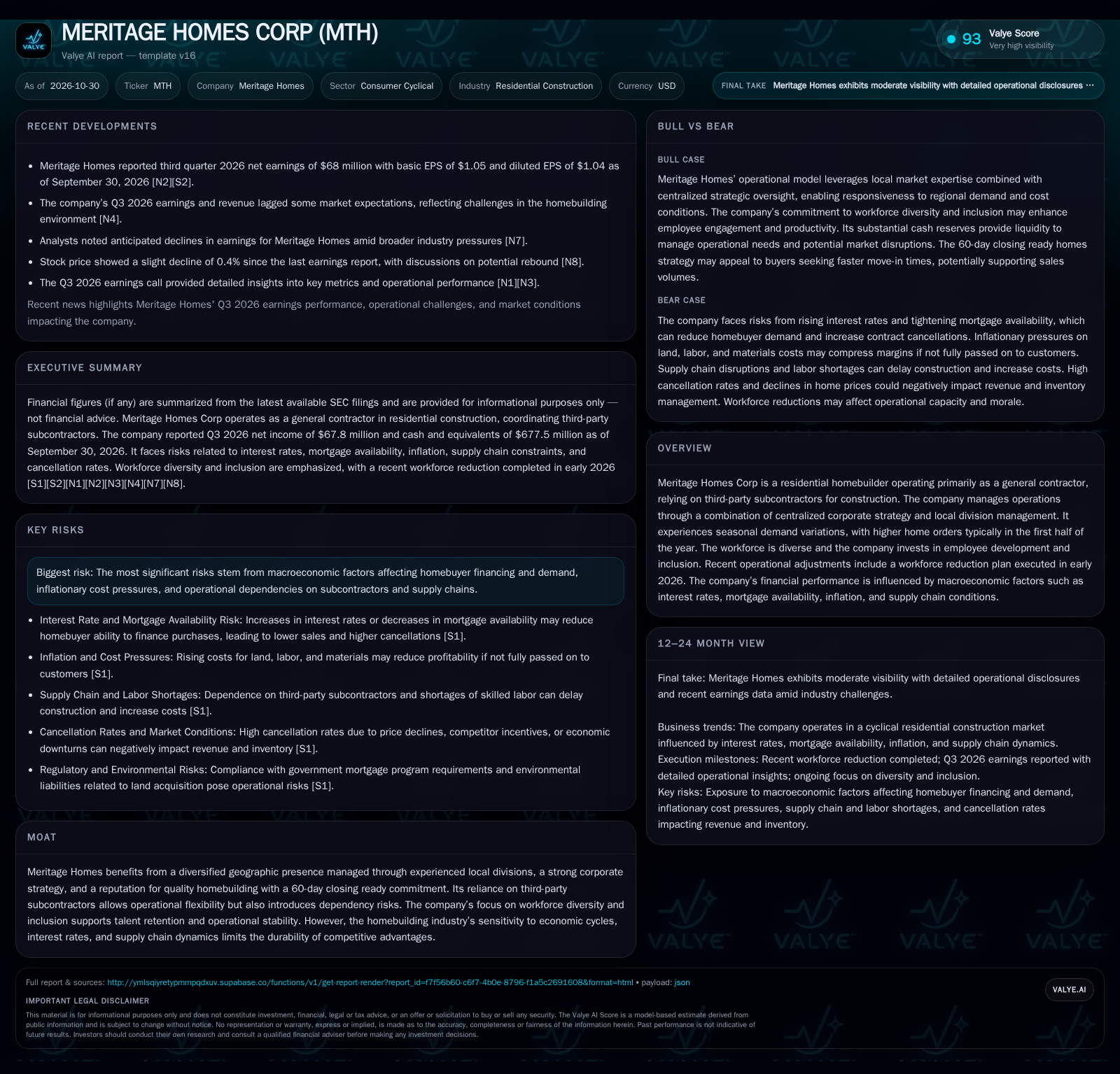
Meritage Homes reported Q3 2026 net income of $67.8 million and a cash balance of $677.5 million, but missed earnings estimates amid industry-wide headwinds. The company’s fortunes hinge on navigating interest rate risks, passing through inflation-driven costs, and managing subcontractor dependencies while maintaining sales momentum and controlling cancellation rates. Future performance will depend on the housing cycle, ability to sustain margins, and operational execution in a volatile market.[S2] [N2] [N4] [N7]
Meritage Homes enters late 2026 at a crossroads, balancing moderate profitability against mounting external pressures. Q3 results undershot market expectations, reflecting the drag from higher interest rates, constrained mortgage availability, and persistent cost inflation. The company’s operational model—centralized strategy with decentralized execution—offers flexibility, but reliance on third-party subcontractors and a recent workforce reduction underscore vulnerability to both macroeconomic and operational shocks. As the U.S. housing market navigates cyclical headwinds, Meritage’s ability to sustain sales, manage cancellations, and protect margins will be tested in the quarters ahead.
Earnings Miss and Operational Adjustments Define the Current Backdrop
The company reported cash and liquidity metrics for the period; these figures do not by themselves establish operating runway, investment capacity, financial flexibility, or financing capacity. [S2] [N2] [N4] [N7] [S1]
How Meritage Monetizes: Price, Volume, and the Leverage of Centralized Strategy
Meritage Homes generates revenue by acquiring and developing land, constructing homes through third-party subcontractors, and selling finished properties to buyers. The company’s economic model is highly sensitive to both price and volume: higher home prices can offset rising construction costs only if demand remains intact, while volumes are acutely responsive to mortgage rates and overall housing affordability. Fixed costs are managed at both the corporate and local divisional levels, with corporate overseeing land acquisition and capital allocation, while local teams drive project execution and sales.[S1]
Operating leverage is significant—incremental increases in home sales flow disproportionately to the bottom line when costs are contained. However, variable costs (labor, materials, land) are subject to inflation and supply chain volatility, which can erode gross margins if not passed through to buyers. [S2]
The sensitivity of Meritage's revenue model to price and volume dynamics underscores the importance of market timing and demand forecasting in land acquisition strategies. If the company overestimates demand or misjudges regional housing cycles, it may face higher holding costs or forced discounting, which compress margins. Conversely, precise alignment of land purchases with anticipated demand peaks can enhance returns on invested capital. Additionally, the decentralized execution model, while flexible, requires robust coordination mechanisms to ensure that local teams adapt pricing and product offerings swiftly in response to rapidly changing macroeconomic conditions without sacrificing brand consistency or operational efficiency.
Competitive Advantages and the Limits of Subcontractor-Driven Scale
Meritage competes with other national and regional homebuilders, as well as local developers and resale inventory. Its model of centralized strategic oversight combined with locally empowered divisions enables targeted land acquisition and responsiveness to regional market trends, which may allow for nimble adjustments in pricing or product mix when demand shifts.[S1] The company’s reputation for quality and a 60-day closing ready home offering could differentiate it for buyers wanting speed and certainty.
However, the heavy reliance on third-party subcontractors exposes Meritage to operational risks that competitors with more vertically integrated models may partially avoid. Labor shortages, supply chain hiccups, and cost inflation can undermine schedule reliability and profitability. While geographic diversification helps mitigate localized downturns, the cyclical nature of residential construction and the limited durability of most competitive advantages in the sector mean that Meritage’s moat is modest and subject to erosion if macro conditions worsen or if competitors become more aggressive on pricing or incentives.
Margin Resilience and Demand Recovery Could Drive Outperformance
If mortgage rates stabilize or decline and housing affordability improves, Meritage could see a rebound in order volumes, supporting better absorption of fixed costs and higher operating leverage. A scenario in which the company successfully passes through most input cost inflation to buyers—leveraging its quick-close product and local market expertise—would protect or expand gross margins. Evidence supporting this outcome would include a reversal of recent earnings misses, rising home closing volumes, improved gross margin percentages, and commentary from management on successful price increases or lower-than-expected cancellations.
Additionally, if the workforce reduction leads to sustainable cost savings without impairing execution, operating margins could recover even if top-line growth is modest. Accelerated turnover of inventory and reduced days to close would further enhance cash flow and potentially allow opportunistic land purchases at favorable prices. The upside case would be challenged if inflation outpaces the ability to raise prices or if demand remains weak, but a combination of easing interest rates and disciplined cost management could set the stage for outperformance.
Navigating a Tough Housing Market: Stable but Uninspiring Performance
The most plausible near-term scenario is one of continued cyclical pressure: interest rates remain elevated, mortgage availability is constrained, and homebuyer demand is tepid. Meritage may maintain profitability through ongoing cost discipline and selective price increases, but margins are likely to remain compressed relative to prior years. Home closing volumes could be flat or modestly down, with periodic spikes tied to promotional activity or local market strength.
Evidence confirming this scenario would include continued reporting of modest quarterly profits, stable or slightly declining home closing volumes, and management commentary focused on operational efficiency and cost containment rather than aggressive expansion. Rising cancellation rates or persistent supply chain delays would reinforce the view that the company is managing through a difficult environment rather than breaking out to new growth. This scenario assumes no severe shock (such as a sharp recession or credit crunch) but also no rapid easing of macroeconomic headwinds.
Cancellations, Margin Compression, and Subcontractor Disruption Threaten the Bottom Line
The principal downside risk is that higher interest rates and reduced mortgage availability further erode homebuyer demand, driving up contract cancellations and forcing Meritage to offer deeper discounts or incentives to clear inventory. If input cost inflation continues but cannot be passed through, gross margins may contract sharply, leading to earnings declines or even operating losses. Supply chain disruptions or labor shortages could delay home completions, exacerbate inventory buildup, and increase carrying costs.
Evidence of a downside scenario would include a spike in cancellation rates, negative gross margin trends, rising finished inventory, and management guidance cuts. Additional warning signs would be the need to draw on credit facilities to fund operations, significant increases in unsold home inventory, or commentary highlighting competitive pricing pressure and inability to maintain prior sales velocity. In the extreme, persistent cash burn could force further workforce reductions, asset sales, or dilutive capital raises.
Testing the Meritage Thesis: Operational, Financial, and Market Triggers to Track
Quarterly home closing volumes and average selling prices, as reported, to assess how demand and pricing power are evolving.
Gross margin percentage trends, which will reveal the company’s ability to pass through cost increases or absorb inflation.
Cancellation rates and their trajectory, as a rapid rise would be a leading indicator of demand weakness or buyer stress.
Days to close and inventory turnover metrics, if disclosed, to gauge operational efficiency and the effectiveness of the quick-close strategy.
Supply chain disruption disclosures or commentary on subcontractor availability, as these affect construction timelines and cost structure.
Management guidance revisions or commentary on land acquisition strategy, which could signal a change in market outlook or risk appetite.
Regional performance breakdowns, as varying trends in the West, Central, and East segments may highlight localized risks or opportunities.
Disclaimer: This is research-only, informational analysis and not investment advice. It may include AI-generated interpretation and general industry context. Always verify important details using primary sources.

Comments