
Murphy USA in 2026: Low-Cost Fuel Retail at Scale, Strategic Risks, and the Stakes of Walmart Proximity
Murphy USA’s disciplined low-cost, high-volume fuel retail model—anchored by Walmart adjacency, company-owned real estate, and supply chain leverage—continues to deliver earnings and shareholder returns.
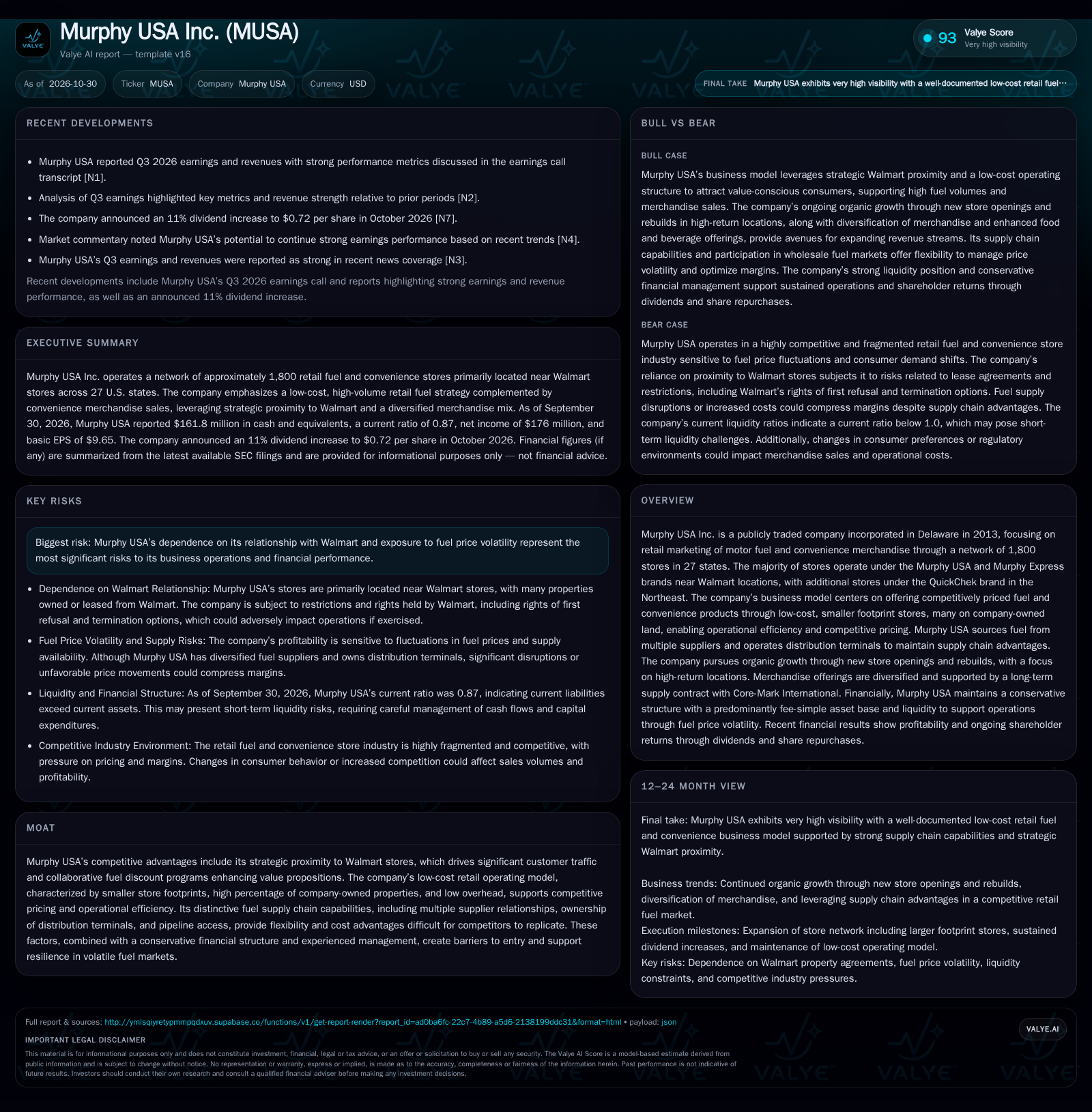
Murphy USA reported strong Q3 2026 earnings, raising its dividend by 11% and maintaining a network of 1,800 fuel and convenience stores, largely near Walmart locations. Strategic Walmart proximity is both a major advantage and a potential vulnerability if property or traffic dynamics shift. Sustained earnings growth depends on merchandise diversification, execution of new store projects, and the ability to manage operating leverage amid changing market conditions. [S2] [N1] [N7]
Murphy USA’s 2026 trajectory highlights both the strengths and vulnerabilities of a disciplined, scaled retail fuel model. By anchoring itself near Walmart locations and operating a lean, company-owned asset base, Murphy USA has delivered robust earnings, increased dividends, and maintained a national presence across 1,800 stores. Yet, as the company pushes forward with new store openings and merchandise diversification, it faces mounting pressures: industry competition, fuel margin volatility, and the ever-present strategic risk tied to its Walmart-centric footprint. The real question is whether Murphy USA’s operational discipline and supply chain advantages can continue to outpace these headwinds—or if the company’s structural dependencies will become limiting factors as market conditions evolve. [S2] [N1] [N7]
Q3 2026 Earnings, Dividend Growth, and Liquidity: What the Latest Numbers Reveal
Murphy USA reported net income of $176 million and basic earnings per share of $9.65 for Q3 2026, underscoring the company’s ability to generate solid profitability from its core retail fuel and convenience platform. The cited source reports dividend-related activity; that disclosure alone does not establish dividend-policy continuity, management confidence, or a material constraint on capital flexibility. As of September 30, 2026, Murphy USA’s cash and equivalents stood at $161.8 million, with current assets of $1.01 billion and current liabilities of $1.16 billion—producing a current ratio of 0.87 and a cash ratio of 0.31. These figures highlight both ongoing earnings strength and the need for vigilant liquidity and working capital management, especially in a sector prone to margin and demand volatility. [S2] [N1] [N7]
How Murphy USA Extracts Value from Scale, Location, and Cost Structure
Murphy USA’s core economics hinge on its high-volume, low-price fuel retailing model, supported by a network of small-format stores, most of which are located on company-owned land near Walmart properties. This setup minimizes rent and overhead, enabling aggressive fuel pricing that drives volume and generates significant customer traffic. Merchandise sales—including food, beverage, and convenience items—provide higher-margin revenue streams and are supported by a long-term supply contract with Core-Mark International, which locks in procurement efficiency through 2031. The capital needs for new store openings and raze-and-rebuild projects are disciplined: the company targets 45-55 new stores and up to 30 rebuilds annually, focusing on high-return locations. Operating leverage is achieved through scale in fuel procurement, distribution terminals, and streamlined store operations, but gross margins remain sensitive to fuel price swings and competitive pressures. While the fee-simple asset base reduces fixed costs, the low current and cash ratios mean Murphy USA must carefully balance growth investments, working capital, and shareholder returns to avoid liquidity strain. [S2]
Walmart Adjacency and Cost Discipline: Durable Advantages or Double-Edged Sword?
Murphy USA’s principal competitive edge lies in its strategic proximity to Walmart stores, which delivers high foot traffic and enables collaborative programs like Walmart+ fuel discounts. Its low-cost operating model—characterized by small footprints, company-owned land, and supply chain integration—allows sustained price competitiveness, which is difficult for many regional and local fuel retailers to match. Direct control over fuel sourcing and distribution terminals further supports margin stability and rapid response to market disruptions. However, these advantages are not unassailable. The company’s heavy concentration of locations near Walmart properties exposes it to contract risks, including Walmart’s rights of first refusal and lease termination options. In a fiercely fragmented industry, Murphy USA competes not only with other fuel/convenience chains (such as Circle K, Speedway, and regional independents) but also with big-box and grocery-affiliated fuel operators. As EV adoption and alternative mobility models gradually erode gasoline demand, Murphy USA’s location-driven customer access may be challenged unless merchandise and foodservice offerings can deepen wallet share and drive non-fuel traffic.
If Store Expansion and Merchandise Diversification Outpace Industry Headwinds
Murphy USA’s earnings and cash flow could accelerate if its ongoing strategy of new store openings, rebuilds, and merchandise innovation successfully outpaces both fuel margin compression and competitive encroachment. The company’s disciplined capital allocation—prioritizing high-return locations, larger-format QuickChek stores, and expanded food/beverage offerings—could raise average unit volumes and merchandise gross margins. Enhanced supply chain flexibility, plus further integration with Walmart+ and other traffic-driving programs, may capture incremental market share from less efficient peers. What would confirm this scenario? Sustained growth in same-store sales (particularly in merchandise), operating margin expansion, and evidence of successful scaling of new store formats would be strong indicators. Additionally, further dividend increases and share repurchases—without deterioration in liquidity metrics—would suggest durable free cash flow generation and capital discipline. [S2] [N1] [N7]
Disciplined Growth Meets Persistent Margin and Liquidity Pressure
The most plausible trajectory is that Murphy USA continues to deliver solid, but not breakout, earnings by executing its core low-cost, high-volume model while carefully managing liquidity and capital expenditures. Store network growth and merchandise diversification likely offset, but do not eliminate, the ongoing pressures of fuel price volatility, competitive pricing, and evolving consumer demand. The company’s Walmart-centric footprint continues to deliver traffic advantages, but property rights and lease structures require ongoing vigilance. Confirming evidence would include stable or modestly improving operating margins, steady store count growth in targeted markets, and maintenance of shareholder returns (dividends and buybacks) without further deterioration in current or cash ratios. Falsifying evidence would include a sustained decline in fuel or merchandise gross margins, inability to fund new projects without external financing, or operational disruptions related to Walmart property agreements. [S2] [N1] [N7]
Margin Compression, Liquidity Squeeze, and Structural Walmart Risk
A negative chain could unfold if fuel price volatility or supply disruptions compress gross margins beyond what store-level cost discipline can offset. If competitive intensity increases—either from national chains, grocery-affiliated fuel stations, or new retail formats—pricing pressure could erode both fuel and merchandise profitability. The company’s liquidity metrics already reflect a below-1.0 current ratio; any further working capital stress, unexpected cost spikes, or slowdowns in merchandise sales could force Murphy USA to curtail growth projects or seek outside capital on less favorable terms. The most acute risk remains Walmart-centric: if property agreements are altered, terminated, or traffic patterns shift (due to Walmart store closures, relocations, or new retail anchors), Murphy USA’s location-driven edge could erode quickly. Confirming evidence would include a sharp drop in fuel or convenience gross margins, negative same-store sales, increased debt or asset sales to fund operations, or announced changes in Walmart-related property rights. [S2]
What Will Prove Murphy USA’s Model Durable in the Next Cycle?
Track the growth rate and profitability of new store openings and raze-and-rebuild projects—particularly whether larger QuickChek and Murphy Express formats deliver higher average unit volumes or margins, if disclosed.
Monitor same-store fuel and merchandise sales trends, as these will reveal whether the company is gaining share or merely maintaining volume in a competitive, slow-growth market.
Watch for changes in current and cash ratios; persistent or worsening liquidity metrics could signal elevated working capital stress or funding constraints.
Assess operating margin and gross profit per gallon for fuel—declines here may indicate competitive or supply chain pressures.
Look for updates regarding Walmart property agreements, including any changes to rights of first refusal, lease terms, or store adjacency, as these could materially affect traffic and location economics.
A useful metric would be the proportion of merchandise sales from higher-margin categories (foodservice, prepared beverages) versus traditional convenience goods, to evaluate success in merchandise diversification.
Stay alert for any disclosed shifts in customer traffic patterns, particularly if EV adoption or alternative mobility models begin to impact gasoline demand at Murphy USA’s core locations.
Disclaimer: This is research-only, informational analysis and not investment advice. It may include AI-generated interpretation and general industry context. Always verify important details using primary sources.

Comments