
ASPAC II Acquisition Corp.: SPAC Execution Risk, China Ties, and the Stakes of a Shrinking Timeframe
The company’s future hinges on its ability to secure a high-quality target in a competitive market while navigating geopolitical headwinds and investor skepticism.
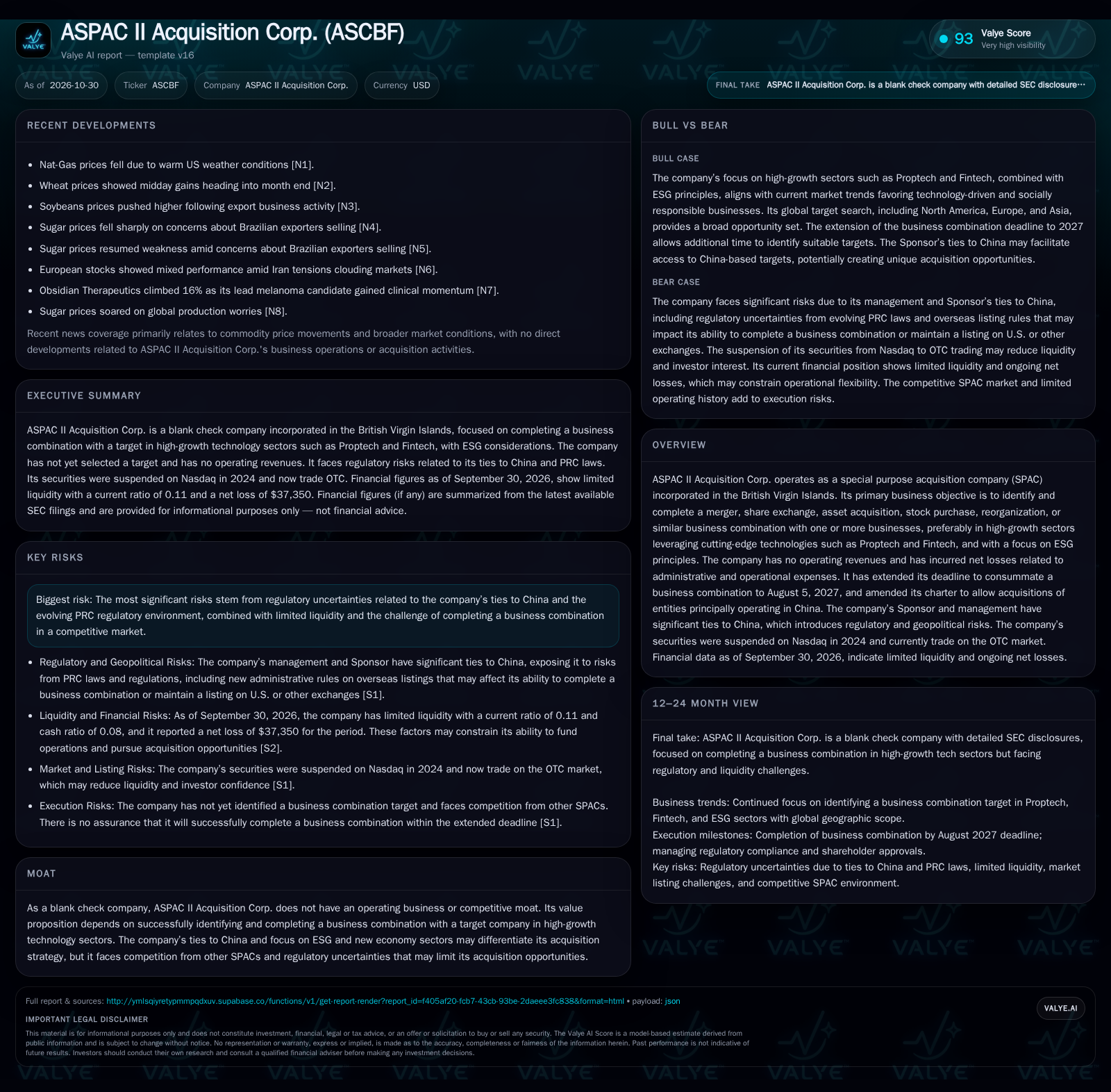
ASPAC II Acquisition Corp. remains a pre-combination SPAC with no operating revenues, a net loss, and sharply reported liquidity position. Its extension of the business combination deadline to August 2027 buys time, but ongoing OTC trading and sponsor ties to China introduce both unique sourcing opportunities and acute regulatory hurdles. The next phase depends on target selection, deal structuring, and the external environment for cross-border transactions—all against a backdrop of significant financial constraints and execution risk. [S1] [S2]
With its original Nasdaq platform lost and the deadline for a business combination now set for August 2027, ASPAC II must overcome both regulatory and financial headwinds to deliver value. Its strategy—targeting high-growth sectors like Proptech and Fintech with an ESG tilt—remains untested, and the ultimate outcome will depend on the quality and execution of any future deal, as well as the evolving global regulatory landscape. [S1] [S2]
A Shrinking Runway and a Shifting Regulatory Landscape
As of September 30, 2026, ASPAC II Acquisition Corp. reported cash and equivalents of just $72,752, current assets of $98,718, and current liabilities of $923,839, resulting in a reported current ratio of 0.11 and a cash ratio of 0.08. The company posted a net loss of $37,350 for the period. Meanwhile, its securities have been relegated to the OTC market since a Nasdaq suspension in September 2024. No business combination target has been announced, and the company’s activities remain limited to organizational and preparatory work. The deadline to complete a deal has been extended to August 5, 2027, and the charter now permits transactions with entities operating primarily in China, Hong Kong, or Macau. [S1] [S2]
These facts are material because they highlight a substantial execution risk: the SPAC faces mounting financial pressure and an increasingly uncertain regulatory environment, especially given its sponsor’s China ties. The extended deadline offers more time to find a target, but the longer the search drags on, the greater the risk that dwindling resources and shifting market dynamics will undermine the company’s prospects.
SPAC Economics: Cash Burn, Sponsor Support, and the Deal-Driven Value Proposition
ASPAC II’s economics are typical for a pre-deal SPAC: no operating revenue, ongoing administrative costs, and a reliance on sponsor loans to fund basic operations. The company’s only non-operating income comes from interest on trust assets, which is minimal at this stage. Outstanding sponsor loans have funded working capital and expenses, are non-interest bearing, and convertible into warrants at $1.00 per warrant; as of September 30, 2026, $460,049 was outstanding. [S2]
The core value proposition for investors lies in the successful completion of a business combination—ideally with a high-growth, ESG-conscious Proptech or Fintech target. Upon a deal, the economics shift dramatically: capital raised in the IPO and any PIPE financing would be deployed to acquire or merge with a private company, granting public-market access and potential upside from post-combination growth. The company reported cash and liquidity metrics for the period; these figures do not by themselves establish operating runway, investment capacity, financial flexibility, or financing capacity. If a deal fails to materialize by the deadline, the SPAC would face liquidation, returning remaining trust assets (if any) to shareholders—often at a discount to initial investment due to costs and redemptions.
Navigating a Crowded SPAC Market with Unique Geographic Risks
ASPAC II operates in a saturated SPAC landscape where hundreds of blank check companies compete for a finite pool of attractive targets—especially in technology verticals that have seen significant private capital inflows. Its stated focus on high-growth Proptech and Fintech firms, with an ESG overlay, aligns with current investment themes but does not materially differentiate the platform unless it can surface proprietary deal flow or structure a more compelling offer.
The company’s most distinctive feature—the sponsor’s deep ties to China and a management presence entirely in China—cuts both ways. On one hand, this may facilitate access to Chinese or Greater China-based technology companies looking for a U.S.-listed vehicle. On the other, it exposes ASPAC II to heightened regulatory scrutiny from both U.S. and PRC authorities, especially as cross-border listings face increased hurdles post-2021. Recent amendments allowing the acquisition of China-based entities expand the opportunity set but also increase the complexity and risk profile. The Nasdaq suspension and OTC trading status further erode ASPAC II’s appeal to potential targets, who may prefer a sponsor with a stronger, more stable listing and global investor reach.
Unlocking Value Through a High-Quality Cross-Border Deal
The most favorable scenario for ASPAC II is the identification and successful closing of a business combination with a high-growth, ESG-aligned technology company—ideally one with compelling fundamentals and scalability in global Proptech or Fintech markets. If the sponsor’s China connections enable access to a target that is otherwise unavailable to Western SPACs, and if the company can navigate all regulatory approvals and investor redemptions, the transaction could create significant value for public shareholders.
Evidence that would confirm this upside includes: a definitive merger agreement with a private company exhibiting strong growth metrics and a clear path to public-market acceptance; regulatory filings showing progress through both U.S. and PRC review; and a successful capital raise or PIPE that bolsters post-merger liquidity. Early investor enthusiasm, reflected in improved trading volumes and price action post-announcement, would further validate the scenario.
Extended Search, Financial Strain, and the Race Against Time
The most plausible path is one of continued target search, with ASPAC II incurring ongoing administrative losses and relying on sponsor loans to stay afloat. The company may enter preliminary discussions with multiple targets, but regulatory hurdles, market skepticism due to OTC status, and limited cash resources slow progress. As the August 2027 deadline approaches, the risk of shareholder redemptions and deal failure increases.
This scenario would be confirmed by further sponsor loans, continued net losses, and a lack of concrete deal announcements over the coming quarters. Investor communications focused on process updates rather than substantive milestones would reinforce the base case. A last-minute deal, potentially with a smaller or less desirable target, remains possible—but would likely result in limited upside for public shareholders given the financial and reputational overhang.
Failure to Secure a Target: Liquidation Risk and Erosion of Trust Value
The adverse scenario is that ASPAC II fails to identify or close a business combination before the August 2027 deadline. Mounting financial strain, increasingly challenging regulatory requirements, and an unattractive OTC platform could repel potential targets and investors. In this case, the company would be forced to liquidate, returning what remains of the trust account to public shareholders—often after costs and redemptions have eroded the principal.
Concrete signs of this scenario include a further decline in cash balances, an acceleration of sponsor loans to cover basic expenses, and the absence of credible merger discussions or regulatory progress. If disclosed, a rising rate of shareholder redemptions or a formal liquidation plan would confirm the downside.
Milestones That Will Shape ASPAC II’s Outcome
Any definitive announcement of a business combination target, especially one with strong growth and clear regulatory viability, would be a pivotal development.
Updates on regulatory filings and approval progress with both U.S. and PRC authorities—if disclosed—will help gauge deal feasibility and timing.
The pace and magnitude of further sponsor loans, or any new external financing, will indicate the company’s ability to sustain operations through the search period.
Disclosure of any PIPE financing or capital commitments accompanying a potential deal would signal market confidence and post-merger viability.
Changes in shareholder redemption rates—if disclosed—could indicate investor sentiment and the likely capital base post-combination.
Improvement or further deterioration in trading liquidity and price action on the OTC market would reflect ongoing investor appetite and perceived deal likelihood.
Board or management changes, particularly involving U.S.-based directors or advisors, could foreshadow a shift in acquisition strategy or regulatory posture.
Explicit communication about liquidation plans or deadline extensions beyond August 2027 would be material for the company’s remaining option value.
Disclaimer: This is research-only, informational analysis and not investment advice. It may include AI-generated interpretation and general industry context. Always verify important details using primary sources.

Comments