
CBIZ in 2026: Diversified Revenue, Merger Stakes, and the Economics of Professional Services Scale
CBIZ, Inc. stands at an inflection point as it pursues scale through diversified service offerings and a pending merger, while managing regulatory, control, and debt-related headwinds. With a broad client base and recurring revenue streams, the company's ability to integrate acquisitions and remediate internal weaknesses will shape its trajectory in the evolving business services landscape.
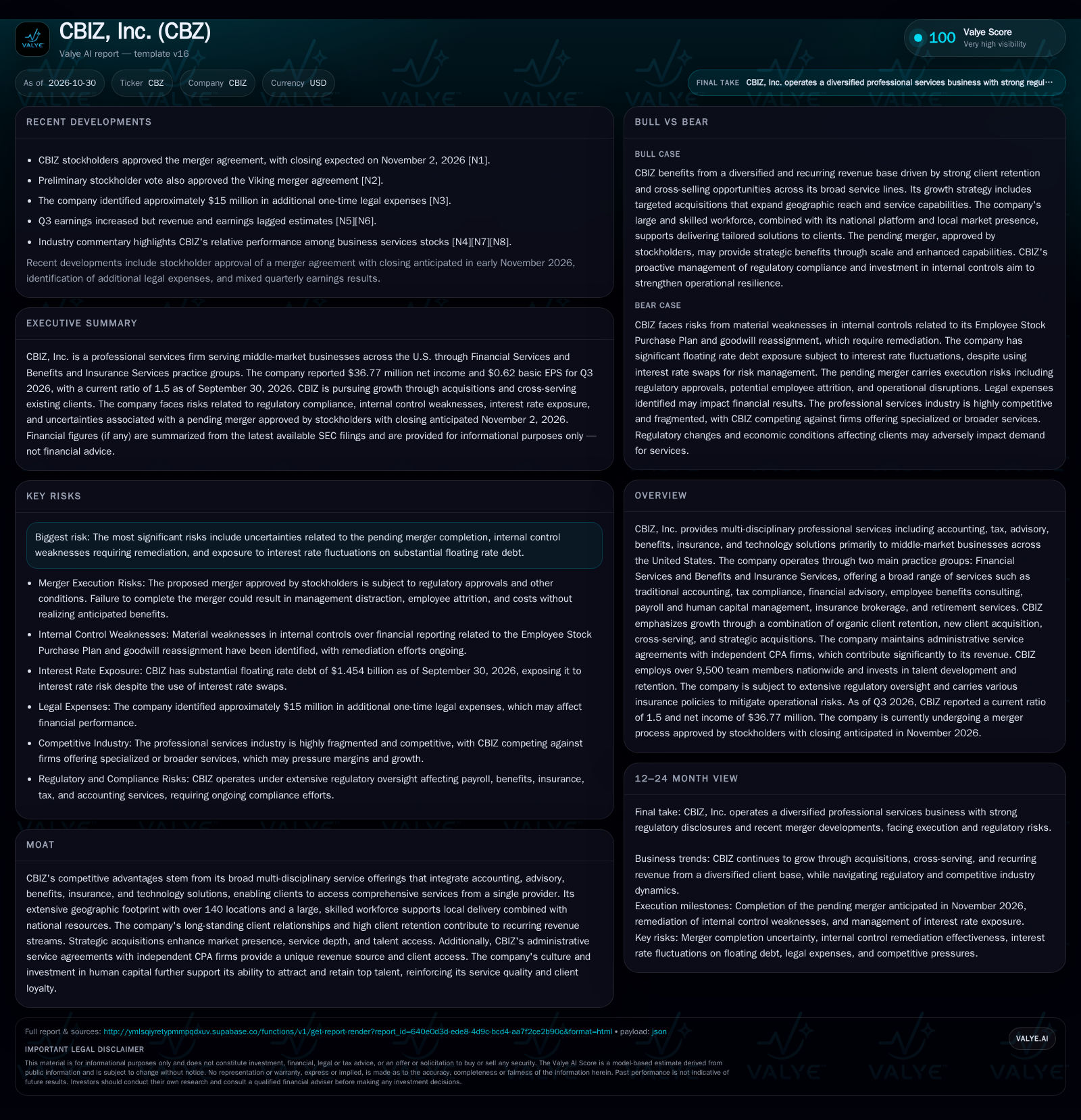
CBIZ, Inc. reported $2.76 billion in 2025 revenue, with 85% from Financial Services and a highly diversified client base. The company faces near-term operational and financial complexities: a pending merger due in November 2026, material weaknesses in internal controls, $1.454 billion in floating rate debt, and $15 million in additional legal expenses. Its growth model relies on recurring revenue, cross-selling, and strategic acquisitions, but successful execution will depend on integration, risk management, and competitive positioning in a fragmented market. [S1] [S2] [N1] [N3]
CBIZ, Inc. enters late 2026 at a strategic crossroads, balancing the promise of scale and breadth from its diversified professional services platform with the operational and financial risks inherent in rapid growth and merger execution. With $2.76 billion in annual revenue and a business model anchored by recurring services and client diversification, CBIZ is positioned to benefit from industry consolidation and cross-selling. Yet, substantial floating rate debt, internal control weaknesses, and elevated legal expenses create a complex risk environment as the company prepares to close a significant merger. How CBIZ manages these tensions will determine whether it can solidify its standing as a leading middle-market advisor.
Merger Approval, Debt Load, and Internal Controls Define CBIZ’s Near-Term Operating Backdrop
CBIZ, Inc. reported $2.76 billion in revenue for 2025, with 85.1% from Financial Services and the remainder from Benefits and Insurance Services, underscoring a diversified, multi-segment platform. The company’s largest client represented only 1.7% of consolidated revenue, pointing to a broad and resilient client base [S1].
The company faces several immediate challenges and inflection points. First, stockholders have approved a merger agreement, with closing anticipated in November 2026, potentially altering the company’s scale, integration complexity, and financial profile [N1] [N2]. Second, CBIZ disclosed approximately $1.454 billion in floating rate debt as of September 30, 2026, managed in part through interest rate swaps. Third, the company identified $15 million in additional one-time legal expenses, adding to near-term cost pressures [S2] [N3].
Material weaknesses in internal control over financial reporting—specifically in the Employee Stock Purchase Plan and goodwill reassignment—are under remediation, introducing process risk and possible regulatory scrutiny [S2]. These factors collectively set the stage for a period of heightened operational and financial execution risk.
How CBIZ’s Revenue Mix and Cost Structure Shape Its Earning Power
CBIZ’s business model is structured around two main practice groups: Financial Services (accounting, tax, advisory) and Benefits and Insurance Services. The firm’s economics are underpinned by a mix of recurring service contracts (such as accounting, compliance, payroll, and benefits administration) and project-based advisory fees. This recurring component drives revenue visibility and reduces reliance on any single client or sector, as evidenced by the low revenue concentration [S1].
The company’s growth model blends organic initiatives—client retention, cross-selling, and new client acquisition—with inorganic expansion via targeted acquisitions. The administrative service agreements (ASAs) with independent CPA firms create a unique revenue stream, likely generating high-margin, fee-based income with lower capital intensity compared to asset-heavy business models.
On the expense side, the professional services labor model means people costs dominate, with over 9,500 employees and ongoing investments in recruitment, retention, and development. While this limits gross margin expansion, it supports service quality and client stickiness. Operating leverage is available through scale (shared back-office, technology platforms, national branding) but can be offset by integration costs, regulatory compliance, and one-time legal or merger-related expenses.
Capital needs are moderate outside of M&A and technology investments, but the floating rate debt load of $1.454 billion introduces material interest expense sensitivity and refinancing risk, particularly in a volatile rate environment [S2].
Service Breadth, Local Scale, and Talent as Differentiators—But Competitive Pressures Persist
CBIZ’s primary competitive advantages stem from its ability to deliver a broad suite of services—accounting, tax, benefits, insurance, and technology—under one roof for middle-market clients. This integration supports cross-selling and positions CBIZ as a one-stop advisor, a value proposition that smaller niche firms and some larger national players may struggle to fully match.
Its footprint—over 140 locations in 23 major U.S. markets—enables local market penetration while leveraging national scale for branding, resource sharing, and talent recruitment. The administrative service agreements with independent CPA firms further extend reach and provide a unique, partially captive revenue stream [S1].
However, the professional services industry remains highly fragmented and competitive. CBIZ faces pressure from large national accounting/advisory brands, regional specialists, and technology-enabled disruptors. Price competition, talent retention, and evolving client demands (including digital transformation and regulatory complexity) are persistent headwinds.
Switching costs for clients are moderate; while embedded relationships and bundled services create some friction, corporate clients can and do switch providers for price, expertise, or service reasons. CBIZ’s diversified client base helps mitigate the loss of any single account but requires constant investment in service innovation and talent to avoid commoditization.
If Integration Delivers and Cross-Selling Accelerates, Margin Expansion and Market Share Gains Are Plausible
The most constructive scenario for CBIZ is one in which the pending merger closes smoothly, integration costs are contained, and the combined entity achieves targeted synergies in cross-selling, talent leverage, and geographic reach. Successful remediation of internal control weaknesses would restore confidence among clients, regulators, and investors, minimizing distraction and regulatory risk.
If the company can accelerate cross-selling across its expanded service portfolio and client base, it could see improved client lifetime value, higher wallet share, and increased retention. Operating leverage would be realized through shared back-office functions, technology investments, and reduced duplication post-merger.
Confirmation of this scenario would come from post-merger revenue and margin outperformance, evidence of increased client cross-utilization of service lines, improved employee retention rates, and explicit disclosure of realized cost or revenue synergies. Stabilization or reduction of legal and one-time expenses, alongside improved internal control audit outcomes, would further validate the upside case.
Steady Growth with Execution Hurdles: CBIZ’s Most Likely Trajectory
The most plausible path for CBIZ is mid-single digit organic growth, supplemented by modest contributions from ongoing acquisitions and cross-selling. The merger closes as planned but brings typical integration friction—IT and process harmonization, moderate employee turnover, and some client churn, but no major operational disruptions.
Recurring revenue streams and a diversified client base anchor stability, while floating rate debt keeps net income growth in check amid rising or volatile interest rates. Legal and regulatory expenses remain an episodic drag, but not a structural threat. Internal control remediation proceeds as planned, with no further material weaknesses identified after 2027.
This scenario would be confirmed by continued revenue growth in line with historical averages, stable or gradually improving operating margins, and manageable turnover in both clients and key personnel. Persistent—but not worsening—interest expense and legal costs would be consistent with this middle-of-the-road outcome.
Integration Stumbles, Cost Overruns, or Control Failures Could Disrupt CBIZ’s Momentum
A more adverse scenario would see the merger encounter significant execution problems—delays, higher-than-expected integration costs, cultural clashes leading to employee or client attrition, or operational disruptions that erode service quality. Failure to promptly remediate internal control weaknesses could invite regulatory action, auditor scrutiny, or further reputational harm.
If interest rates rise or remain elevated, the $1.454 billion floating rate debt could compress earnings, especially if revenue growth slows. Additional legal or regulatory expenses beyond the $15 million already identified would further pressure margins and distract management.
This scenario would be confirmed by missed revenue or margin targets, higher-than-expected turnover, new or prolonged internal control deficiencies, or further adverse legal disclosures. Client concentration or loss would be a warning sign if the diversified base begins to erode.
Milestones and Metrics That Will Reveal Whether CBIZ Can Deliver on Its Strategic Ambitions
Progress and disclosures related to the closing and initial integration of the pending merger—timing, synergy targets, and early operational outcomes.
Updates on the remediation of material weaknesses in internal controls, especially any new findings or delays in resolving existing issues.
Quarterly tracking of interest expense and floating rate debt outstanding, to assess earnings sensitivity to rate changes.
Disclosure of realized legal and regulatory expenses, and any new material legal or compliance events.
Evidence of cross-selling success—such as increased revenue per client, higher client retention, or explicit reporting of multi-service adoption rates (if disclosed).
Employee turnover rates, particularly among senior professionals and post-merger integrations, as a proxy for cultural fit and talent retention.
Organic revenue growth in core service lines versus acquisition-driven expansion.
Disclaimer: This is research-only, informational analysis and not investment advice. It may include AI-generated interpretation and general industry context. Always verify important details using primary sources.

Comments