
Dime Community Bancshares: Capital Strategy and Competitive Dynamics in Metro New York Banking
Dime Community Bancshares leverages its dense branch footprint and diversified lending in the competitive New York metro market, but faces persistent margin and credit risks as it manages capital through debt redemption and buybacks. The path forward will hinge on its ability to sustain local relationships, defend spreads, and navigate regulatory and economic crosscurrents.
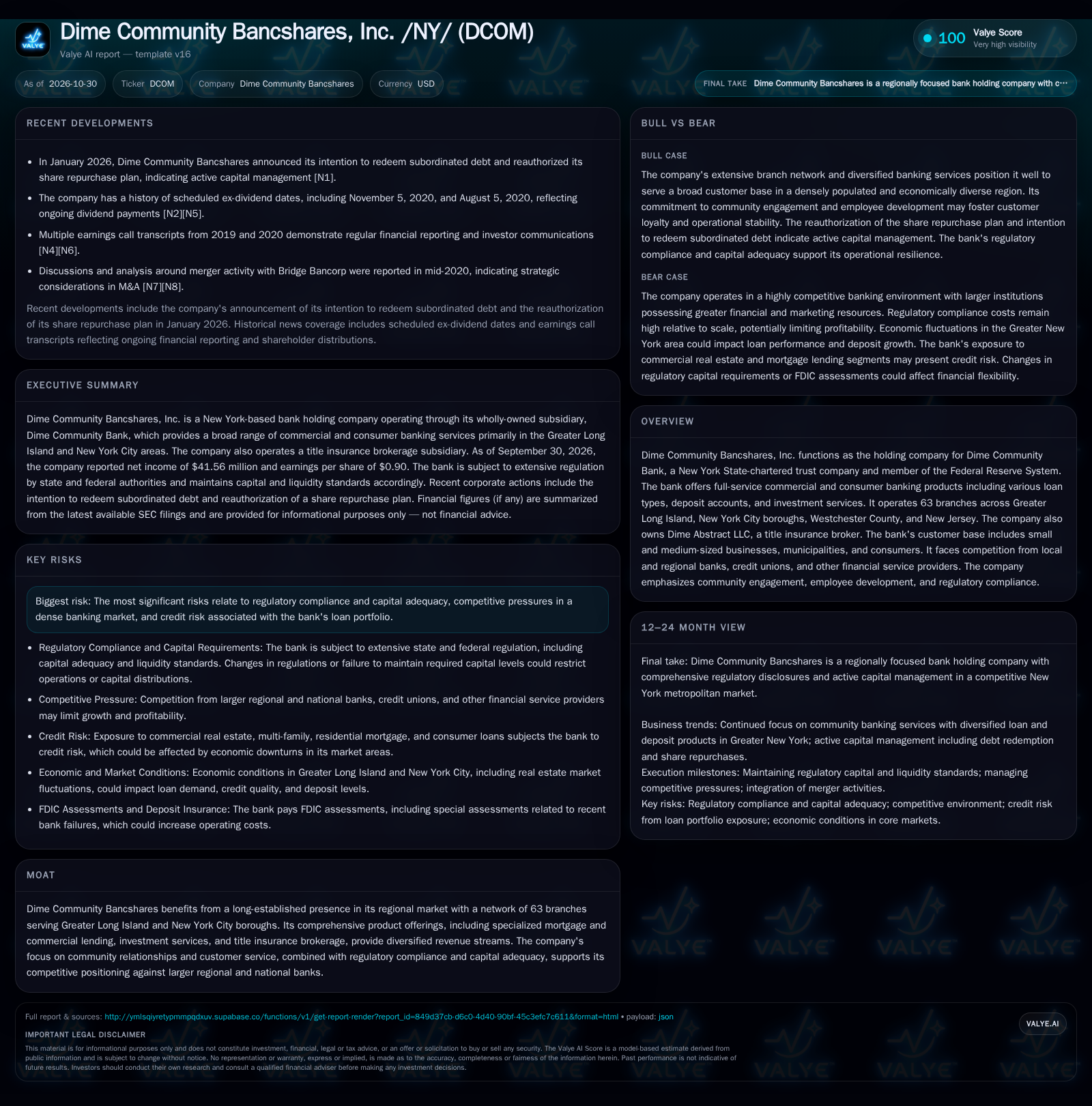
Dime Community Bancshares operates 62+ branches across Greater Long Island, NYC, and nearby regions, reporting $41.56 million in net income for the first nine months of 2026. The company is actively managing capital via a planned subordinated debt redemption and share repurchase reauthorization. Its fortunes depend on loan growth, credit quality, and effective competition with larger banks and alternative lenders in a challenging regulatory and rate environment. Watch for shifts in loan performance, deposit mix, and margin trends as key signals for the next phase. [S2] [N1]
Dime Community Bancshares stands at the intersection of local banking scale and metropolitan competition, operating over 60 branches across the economically diverse and heavily banked New York region. With recent moves to redeem subordinated debt and expand its share repurchase program, the company is signaling active capital stewardship. Yet, Dime's long-term trajectory is shaped less by near-term capital actions and more by its ability to grow loans, retain low-cost deposits, and manage credit risk against the backdrop of intensifying competition and a shifting regulatory landscape. Whether its community banking model can defend margins and market share will be tested by both macroeconomic headwinds and the ongoing evolution of customer preferences.
Recent Capital Initiatives and Profit Trends in a Competitive Market
As of September 30, 2026, Dime Community Bancshares reported net income of $41.56 million for the first nine months of the year, underscoring continued profitability amid a competitive metropolitan banking environment. The company operates 62 branch locations spanning Greater Long Island, the New York City boroughs, Westchester County, and New Jersey, maintaining a physical presence that is increasingly rare among regional peers. In January 2026, Dime announced its intention to redeem subordinated debt and reauthorized its share repurchase plan, highlighting a focus on capital optimization and shareholder returns. These actions suggest management is seeking to improve capital structure and signal confidence in underlying earnings, though they also reflect the need to respond to evolving regulatory and market dynamics. [S2] [N1]
Revenue Drivers: Spreads, Scale Efficiencies, and Capital Management
Dime Community Bancshares generates revenue primarily through net interest income—the spread between interest earned on loans and investments (such as commercial and residential real estate, multi-family, and consumer loans, plus mortgage-backed securities and other bonds) and the cost of deposits and wholesale funding. Non-interest income streams, such as fees from title insurance (via Dime Abstract LLC) and ancillary banking services, provide some diversification but are likely modest relative to core lending. The dense branch network gives Dime access to a broad deposit base (including commercial, municipal, and retail customers), which can be a source of low-cost funding if the company can defend its share of checking, savings, and money market accounts.
Operating leverage is possible if Dime can grow loans and deposits without proportional increases in branch or compliance costs. However, fixed costs tied to physical distribution and regulatory compliance remain significant. In the current environment, margin compression is a risk if loan yields do not rise as fast as funding costs, particularly as larger banks and fintechs compete aggressively for deposits and loan customers. Capital actions—such as redeeming subordinated debt and buying back shares—can improve per-share metrics and reduce interest expense, but must be balanced against the need for regulatory capital buffers and capacity to absorb credit shocks.
Branch Network Density and Local Relationships as Competitive Factors
Dime competes with a wide array of financial institutions—local and regional banks, national banks, credit unions, mortgage brokers, and digital-first lenders. Its competitive edge historically derives from deep community relationships, local decision-making, and tailored service to small and midsized businesses, municipalities, and consumers. The 62-branch footprint across densely populated, economically diverse neighborhoods provides physical accessibility, but also exposes Dime to high fixed costs and direct competition from larger players with more extensive technology and marketing budgets.
Larger banks can undercut on pricing, invest more in digital capabilities, and offer broader product suites, while fintech entrants target niche segments with streamlined processes. Dime’s ability to differentiate may rest on customer service, local knowledge, and responsiveness. However, cost structure and technology parity remain ongoing threats. The bank’s exposure to commercial real estate and mortgage lending—segments that can be cyclical—also means its fortunes are closely tied to the health of the regional economy.
Growth Potential Rooted in the Community Banking Framework
The most favorable scenario for Dime sees it leveraging its branch network and local relationships to grow loans and core deposits faster than regional peers. If economic conditions in Greater New York remain stable or improve, demand for commercial and multi-family lending could rise, supporting net interest income. Effective cost control and operational discipline could drive positive operating leverage, while prudent credit management keeps losses in check. Successful execution of capital actions—such as debt redemption and share buybacks—would further enhance per-share earnings and return on equity.
Confirmation of this scenario would require evidence of above-peer loan growth, stable or expanding net interest margin, increasing non-interest income, and continued benign credit quality (e.g., low non-performing loan ratios, minimal charge-offs). Indications that deposit mix is shifting toward lower-cost, sticky accounts would also support the case for sustainable spread income and funding advantage.
Maintaining Market Share and Margins Amid Regulation and Competition
The most plausible outcome is that Dime sustains moderate growth in loans and deposits, but faces persistent margin pressures as competition for both customers and funding intensifies. Net interest margin may fluctuate with market rates and competitive pricing, while regulatory compliance and technology investments limit the pace of operating leverage. Credit quality remains manageable, but some normalization of losses is likely as the credit cycle matures.
In this scenario, Dime’s capital actions (debt redemption, share buybacks) provide incremental benefits but do not fundamentally alter the earnings trajectory. The company maintains adequate capital and liquidity, keeps pace with regulatory requirements, and continues to pay dividends, but does not generate outsized growth or margin expansion. Evidence would include stable, mid-single-digit loan and deposit growth, modest changes in net interest margin, and manageable credit metrics. Any marked deterioration in credit or deposit outflows would challenge this view.
Risks from Margin Pressure and Credit Quality Declines
The adverse scenario emerges if intense competition for deposits drives up funding costs and squeezes net interest margin, while loan growth stalls or credit quality deteriorates—particularly in commercial real estate and multi-family portfolios. A regional economic downturn or sharp decline in property values could trigger higher non-performing loans and charge-offs, eroding earnings and forcing Dime to provision more for loan losses. Fixed branch costs and regulatory compliance become less supportable amid declining revenues, potentially leading to cost-cutting or branch consolidation.
If capital ratios come under pressure, the bank could be forced to suspend buybacks or dividends, limiting shareholder returns. Confirmation of this scenario would include a sharp drop in net interest margin, rising non-performing assets, higher credit losses, and evidence of deposit outflows or loss of commercial relationships. Regulatory warnings or heightened FDIC assessments could accelerate the negative spiral.
Factors Influencing Dime Community Bancshares’ Market Position
Quarterly trends in net interest margin—direction and magnitude of changes will reveal the bank’s ability to manage funding costs and loan yields in a volatile rate environment.
Loan growth by segment (commercial, multi-family, residential, consumer)—if disclosed, tracking whether Dime is gaining share in core markets or losing ground to competitors.
Deposit mix evolution—monitoring the proportion of non-interest-bearing and low-cost deposits versus higher-cost time deposits, which impacts funding advantage.
Credit quality metrics, especially non-performing loans and net charge-offs in the commercial real estate and multi-family portfolios.
Capital ratios (CET1, Tier 1, leverage)—watch for any signs of regulatory pressure or capital erosion as a result of credit losses or capital actions.
Progress on cost efficiency—evidence of stable or improving efficiency ratio would indicate success in leveraging branch scale or managing fixed costs.
Outcomes of capital management actions—actual execution and financial impact of subordinated debt redemption and share repurchases.
Disclaimer: This is research-only, informational analysis and not investment advice. It may include AI-generated interpretation and general industry context. Always verify important details using primary sources.

Comments