
Repligen’s BioLife Acquisition: Advancing Cell Therapy and Scaling Bioprocessing
Repligen’s $1.9B BioLife Solutions acquisition marks a strategic leap into cell therapy tools, but integration complexity and ongoing net losses raise the stakes for operational execution and market validation.
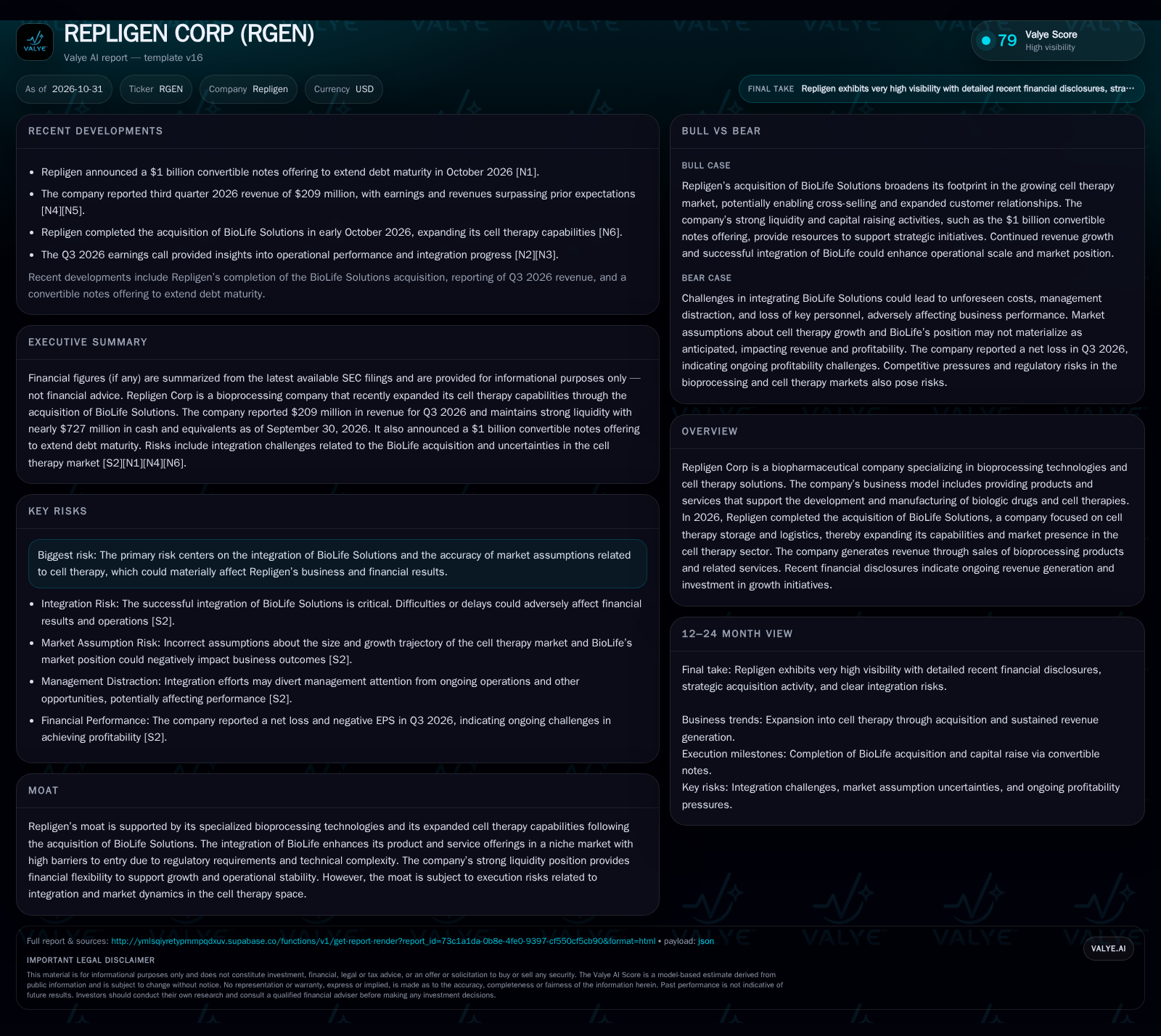
Repligen expanded its cell therapy capabilities with the $1.9B acquisition of BioLife Solutions in October 2026. Success will depend on capturing synergies, managing costs, and validating robust demand for advanced bioprocessing and cell therapy solutions. [S2] [N4] [N6]
Repligen’s acquisition of BioLife Solutions in October 2026 is a transformative move aimed at deepening the company’s footprint in the fast-evolving cell therapy market. While the deal substantially widens Repligen’s addressable market and product capabilities, it also introduces new integration risks and execution challenges at a time when the company is contending with profitability pressures. [S2] [N4] [N6]
How BioLife Acquisition Transforms Repligen’s Strategic Direction
The most material current development is Repligen’s completion of the $1.9 billion BioLife Solutions acquisition in October 2026, paid in both stock and cash. This transaction moves Repligen decisively into the cell therapy tools and logistics space, broadening its bioprocessing portfolio and introducing new market dynamics and operational challenges. The company reported Q3 2026 revenue of $209 million, reflecting ongoing sales momentum, but also posted a net loss of $38.4 million for the quarter and negative basic and diluted EPS of -$0.68 [S2] [N4] [N6].
Repligen’s liquidity is substantial, with $727 million in cash and a current ratio of 9.88 as of September 30, 2026 [S2]. However, risk disclosures prominently highlight the complexity of integrating BioLife, including potential delays, cost overruns, and retention of key personnel. The company’s financial outcomes are now more tightly linked to the success of this integration and the realization of cell therapy market growth assumptions [S2].
The strategic implications of the BioLife acquisition extend beyond immediate financial metrics to encompass shifts in Repligen’s competitive positioning within the broader bioprocessing ecosystem. The integration introduces a hybrid business model combining product sales with service-oriented logistics solutions, which may alter capital allocation priorities and operational workflows. This shift necessitates a recalibration of internal capabilities, including supply chain management, customer service, and regulatory compliance processes tailored to cell therapy’s unique requirements. Furthermore, the timing of this acquisition amid ongoing net losses underscores the criticality of balancing growth investments with disciplined cost control to sustain financial health during the transition period.
Revenue Composition and Operating Leverage in Bioprocessing Growth
Repligen’s core business model has historically focused on supplying high-value consumables and equipment for upstream and downstream biologics manufacturing. Revenue is primarily derived from sales to biopharmaceutical companies, CDMOs, and life sciences integrators. The underlying economics of bioprocessing components typically feature high gross margins, recurring sales linked to drug production cycles, and opportunities for cross-selling as customers scale up biologic pipelines.
The BioLife acquisition adds a layer of complexity: cell therapy logistics and storage solutions may involve different revenue recognition patterns, margin profiles, and capital needs. If BioLife’s offerings are service-heavy or require significant infrastructure investment, Repligen’s fixed cost base could rise, increasing operating leverage and the risk profile. The company’s ongoing net losses suggest that either integration costs, margin pressure, or both are impacting bottom-line performance. Profitability will likely depend on the speed and efficiency of integration, realization of cross-selling synergies, and the growth rate of the cell therapy segment relative to core bioprocessing products [S2] [N6].
From an operational leverage perspective, the addition of BioLife’s logistics and storage services could introduce variable cost components that differ materially from Repligen’s traditional product-centric revenue streams. If BioLife’s service offerings require significant upfront infrastructure or recurring maintenance expenses, the fixed-to-variable cost ratio may shift, impacting scalability and margin volatility. Additionally, the integration may affect working capital dynamics, especially if inventory turnover or receivables collection cycles differ between the legacy and acquired businesses. Monitoring these changes will be essential to understanding the combined entity’s cash flow profile and the sustainability of its margin expansion efforts.
Evolving Competitive Landscape: Integration and Market Specialization
Repligen’s moat historically rested on technical specialization in bioprocessing and a broad suite of proprietary products. Post-BioLife, the company aims to leverage deeper integration across cell therapy workflows, potentially offering end-to-end solutions that could increase customer stickiness and could raise switching costs—if execution is strong.
However, the cell therapy tools market is less mature and more fragmented than traditional bioprocessing, with rapid innovation, evolving standards, and both established life sciences players and emerging startups competing for share. Integration risks—especially the retention of key BioLife personnel and seamless product integration—could erode the intended competitive advantage. Moreover, larger life sciences conglomerates or CDMOs with in-house capabilities may act as powerful substitutes, especially if Repligen’s combined offering does not demonstrate clear differentiation or cost-of-ownership benefits to customers.
The competitive landscape’s evolution will likely hinge on Repligen’s ability to innovate within the integrated product-service continuum. Success depends on developing differentiated offerings that not only meet technical performance benchmarks but also address end-to-end customer pain points such as supply chain reliability, regulatory compliance, and scalability of cell therapy manufacturing. If Repligen can create seamless interoperability between its traditional bioprocessing components and BioLife’s logistics solutions, it may establish a higher barrier to entry for competitors. Conversely, failure to achieve this integration could leave the company vulnerable to specialized startups or established conglomerates that offer modular, best-in-class solutions tailored to discrete customer needs.
Potential for Cross-Selling to Accelerate Cell Therapy Expansion
A favorable outcome would see Repligen rapidly and cost-effectively integrating BioLife, retaining key talent, and leveraging its legacy commercial infrastructure to cross-sell cell therapy solutions to its established bioprocessing customer base. If the cell therapy market grows at or above management’s expectations, demand for advanced logistics, storage, and processing tools could drive above-market revenue growth and margin expansion.
Evidence of this scenario would include accelerating revenue growth from the combined business, improving gross and operating margins, and disclosure of major new customer wins or expanded multi-product contracts in cell therapy. Confirmation would also come from stable or improving employee retention metrics within the acquired BioLife division and explicit management commentary regarding successful integration milestones and realized synergies.
Expected Outcomes from Integration and Market Adoption Challenges
The most plausible path is a mixed outcome: Repligen delivers steady top-line growth through its expanded product suite, but integration costs, cultural mismatches, or slower-than-expected cell therapy adoption temper the financial upside. Margins may be pressured by the costs of combining operations and supporting a broader, potentially more capital-intensive business.
This scenario would be confirmed by sequential revenue growth but no dramatic step-change in profitability, continued but narrowing net losses, and management guidance that acknowledges both progress and ongoing challenges. Evidence refuting this outcome would include either rapid, sustained profitability or a material deterioration in revenue or operational performance linked to integration setbacks.
Risks of Integration Delays and Cell Therapy Market Shortfalls
An adverse scenario unfolds if Repligen faces significant integration hurdles—such as loss of key BioLife staff, system incompatibilities, or persistent cost overruns—while the cell therapy market fails to meet growth expectations. In this case, Repligen could see margin compression, elongated net losses, and potentially write-downs related to the acquisition.
Confirmation would come from rising SG&A or integration expenses, declining gross margins, customer attrition, or negative revisions to revenue guidance. Management commentary highlighting unexpected integration challenges or market softness, as well as the absence of cross-selling wins, would further support this scenario.
Factors Influencing the Success of Repligen’s Cell Therapy Strategy
Material improvement or deterioration in consolidated gross and operating margins in the next 2-4 quarters, revealing the impact of integration and business mix.
Disclosure of cross-selling activity or multi-product contracts involving legacy Repligen and BioLife customer bases—if disclosed.
Retention rates and turnover among key BioLife personnel, especially technical and commercial leaders—any explicit disclosure would be informative.
Trends in cell therapy-related revenue as a share of total sales, either in segment reporting or management commentary.
Integration-related expenses and progress updates in quarterly filings and earnings calls.
Major customer wins, product launches, or strategic partnerships in cell therapy tools and logistics.
Changes in management’s assumptions or guidance regarding cell therapy market size, growth rates, or BioLife’s competitive position.
Any evidence of cost overruns or delays linked to integration, such as rising SG&A, restructuring charges, or impairment disclosures.
Disclaimer: This is research-only, informational analysis and not investment advice. It may include AI-generated interpretation and general industry context. Always verify important details using primary sources.

Comments