
ConnectOne Bancorp’s Strategic Portfolio Actions and the Stakes of Risk Management in 2026
ConnectOne Bancorp’s Q3 2026 results highlight not only solid profitability and liquidity but also a decisive move to reshape its loan book with a major multifamily loan sale. As the bank contends with legal and cybersecurity risks, the next phase will test its ability to balance capital deployment, risk controls, and income-focused shareholder appeal.
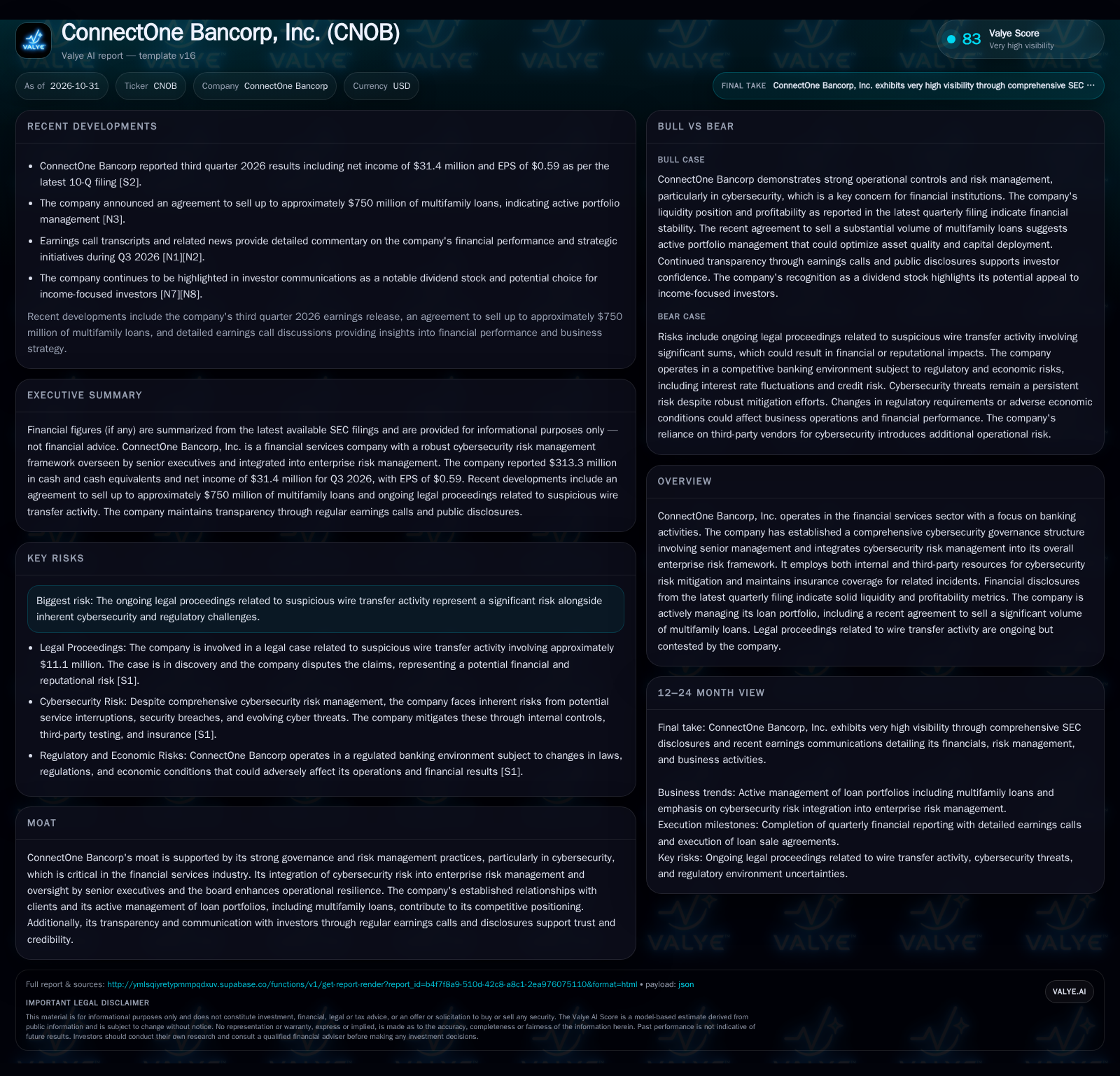
ConnectOne Bancorp reported Q3 2026 net income of $31.4 million and agreed to sell up to $750 million of multifamily loans, signaling active portfolio management. The company maintains a strong cybersecurity governance structure but faces ongoing legal proceedings related to wire transfer activity. Its transparency and recognition as a dividend stock continue to attract income-focused investors, yet execution risks and regulatory pressures remain central to the outlook. [S2] [N3] [S1] [N7]
ConnectOne Bancorp enters late 2026 at an inflection point, combining healthy Q3 profitability and liquidity with a bold step to sell a substantial portion of its multifamily loan portfolio. This move underscores a proactive approach to balance sheet optimization and capital deployment at a time when regulatory, legal, and cybersecurity risks are front and center for banks of its scale.
Recent Developments Reshape ConnectOne’s Risk and Capital Profile
The company reported cash and liquidity metrics for the period; these figures do not by themselves establish operating runway, investment capacity, financial flexibility, or financing capacity. The company announced an agreement to sell up to approximately $750 million of multifamily loans, a move that could meaningfully alter its loan mix and capital structure. This transaction signals an active approach to managing credit exposure and regulatory capital requirements. Meanwhile, the company continues to contest a legal proceeding involving $11.1 million in suspicious wire transfer activity, which remains in discovery and could carry financial or reputational consequences if not resolved favorably. [S2] [N3] [S1]
How Asset Mix and Fee Streams Could Shape Future Profitability
ConnectOne Bancorp’s core business economics are driven by traditional spread banking: net interest income from lending versus the cost of funding, with fee income as a potential supplement. The planned sale of up to $750 million in multifamily loans could improve the risk profile by reducing exposure to a sector that often carries higher regulatory capital charges and cyclical risk. If the loan sale is executed at or above book value, the company may unlock capital for redeployment toward higher-margin or less capital-intensive assets, or bolster liquidity for further strategic flexibility.
Operating leverage in regional banking is typically modest, with fixed costs in regulatory compliance, technology, and branch operations. ConnectOne’s robust cybersecurity investment, overseen by a dedicated IT Committee, represents a necessary but non-trivial fixed expense that protects both operations and reputation. The ongoing legal case introduces the risk of a non-recurring charge, though the company disputes the claim. The cited source reports dividend-related activity; that disclosure alone does not establish dividend-policy continuity, management confidence, or a material constraint on capital flexibility. [S1] [N7] [N8]
The interplay between asset mix adjustments and fee income diversification is critical in shaping ConnectOne’s medium-term profitability trajectory. If the multifamily loan sale successfully reduces capital-intensive exposures, the bank’s return on equity could improve, provided redeployment targets assets with favorable risk-adjusted yields. However, this assumes that the bank can identify and underwrite new loans or fee-generating opportunities without incurring disproportionate credit or operational risks. Additionally, the timing of capital redeployment is essential; prolonged holding of sale proceeds in low-yielding liquid assets could compress net interest margins, while overly aggressive deployment into higher-risk segments might elevate credit volatility. Therefore, the bank’s capacity to balance these dynamics will materially influence its earnings stability and growth.
Furthermore, the fixed-cost nature of regulatory compliance, technology infrastructure, and cybersecurity investments creates a baseline expense that limits operating leverage, especially in a regional bank context. ConnectOne’s emphasis on cybersecurity governance, while necessary, may constrain near-term efficiency gains unless offset by scaling fee-based services or operational automation. The legal proceedings add an additional layer of expense uncertainty, potentially requiring reserves or legal costs that could reduce reported earnings. The bank’s ability to manage these cost pressures while sustaining revenue growth will be a key determinant of its overall financial resilience, particularly if interest rate environments or competitive pressures limit margin expansion.
Risk Controls and Relationship Banking in a Crowded Field
ConnectOne operates in a competitive tri-state banking market, facing pressure from both large national banks and nimble community banks. Its differentiation hinges on a combination of risk management rigor and relationship-driven lending. The integration of cybersecurity oversight into enterprise risk management, with involvement from multiple C-suite officers and regular Board reporting, may offer a competitive edge in trust and operational resilience, especially as cyber threats escalate in the sector. [S1]
However, the commoditization of lending products and the rise of digital-first competitors threaten pricing power and customer stickiness. The multifamily loan sale could signal an intent to focus on niche lending or service-oriented fee businesses, but the risk is that asset reallocation does not fully offset lost interest income unless fee-based or higher-yielding assets are scaled efficiently. The cited source reports dividend-related activity; that disclosure alone does not establish dividend-policy continuity, management confidence, or a material constraint on capital flexibility.
Capital Reallocation and Risk Management Drive Value Creation
The most favorable outcome for ConnectOne is that the multifamily loan sale is executed at attractive pricing, freeing up capital that is redeployed into higher-return or lower-risk assets. This could enhance both net interest margin and risk-adjusted returns, especially if management leverages local market knowledge to identify underserved lending segments or develops non-interest income streams. Robust cybersecurity and internal controls could prevent material operational disruptions, maintaining trust with clients and regulators.
A favorable resolution to the legal dispute would remove a cloud over the company, while strong loan origination in targeted segments would signal effective capital redeployment. Sustained transparency in investor communications would further support valuation multiples. [N3] [N7]
Pragmatic Balance Between Growth, Risk, and Capital Return
The most plausible path is that ConnectOne completes the multifamily loan sale with limited one-time impact on earnings, reallocates some capital to core lending, and maintains a conservative approach to risk management. Net interest margins may remain under modest pressure if redeployment opportunities are limited or if competition for new loans intensifies. The legal case may linger but not materially disrupt day-to-day operations, while cybersecurity investments continue to absorb a predictable share of expenses.
Dividend payments are likely to persist, supporting the bank’s income stock positioning, but growth in payout may be restrained by regulatory oversight and the need for balance sheet flexibility. Confirmation of this scenario would come from stable earnings, steady loan growth in targeted areas, and the absence of major credit or operational losses. If disclosed, trends in non-interest income and margin evolution would further validate the stability of the business model. [S2] [N7]
Legal, Regulatory, or Credit Shocks Could Undermine Stability
A negative turn could occur if the legal proceeding results in a sizable financial judgment or settlement, eroding capital and damaging reputation. Should the multifamily loan sale be delayed, executed at a loss, or fail to yield productive redeployment, ConnectOne could face shrinking net interest income and margin compression. Persistent low-rate environments or a spike in credit losses—especially if economic conditions deteriorate—could further pressure profitability.
Operational setbacks, such as a material cybersecurity breach or regulatory sanction, would not only result in direct costs but could also trigger client defections and increased compliance scrutiny. Evidence would include elevated non-performing loan ratios, declining capital ratios, or a sharp drop in fee and interest income. [S1]
Factors That Will Determine ConnectOne’s Resilience and Value Proposition
Execution and pricing of the $750 million multifamily loan sale—whether the transaction closes at or above book value and how proceeds are redeployed. [N3]
Resolution timeline and financial impact of the $11.1 million wire transfer legal proceeding. [S1]
Net interest margin trends post-loan sale, especially relative to peer banks and market rates, if disclosed.
Non-interest income growth from fee-based businesses or other sources, as reported in future filings.
Credit quality indicators, including non-performing asset ratios and charge-offs in the reconstituted loan portfolio, if disclosed.
Cost trajectory and effectiveness of ongoing cybersecurity investments, including incident frequency and insurance claims, if disclosed.
Sustainability and growth of dividend payments in the context of changing capital requirements and earnings capacity. [N7] [N8]
Management’s commentary on strategic asset allocation and risk appetite in future earnings calls.
Disclaimer: This is research-only, informational analysis and not investment advice. It may include AI-generated interpretation and general industry context. Always verify important details using primary sources.

Comments