
Fortress Value Acquisition Corp. V: Capital Structure, SPAC Timelines, and the Stakes of the Search
Fortress Value Acquisition Corp.
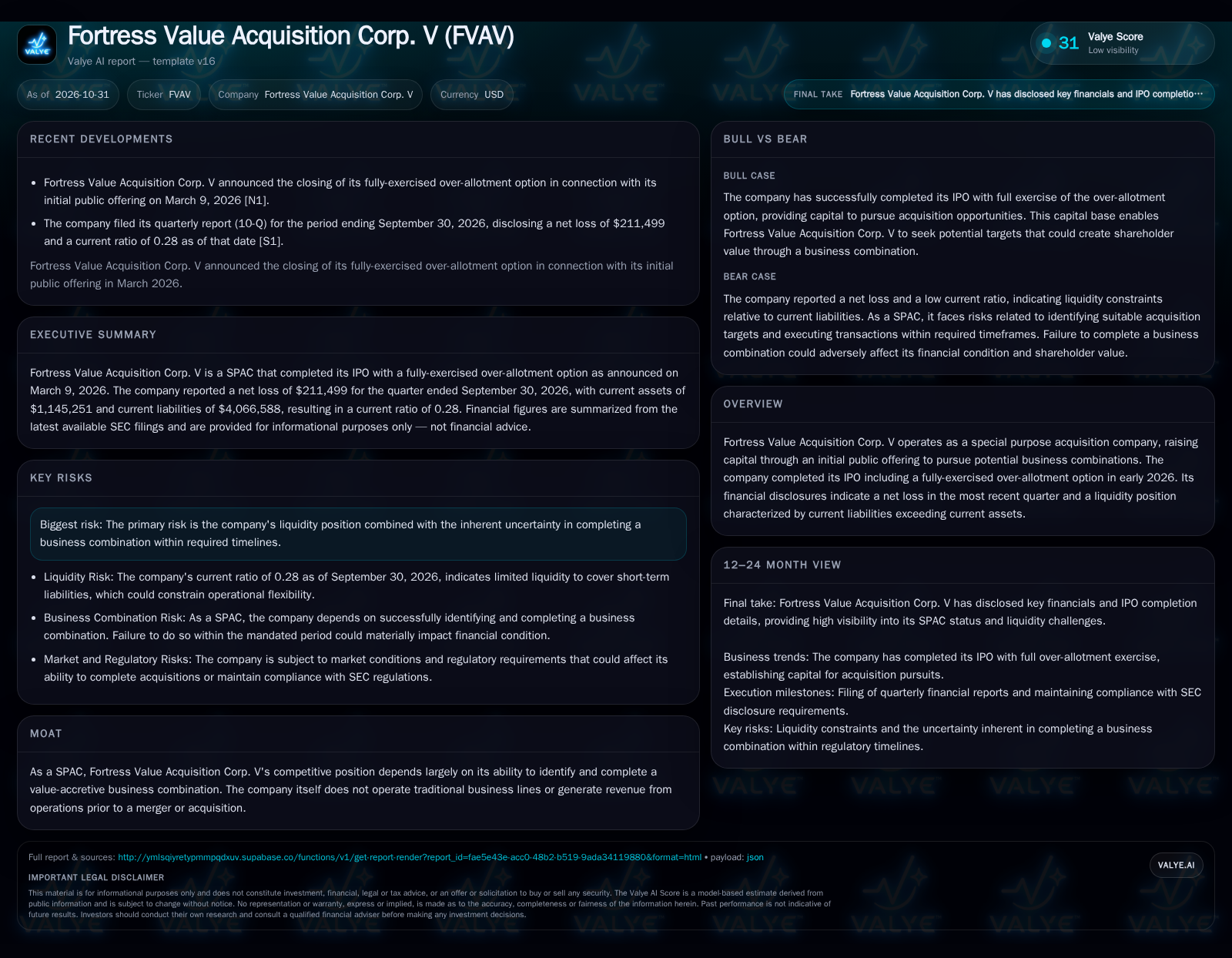
FVAV closed its IPO and over-allotment, placing $287.5M (gross) in trust. However, its latest 10-Q shows current liabilities far exceeding current assets at the holding-company level, with a net loss and no operating revenue. Success now hinges on identifying and closing a value-accretive acquisition within typical SPAC deadlines, under the constraints of limited accessible cash and mounting costs tied to status-quo operations. [S1] [N1]
Fortress Value Acquisition Corp. V (FVAV) exemplifies the modern SPAC lifecycle: flush with trust capital after a successful IPO and over-allotment, yet operationally cash-strapped with a visible liquidity mismatch and no revenue until a business combination is closed. The company’s latest filings reveal a net loss, liabilities exceeding accessible assets, and a trust account that cannot be tapped for ordinary expenses. The clock is now ticking for FVAV to identify and execute a merger with a suitable target—a process that will determine whether its capital structure transforms into lasting shareholder value or dissolves in liquidation.
IPO Proceeds, Trust Account, and the Operating Company’s Liquidity Squeeze
FVAV completed its IPO (including a fully exercised over-allotment option) by March 2026, generating $287.5 million in gross proceeds, which were placed in a trust account to fund a future acquisition. However, as of September 30, 2026, filings show that current liabilities at the operating-company level ($4.07M) far exceed current assets ($1.15M), resulting in a current ratio of 0.28 and a net quarterly loss of $211,499. The trust account is legally segregated and cannot be used for day-to-day expenses, leaving the company reliant on limited accessible cash for operating needs. These facts set the stage for a race against time and costs: FVAV must close a business combination before regulatory deadlines or face the prospect of forced liquidation. [S1] [N1]
How a SPAC Generates (or Fails to Generate) Shareholder Value
SPACs like FVAV are structured as financial vehicles, not operating businesses. The economics hinge on two events: successful identification and consummation of an acquisition, and the subsequent performance of the combined entity. Until a merger closes, the SPAC earns only nominal interest on its trust assets, while incurring recurring legal, administrative, and diligence costs. The trust’s capital is sequestered to protect public shareholders in the event of liquidation, so accessible funds for operations remain tight.
Success is driven by the quality and terms of the eventual business combination. If FVAV completes a value-accretive merger, sponsors and public shareholders can benefit from equity appreciation and warrant exercise. If no deal is struck, the trust is liquidated, and public shareholders are repaid their pro-rata share, but the sponsor’s capital and any operating expenses outside the trust are lost. Operating leverage is minimal until a merger closes; most costs are fixed and front-loaded, with upside entirely contingent on the acquisition outcome.
SPAC Search Dynamics: Competing for Targets in a Crowded Field
FVAV’s competitive positioning is determined by its ability to source and close a compelling deal ahead of hundreds of other SPACs and private equity buyers. Key differentiators may include sponsor reputation, dealmaking track record, and the Fortress platform’s network. However, the market for attractive targets has become increasingly competitive, with many SPACs chasing a finite pool of high-quality private companies, often driving up valuations or pushing sponsors into riskier, less-proven sectors.
FVAV’s challenge is to convince a desirable target to merge at terms that leave room for public shareholder returns. The risk is that, under time pressure, SPACs may compromise on quality or pay up for deals that fail to deliver post-merger value. Substitutes include direct listings, traditional IPOs, and private capital, all of which may be more attractive to targets in strong capital markets. The sponsor’s ability to source proprietary opportunities and add operational value post-deal is a potential advantage, but not a guarantee.
Unlocking Value: What a Successful Business Combination Would Look Like
The bull case for FVAV is predicated on identifying a high-quality, growth-oriented private company willing to merge at a valuation that is attractive for public market investors. In this scenario, FVAV’s trust capital is deployed as part of the merger consideration, the target’s management joins the public company, and the post-merger entity demonstrates strong revenue growth, profitability, or strategic differentiation.
Confirmation of this scenario would come through a deal announcement featuring a well-known or fast-growing target, investor enthusiasm (narrowing of SPAC NAV discount or price pop), and clear communication of the combined company’s financial prospects. Additional validation would include successful PIPE (private investment in public equity) participation from blue-chip investors, minimal redemptions at the merger vote, and favorable post-close trading. Falsification would be a lack of deal announcement as deadlines approach, or a merger with a low-quality or distressed target.
What Happens If FVAV Follows the Typical SPAC Trajectory
The most plausible outcome is that FVAV spends the next several quarters searching for a target, incurring ongoing operating losses and depleting its accessible cash. If a deal is announced, it is likely to be in a competitive segment, possibly with a modestly attractive target but requiring additional capital or sponsor concessions to close. Public shareholders may redeem a significant portion of shares, reducing the cash delivered to the target and potentially limiting deal scope.
This scenario would be confirmed by continued incremental operating losses, additional regulatory filings extending the SPAC’s window, and eventual deal terms that require PIPE financing or sponsor backstops. If no deal is found, the company would move into liquidation, returning trust proceeds to shareholders and leaving the sponsor with sunk costs. Evidence against this base case would be an early, high-quality deal or a sudden, dramatic shift in SPAC market dynamics.
When the Clock Runs Out: Liquidation and Sponsor Losses
The adverse outcome is that FVAV fails to identify or close a business combination within its regulatory deadline (typically 18–24 months from IPO), resulting in forced liquidation. In this case, the trust account is returned to public shareholders—minus any permitted expenses—but the sponsor’s initial investment and all out-of-pocket costs are forfeited.
This scenario could be confirmed by multiple extension votes, disclosure of continued operating losses, and lack of deal-related news as deadlines approach. Heightened redemptions or negative market sentiment toward the SPAC sector could accelerate this path. Falsification would require a credible deal announcement and evidence of sufficient shareholder support to close.
Milestones That Will Determine Whether FVAV Can Deliver Shareholder Value
Announcement of a definitive business combination agreement, including details on target quality, sector, and deal structure.
Level of public-shareholder redemptions at the merger vote—high redemptions may signal weak deal quality or diminished trust in sponsor alignment.
PIPE (private investment in public equity) participation, if any, as a sign of institutional validation and ability to supplement trust capital.
Operating expense burn rate and changes in current assets/liabilities at the holding-company level, if disclosed.
Disclosure of any deadline extensions or sponsor-funded backstop arrangements to keep the SPAC alive.
Market reaction to deal news, including trading above or below trust NAV, as an indicator of perceived deal quality.
Any material changes in risk factors or regulatory environment affecting SPAC timelines or deal viability.
Disclaimer: This is research-only, informational analysis and not investment advice. It may include AI-generated interpretation and general industry context. Always verify important details using primary sources.

Comments