
SkyWest in Late 2026: Contract Stability, Cost Pressures, and the Stakes of Liquidity Management
SkyWest, the leading US regional airline operator, continues to post profits on the strength of long-term capacity purchase agreements with major carriers.
Long-term fixed-fee agreements with major airlines remain a core defensive asset, though pilot supply, contract renewals, and liquidity warrant close monitoring as the regional airline sector evolves. [S2] [N2] [N7]
SkyWest enters late 2026 as the preeminent US regional airline by scale, executing nearly 2,300 daily departures for United, Delta, American, and Alaska through long-term capacity purchase agreements. The company’s Q3 profit performance stands out in a turbulent sector, but a current ratio well below 1 and persistent cost headwinds cast a shadow over its operational momentum.
Profitability Holds, but Liquidity and Margin Pressures Are Front and Center
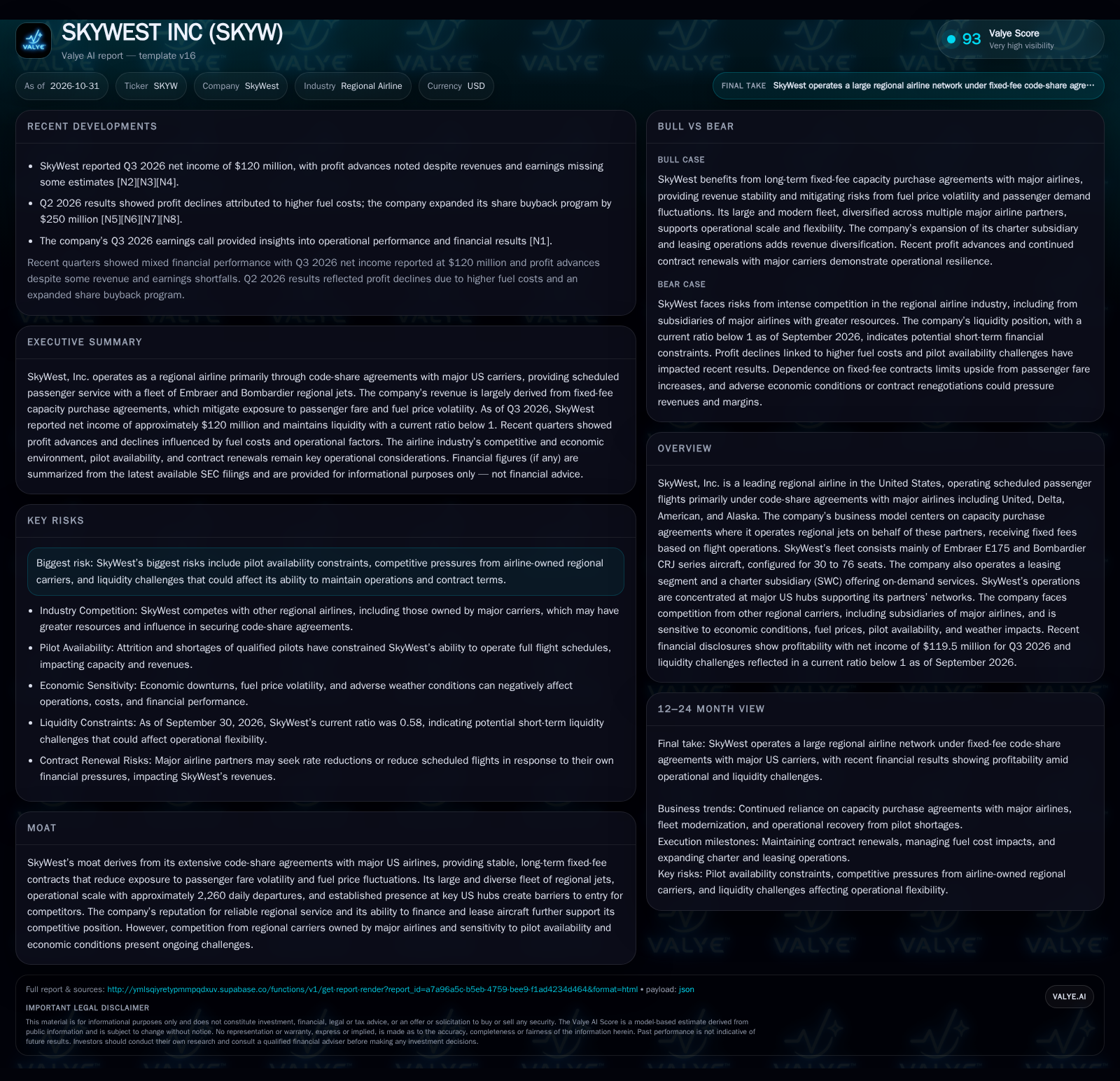
SkyWest reported Q3 2026 net income of $119.5 million, sustaining profitability despite missing some consensus revenue and earnings estimates. This demonstrates the continued resilience of its fixed-fee business model in a challenging environment. [S2] [N2] [N3] [N4]
This financial posture could limit SkyWest’s flexibility in responding to operational shocks or investment needs. [S2]
The company expanded its share buyback program by $250 million in Q2 2026, even as profit margins were pressured by higher fuel costs—a move that may enhance shareholder value but could further constrain near-term liquidity. [N5] [N6] [N7] [N8]
The easing of pilot attrition by the end of 2025 helped restore some operational stability, though pilot supply remains an industry-wide constraint with direct impact on SkyWest’s ability to fulfill contracts and maximize aircraft utilization. [S1]
How the Capacity Purchase Model Shapes SkyWest’s Financial Engine
SkyWest’s economics are fundamentally defined by its capacity purchase agreements (CPAs) with the major US airlines. Under these long-term, fixed-fee arrangements, SkyWest receives payments based on completed flights, flight hours, and aircraft under contract, while partners reimburse fuel and certain direct operating expenses. This structure insulates SkyWest from passenger fare volatility and much of the fuel price risk, supporting revenue predictability even when broader industry demand fluctuates. [S1]
Approximately 84% of revenue came from CPAs in 2025, with the balance from prorate agreements and on-demand charters. While this model limits SkyWest’s direct upside from surging passenger demand or fares, it also provides a buffer during downturns and shields the company from acute cost swings. [S1]
The company’s cost base is primarily driven by labor, maintenance, aircraft leasing, and non-reimbursed overhead. Operating leverage is significant: incremental block hours or new aircraft under contract can drive material profit improvements if fixed costs are already covered. Conversely, underutilization—whether from pilot shortages or schedule changes—can compress margins rapidly.
Capital needs remain substantial. Expansion of the leasing and charter businesses may diversify revenue but typically involves upfront capital outlays and uncertain ramp economics.
Defensible Network, but Structural Headwinds in the Regional Airline Landscape
SkyWest’s competitive position is anchored by its long-standing relationships with United, Delta, American, and Alaska—each of which entrusts SkyWest with hundreds of daily departures at key hubs. This integration into partners’ route networks could increase switching friction, as replacing a regional operator at scale involves regulatory, operational, and training hurdles. [S1]
The company’s large and modern fleet, operational reliability, and geographic breadth are meaningful advantages over smaller independents. However, competition from regional carriers owned outright by the major airlines—who may be less sensitive to short-term profit and more focused on system optimization—remains a persistent threat.
Technological substitution risk is muted in the near term, but the long-term shift toward larger regional jets or mainline narrowbodies on higher-density routes could erode SkyWest’s addressable market if partner airlines continue to upgauge. Additionally, consolidation among regional operators or changes in scope-clause agreements could alter the balance of bargaining power.
Pilot supply is a structural constraint for all regionals: SkyWest’s scale helps, but it must compete fiercely on wages, quality of life, and career progression to attract and retain talent. Any sustained pilot shortage could pressure both costs and operational reliability.
What a Sustained CPA Renewal Cycle Could Unlock for SkyWest
A favorable scenario for SkyWest would see major airline partners renewing and potentially expanding capacity purchase agreements at stable or improved rates. This would lock in multi-year revenue visibility, justify continued fleet investments, and allow SkyWest to leverage its fixed-cost base for incremental profit growth.
Such an outcome likely hinges on continued operational reliability, competitive pilot compensation, and the inability or unwillingness of the majors to bring more regional flying in-house. Expansion of the charter and leasing segments could further diversify cash flows, particularly if SkyWest can leverage its fleet management expertise for third-party customers.
Evidence that would confirm this scenario includes: multi-year contract renewals or expansions with major partners, new aircraft orders placed on behalf of partners, and improving utilization rates across the fleet. A meaningful reduction in pilot turnover and stable-to-improving margins despite inflationary pressures would further support the case.
Incremental Margin Recovery, but Persistent Liquidity and Cost Frictions
The most plausible near-term outcome for SkyWest is continued profitability under its CPA-driven model, but with ongoing margin pressure from labor and non-reimbursed cost inflation. Contract renewals are likely to remain a negotiation battleground, with major airlines seeking to contain regional flying costs and SkyWest seeking to protect or improve rates.
Fleet utilization could gradually improve if pilot hiring and retention trends continue to stabilize, but cost headwinds—particularly for labor and maintenance—will offset much of the benefit.
Confirmation would come from stable or modestly rising quarterly net income, ongoing renewals of CPAs at similar terms, and evidence of cost containment. Conversely, a spike in short-term debt, asset sales to fund operations, or a sharp drop in scheduled departures would signal downside risk.
Liquidity Squeeze and Contract Compression as Structural Risks Materialize
A negative scenario would see SkyWest unable to renew key CPAs on favorable terms, potentially due to partner airline consolidation, insourcing, or a shift to larger aircraft. This would reduce contracted flying, depress utilization, and leave fixed costs stranded, compressing margins and threatening profitability.
Evidence supporting this downside would include announcements of reduced block hours, early contract terminations, rising short-term borrowings, or disclosures of covenant breaches. Widening losses, asset sales at distressed prices, or a suspension of the buyback program would further corroborate distress.
Milestones That Will Define SkyWest’s Resilience in a Shifting Regional Airline Sector
Quarterly net income trends and margin evolution, especially in the face of persistent cost inflation and any changes in CPA reimbursement formulas.
Announcement or renewal of multi-year capacity purchase agreements with United, Delta, American, or Alaska, and the terms attached to those renewals.
Pilot attrition and hiring rates—if disclosed—relative to internal targets and industry benchmarks, as an indicator of operational capacity and labor cost trajectory.
Utilization rates for the Embraer E175 and Bombardier CRJ fleet, as well as the number of aircraft in active scheduled service versus parked or leased-out.
Charter and leasing segment revenue growth, including third-party leasing activity and the ramp of SWC’s on-demand charter business.
Any shift in the mix of reimbursed versus non-reimbursed costs in CPA contracts, which could alter margin sensitivity to fuel, labor, or maintenance expense.
Disclaimer: This is research-only, informational analysis and not investment advice. It may include AI-generated interpretation and general industry context. Always verify important details using primary sources.

Comments