
Labcorp in Late 2026: ERP Integration, IT Reliance, and the Stakes of Diagnostic Scale
Labcorp’s strong Q3 earnings and raised full-year outlook highlight operational resilience, but the ongoing ERP system overhaul and acute IT risks shape the company’s near-term execution challenge. As the diagnostics landscape shifts, Labcorp’s scale, technology dependence, and integration efforts will determine whether it can sustain margin strength and competitive relevance.
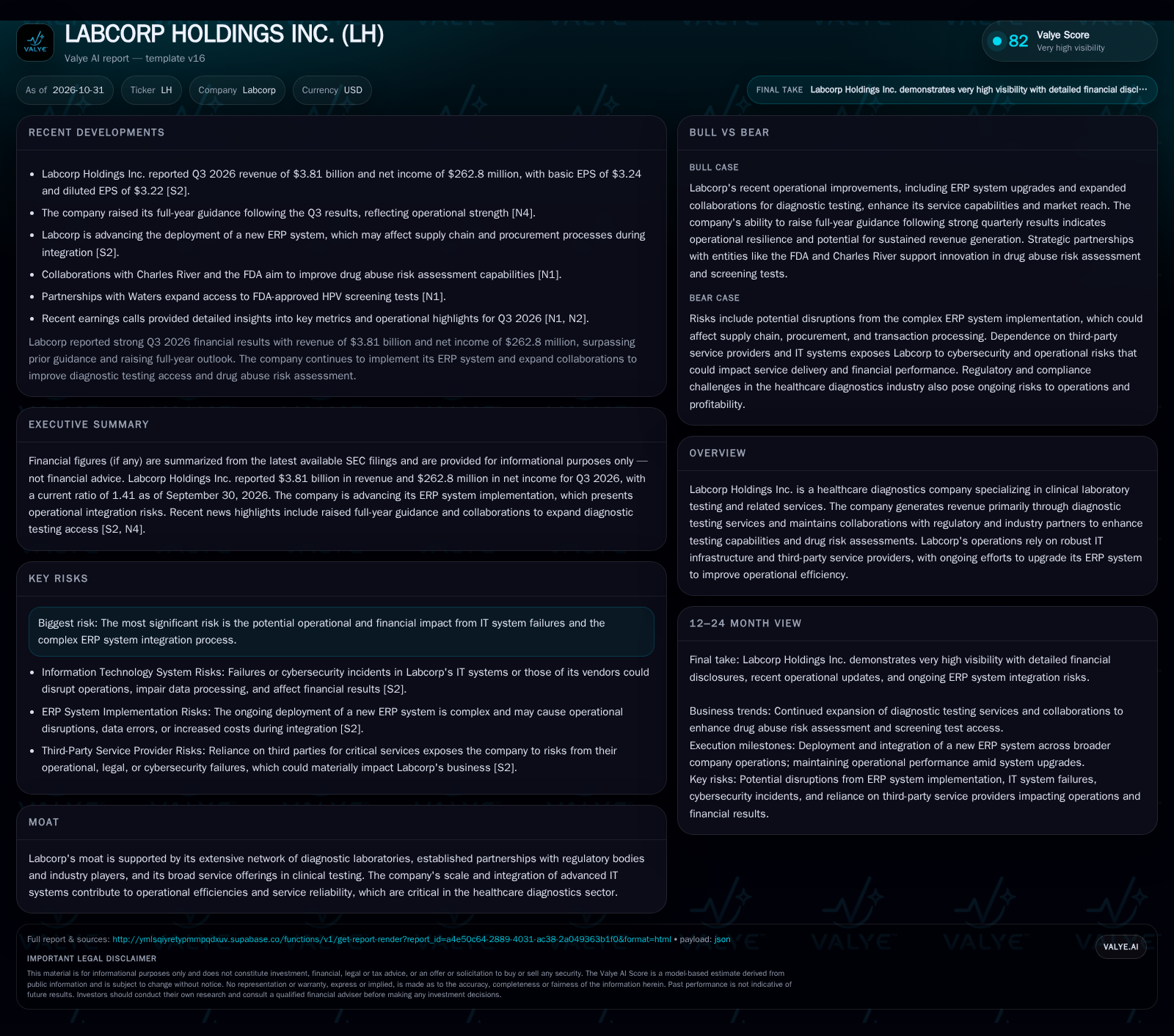
Labcorp reported Q3 2026 revenue of $3.81 billion and net income of $262.8 million, raising its full-year guidance in the wake of solid performance. However, the company faces operational risks from a complex ERP system rollout and ongoing IT/cybersecurity exposures. The next phase will test whether Labcorp can convert its scale and technology investments into lasting margin and service advantages amid industry and regulatory headwinds. [S2] [N4]
Labcorp Holdings enters the end of 2026 with operational momentum, as evidenced by a solid third quarter and a raised full-year outlook. Yet, beneath these headline results, the company is navigating one of its most complex transitions to date: the implementation of a new enterprise resource planning (ERP) system. While Labcorp’s scale and IT backbone have long been sources of strength, the company’s near-term trajectory hinges on its ability to manage integration risks, maintain service reliability, and defend margins in an increasingly competitive diagnostics market.
Q3 Financials and ERP Integration Set the Stage for Labcorp’s Next Transition
Labcorp reported Q3 2026 revenue of $3.81 billion and net income of $262.8 million, with EPS of $3.24 (basic) and $3.22 (diluted) [S2]. Following these results, management raised full-year guidance, reflecting confidence in operational execution and demand stability [N4]. As of September 30, 2026, Labcorp’s current ratio was 1.41, with $261.8 million in cash and cash equivalents [S2].
The company is currently implementing a new ERP system, a major undertaking that may disrupt supply chain and procurement operations during integration [S2]. This project, while aimed at long-term efficiency, introduces near-term execution risk and could impact transaction processing and operational continuity if not managed successfully.
How Labcorp’s Scale and Technology Investments Drive Economics—And Where Frictions Lurk
Labcorp’s core business model revolves around high-volume clinical laboratory testing, leveraging substantial fixed infrastructure and IT systems to drive scale economies. Revenue is primarily generated on a per-test basis, with pricing power generally limited by payer contracts, government reimbursement schedules, and competitive pressures from both national and regional peers.
Operating leverage is significant: incremental test volumes can improve margins if fixed costs (equipment, facilities, IT) are well utilized, but technology upgrades and regulatory compliance drive ongoing capital and operational expenditures. The current ERP upgrade, while potentially unlocking future cost efficiencies, represents a near-term cost and operational distraction and may temporarily increase variable costs if disruptions occur.
Labcorp’s reliance on IT—both for processing and for secure data management—means that system reliability is not just a cost item but a central determinant of revenue continuity and customer trust. Unexpected IT outages or cybersecurity incidents could trigger reputational damage, lost contracts, or costly remediation, eroding both margin and competitive position.
Diagnostics Scale, IT Dependence, and the Dynamics of Industry Rivalry
Labcorp’s scale enables it to negotiate favorable terms with suppliers, invest in automation, and offer broad test menus that smaller labs cannot easily match. In theory, this should yield cost and service advantages. However, the diagnostics industry is marked by intense competition from other large national providers, regional labs, and increasingly, technology-driven entrants seeking to disrupt traditional models with point-of-care devices or direct-to-consumer testing.
Switching costs for institutional customers (such as hospitals and health systems) may be moderate, depending on contract structure and integration of IT systems. For smaller physician practices or consumers, loyalty may be driven more by convenience and pricing than by technical differentiation. The risk is that if Labcorp’s ERP or IT systems experience disruptions, switching frictions could diminish, eroding customer stickiness.
Further, as diagnostics moves toward greater digitalization and interoperability, Labcorp’s ability to integrate new technologies and maintain secure, compliant data flows will increasingly shape its competitive moat.
ERP Success and Digital Execution Unlock Margin Expansion and Market Share
If Labcorp executes a smooth ERP rollout—minimizing operational disruptions and accelerating integration across procurement, billing, and supply chain—the company could realize meaningful cost savings and process efficiencies. This would free resources for investment in new test development, customer acquisition, and digital services, potentially widening the gap with less technologically advanced competitors.
The upside scenario is further supported if the company leverages its IT backbone to introduce new digital offerings, such as advanced analytics, patient portals, and interoperability solutions for health systems. If Labcorp’s raised full-year guidance is confirmed by sustained volume growth and margin improvement in subsequent quarters, this would validate the thesis that technology investment is translating into durable financial and competitive gains.
Key evidence for this scenario would include sequential margin expansion, reduced SG&A as a percentage of revenue, and public customer wins or contract renewals citing Labcorp’s technology or service reliability.
Sustained Demand Meets Integration Friction: Navigating the ERP Transition Period
The most plausible scenario is that Labcorp maintains stable revenue and margin performance through the ERP transition, with occasional operational hiccups or modest cost overruns but no major service interruptions. While ERP integration may temporarily elevate expenses or slow efficiency gains, the company’s scale and contingency planning likely mitigate the risk of severe disruption.
Revenue growth may track general trends in healthcare utilization and diagnostic demand, with incremental wins from new collaborations or expanded test menus. Margin improvement could be muted until the ERP project is fully absorbed, at which point process automation and data integration may begin to yield cost benefits.
Confirmation of this scenario would come from continued quarter-over-quarter revenue growth, stable or slightly compressed operating margins, and management commentary citing both progress and remaining challenges in the ERP rollout.
ERP Disruption or IT Failure Triggers Operational and Reputational Headwinds
The primary risk is that the ERP implementation encounters substantial setbacks—such as extended downtime, data migration errors, or supply chain bottlenecks—that materially disrupt operations. Such events could delay billing cycles, cause order fulfillment errors, or undermine customer trust, resulting in lost business and increased remediation costs.
A significant cybersecurity incident or IT system failure, whether tied to the ERP project or a third-party provider, could magnify these risks, causing regulatory scrutiny and triggering contract terminations or lawsuits. In this scenario, Labcorp’s scale may amplify the impact, as even brief disruptions could affect large volumes of sensitive tests and customer data.
Evidence for this downside pathway would include unexpected revenue shortfalls, margin compression beyond ERP-related guidance, negative customer or regulator statements, or disclosures of material cybersecurity incidents.
Milestones That Will Shape Labcorp’s Margin, Reputation, and Market Standing
Quarterly updates on ERP system deployment progress, with particular attention to any reported operational disruptions or cost overruns.
Sequential changes in gross and operating margins—especially if management attributes these to ERP integration or IT investments.
Disclosure of any significant IT outages, cybersecurity breaches, or data privacy incidents affecting Labcorp or its third-party vendors.
Customer retention rates, contract renewals, or new large customer wins, if disclosed, indicating whether integration and IT reliability are translating into commercial advantage.
SG&A expense trends as a percentage of revenue, as a proxy for realized efficiency gains post-ERP implementation.
Volume growth in core diagnostic testing and any new service lines or digital offerings, which would signal successful expansion and market adaptation.
Management commentary on regulatory compliance, supply chain continuity, and risk mitigation measures during and after the ERP rollout.
Disclaimer: This is research-only, informational analysis and not investment advice. It may include AI-generated interpretation and general industry context. Always verify important details using primary sources.

Comments