
DoubleVerify in 2026: AI-Powered Ad Verification, Platform Expansion, and the Stakes of a Pending Nielsen Acquisition
DoubleVerify stands at the intersection of digital ad verification and optimization, leveraging proprietary AI to ensure quality and effectiveness across trillions of media transactions. With a scalable and profitable model, long-standing customer relationships, and a pending $2.15 billion acquisition by Nielsen, the company faces both new growth opportunities and heightened execution risks as the digital advertising ecosystem evolves.
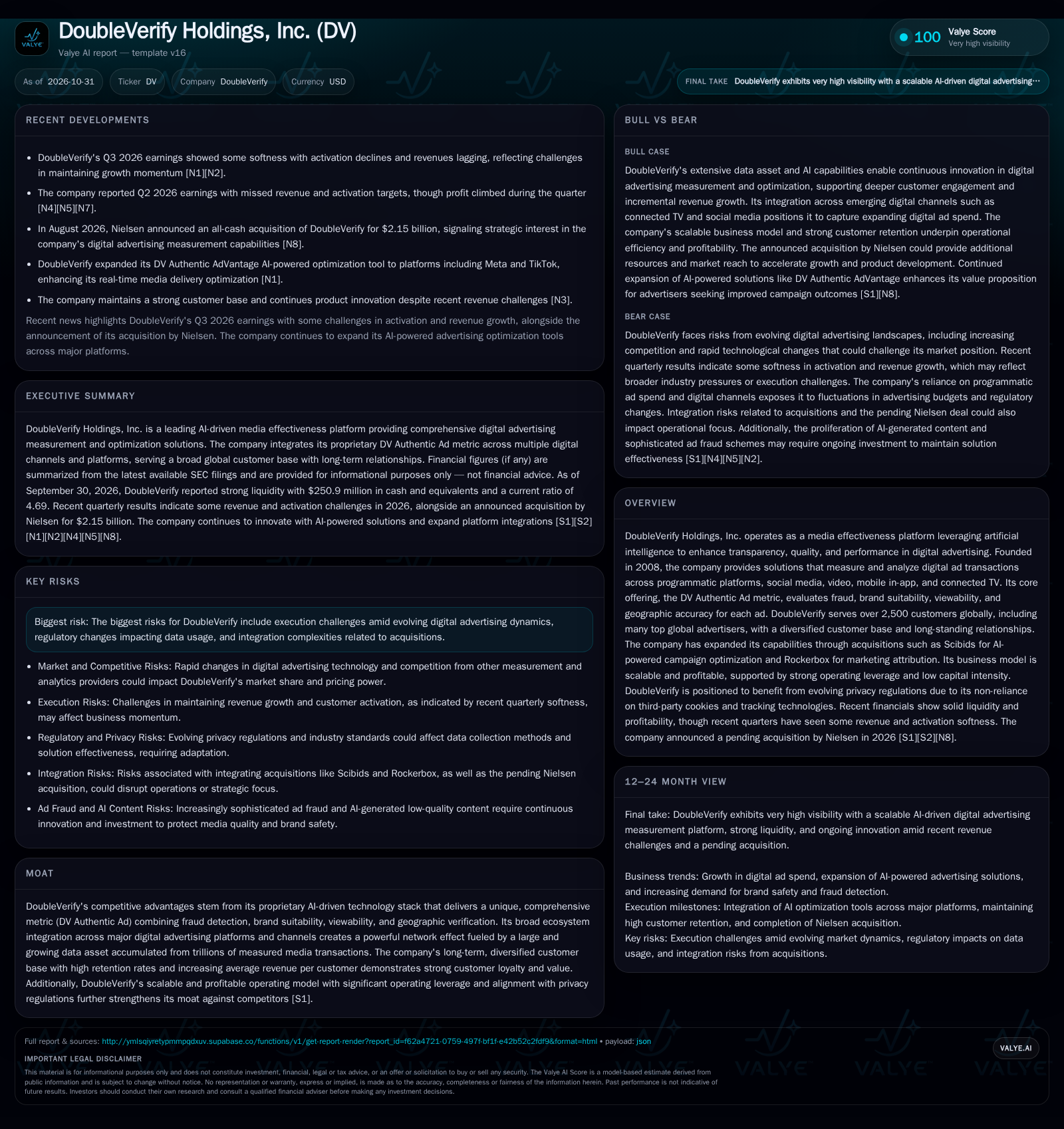
DoubleVerify is a leading AI-driven digital ad verification and optimization platform serving over 2,500 global customers, measuring nearly 9.5 trillion ad transactions annually.
DoubleVerify Holdings, Inc. occupies a central role in digital advertising, acting as both a watchdog and an optimizer for global brands seeking transparency, safety, and performance across an increasingly fragmented media landscape. By analyzing over 23 billion digital ad transactions daily and integrating with all major digital channels, DoubleVerify’s proprietary AI-driven tools help advertisers combat fraud, ensure brand suitability, and maximize campaign outcomes. As the company faces a pending $2.15 billion acquisition by Nielsen, its strong retention metrics, scalable economics, and ongoing innovation are counterbalanced by recent revenue softness and the challenges of integration in a rapidly shifting industry.
Recent Performance, Retention Strength, and the Imminent Nielsen Deal
DoubleVerify measured approximately 9.5 trillion media transactions in 2025, up from 8.3 trillion in 2024, underlining its entrenched position as a foundational analytics provider in digital advertising [S1]. Despite this scale, the most recent quarters saw revenue and activation softness, with Q3 2026 and Q2 2026 both missing topline expectations even as profitability remained solid [N1] [N2] [N4] [N5] [S2]. Gross revenue retention remained above 95%, and net revenue retention was 109% in 2025, signaling that while growth from new activations may be slowing, existing customer relationships continue to deliver reliable recurring revenue [S1]. The company reported cash and liquidity metrics for the period; these figures do not by themselves establish operating runway, investment capacity, financial flexibility, or financing capacity. [S2] Most notably, a $2.15 billion all-cash acquisition by Nielsen is pending, with the accompanying operational and strategic uncertainties that such a transaction entails [N8] [S2].
How DoubleVerify Monetizes Trust and Optimization in Digital Media
DoubleVerify’s revenue model is volume-driven: fees are collected based on the number of media transactions analyzed, with incremental revenue potential as digital ad spend and platform integrations increase [S1]. This model leverages significant operating leverage—core analytics products require high up-front investments in AI, data infrastructure, and integrations, but incremental costs for analyzing more transactions are low. As a result, the business enjoys high gross margins and profitability, especially as it scales.
The company’s capital intensity is relatively low, with few physical assets required and minimal working capital needs. Most expenditures are directed toward R&D, sales and marketing, and ongoing integration of new platforms and acquisitions. The addition of AI-powered optimization (DV Authentic AdVantage), campaign attribution (Rockerbox), and campaign optimization (Scibids) gives DoubleVerify more levers to grow wallet share with existing customers, potentially increasing average revenue per client if adoption of premium analytics and optimization tools deepens.
However, the volume-linked revenue model exposes DoubleVerify to cyclicality in digital ad spend. If programmatic volumes or overall campaign budgets falter, transaction volume and thus revenue can be pressured. Expansion into social, video, and CTV aims to diversify these exposures, but the underlying sensitivity to macro ad cycles and the pace of digital media growth remains.
Defensible Data Assets and Ecosystem Integration Versus Intensifying Analytics Competition
DoubleVerify’s moat rests on several interlocking advantages: proprietary AI-driven technology, the DV Authentic Ad metric (combining fraud, viewability, brand safety, and geography in one score), and a massive, continuously growing dataset from trillions of ad transactions [S1]. Integration with all major programmatic platforms, social networks, and digital publishers enables DoubleVerify to serve as a neutral arbiter of ad quality across the ecosystem.
These integrations, plus the company’s long-standing customer relationships (averaging nine years for top accounts), could increase switching friction: advertisers and platforms are reluctant to disrupt established measurement and optimization pipelines, especially if these are embedded in campaign management workflows. The company’s early and ongoing alignment with privacy regulations (non-reliance on third-party cookies or cross-site tracking) positions it well as privacy rules tighten.
However, the competitive field is crowded and evolving. Alternative ad verification and measurement providers, in-house analytics solutions by major platforms, and emerging AI-driven competitors all vie for share. The proliferation of AI-generated content and more sophisticated fraud schemes require continuous innovation—any perceived lag in detection or optimization could erode DoubleVerify’s relevance or pricing power. Additionally, the pending Nielsen acquisition could trigger customer or partner uncertainty, or embolden rivals to press their advantages during the transition.
If AI Innovation and Platform Expansion Offset Ad Cycle Volatility
A favorable outcome for DoubleVerify would see its recent investments in AI-powered optimization (DV Authentic AdVantage), attribution (Rockerbox), and campaign automation (Scibids) drive a new wave of upsell and cross-sell opportunities within its 2,500-strong customer base [S1] [N1]. If adoption of these advanced tools accelerates, DoubleVerify could capture a greater share of wallet, deepening integration with major digital platforms and emerging channels like CTV and social.
Success in this scenario would be visible in a return to robust top-line growth, measured by sequential improvement in revenue and activations, and a further increase in net revenue retention rates above the historical 109% [S1]. Margin expansion could follow as higher-value analytics and optimization products scale, leveraging DoubleVerify’s low variable cost structure. The Nielsen acquisition, if executed smoothly, could provide additional distribution reach, cross-platform data synergies, and validation of DoubleVerify’s strategic value.
Evidence supporting this scenario would include: renewed acceleration in transaction volumes measured, increased adoption rates for new AI-powered products, and positive commentary from major platform partners (Meta, TikTok, CTV providers) about expanded integrations. Conversely, if new product adoption stalls or integration issues with Nielsen surface, this upside would be less likely.
Sustained Platform Role, but Growth Moderates as Ad Market Normalizes
The most plausible outcome is that DoubleVerify maintains its entrenched role as a core verification and optimization platform for digital advertisers, but experiences more moderate growth as the digital ad market matures and macro headwinds persist. High retention rates and diversified exposure across industries and channels should continue to support stable recurring revenues, even if new customer growth or transaction volume expansion slows.
In this scenario, the company’s operating leverage and low capital intensity enable it to generate strong profitability and cash flow even with slower topline growth. The integration of new AI tools and attribution capabilities enhances the value proposition, but incremental gains may be more gradual as advertisers weigh adoption costs and internalize some analytics functions.
The pending Nielsen acquisition introduces uncertainty: successful integration could unlock synergies and broaden reach, but execution missteps or customer flight could offset gains. Evidence for this base case would be continued high gross and net retention, stable or modestly growing transaction volumes, and steady margins. Signs of prolonged revenue softness or major customer losses would challenge this outcome.
If Competitive Pressures and Integration Risks Trigger Revenue Erosion
The principal downside risk is a combination of intensifying competition, technological disruption, and post-acquisition execution challenges leading to revenue decline and margin compression. If rivals introduce superior AI-driven verification or optimization tools, or if major platforms expand proprietary analytics that render third-party solutions less essential, DoubleVerify could face pricing pressure and customer churn.
A turbulent integration with Nielsen could result in operational distraction, loss of talent, or customer uncertainty, especially if existing partners fear conflicts of interest or data siloing. Regulatory shifts or privacy rules that limit data flows—even for privacy-compliant models—could also dampen the effectiveness and perceived value of DoubleVerify’s solutions.
Confirmation of this scenario would include: sustained declines in revenue or transaction volumes, drops in retention rates, negative customer or partner commentary around the merger, or evidence of product obsolescence (e.g., lagging detection of new fraud vectors or low adoption of new optimization tools).
What Will Determine DoubleVerify’s Long-Term Value Post-Acquisition?
Trends in gross and net revenue retention, especially if disclosed by customer cohort or product line, to gauge depth of customer loyalty and upsell success.
Sequential growth (or decline) in media transactions measured and analyzed, as a proxy for share of digital ad spend and core business momentum.
Adoption rates and revenue contribution from new AI-powered solutions (DV Authentic AdVantage, Rockerbox, Scibids), if disclosed, to test cross-sell and innovation payback.
Feedback from major digital platforms (Meta, TikTok, CTV providers) regarding the depth and durability of DoubleVerify integrations and partnerships.
Progress and commentary on the Nielsen acquisition—regulatory approvals, customer retention during the transition, and any disclosed cost or revenue synergies.
Margin trends, particularly operating leverage realized from scaling new products and platform integrations, versus potential cost inflation or integration drag.
Incidence and detection rates of new digital ad fraud types, and DoubleVerify’s response speed and efficacy, to assess ongoing product relevance.
Any regulatory, legal, or data privacy developments that could alter the addressable market or operational model for ad verification.
Disclaimer: This is research-only, informational analysis and not investment advice. It may include AI-generated interpretation and general industry context. Always verify important details using primary sources.

Comments