
DoorDash in Late 2026: Profitability, Platform Leverage, and the Stakes of Expansion Beyond Delivery
DoorDash’s Q3 2026 net income and reported liquidity position mark a pivot point for the digital logistics leader, but the company’s future value hinges on integrating acquisitions, defending margin in a competitive market, and broadening its platform to new verticals. The interplay of operating leverage, regulatory risk, and evolving customer incentives will define whether DoorDash can retain its edge as food delivery matures.
The next phase will test its ability to generate sustainable profits while integrating new verticals and geographies.
DoorDash enters the close of 2026 with clear profitability and a substantial reported cash balance, the result of a business model that has scaled rapidly in the digital food delivery sector. However, as the company seeks to expand its platform through acquisitions like Deliveroo and SevenRooms, its future will depend on more than delivery volume. The real test will be whether DoorDash can sustain margins and leverage its network effects in a market facing intensifying competition, regulatory scrutiny, and shifting consumer behavior. The company’s next act may determine whether it consolidates its leadership or faces margin compression and strategic drift.
Recent Profitability, Liquidity, and Expansion Moves Define DoorDash’s Current Position
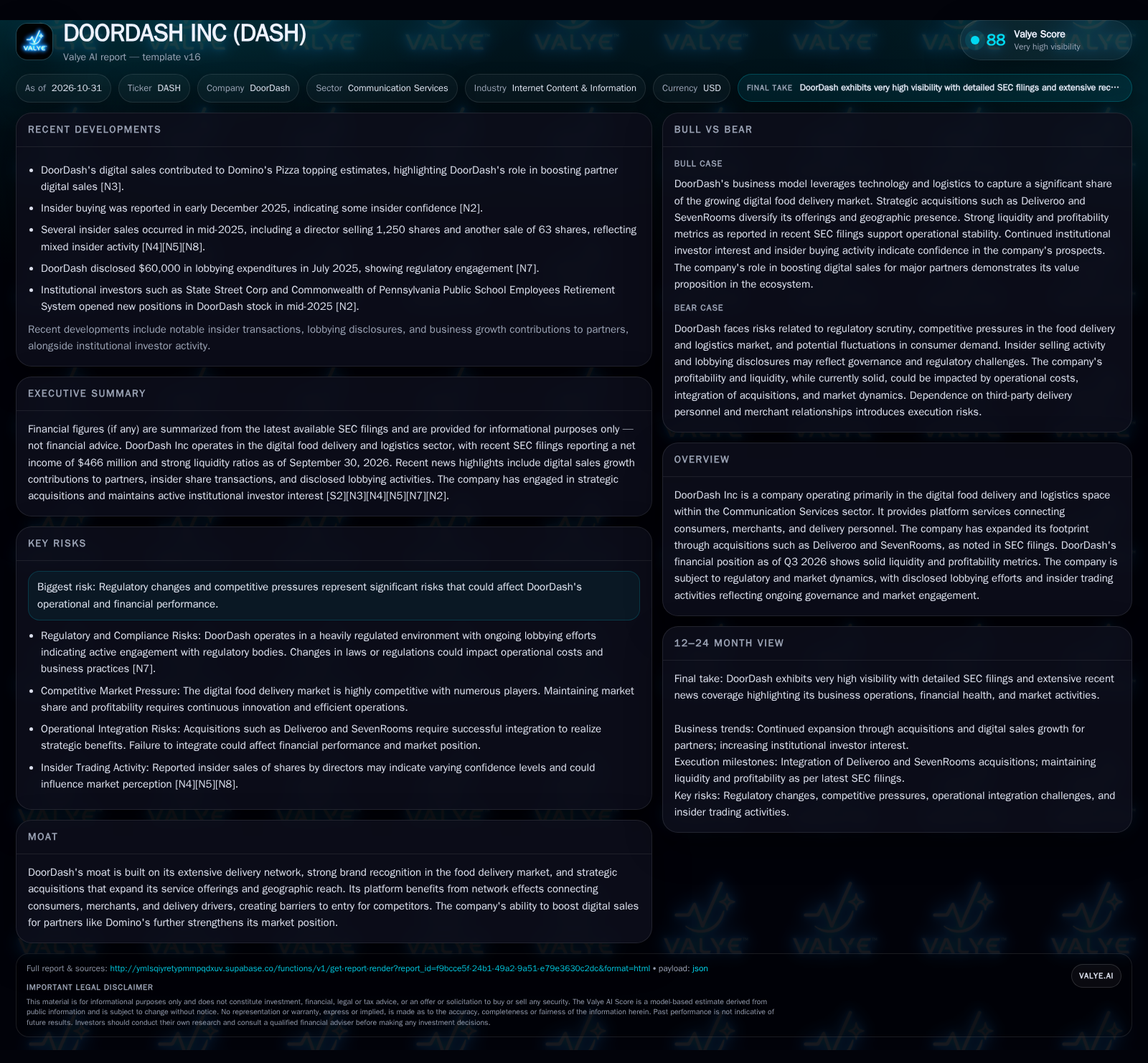
As of September 30, 2026, DoorDash reported $466 million in net income for the quarter, with basic earnings per share of $1.07. The company’s cash and cash equivalents stood at approximately $5.05 billion, and its current assets were $9.36 billion versus $6.39 billion in current liabilities, resulting in a current ratio of 1.46 and a cash ratio of 0.79 [S2]. These figures reflect a company not only operating profitably but also maintaining a substantial liquidity buffer.
Strategically, DoorDash’s recent acquisitions of Deliveroo and SevenRooms indicate a push to diversify its geographic reach and expand into adjacent verticals beyond core food delivery [S1]. Meanwhile, news of DoorDash helping Domino’s Pizza exceed digital sales estimates highlights the company’s ongoing influence as a platform partner [N3].
Insider and institutional activity in 2025 was mixed, with both buying and selling among directors and new institutional positions being opened [N2] [N4] [N5] [N8]. This suggests active engagement by both management and outside investors, but not a clear consensus on future direction.
Platform Economics: Variable Costs, Scale, and the Limits of Operating Leverage
DoorDash monetizes by charging commissions and fees to merchants, delivery partners, and consumers, with revenue directly linked to transaction volumes and order frequency. The model is asset-light in terms of physical infrastructure but carries significant variable costs: driver payments, incentives, customer support, and, increasingly, technology and integration costs as the platform broadens.
Operating leverage can be substantial as fixed costs (engineering, platform maintenance, brand) are spread over a larger order base, but incremental profitability depends on maintaining high order density and keeping customer acquisition and retention costs in check. Expansion into new markets or verticals, as with Deliveroo and SevenRooms, typically requires upfront investment and can temporarily dilute margin until those networks reach scale.
The company reported cash and liquidity metrics for the period; these figures do not by themselves establish operating runway, investment capacity, financial flexibility, or financing capacity. A key future question is whether DoorDash can extract higher-margin revenue streams—such as advertising, SaaS for restaurants, or premium delivery tiers—without eroding its core logistics economics.
Defending Share in a Fragmented and Evolving Delivery Ecosystem
DoorDash’s core advantage lies in its dense delivery network, large consumer base, and established merchant relationships, which create some network effects: more merchants attract more consumers, and vice versa. However, the food delivery industry remains highly competitive, with global and regional players vying for share, often through price competition, promotions, and differentiated service levels.
Strategic acquisitions like Deliveroo and SevenRooms are intended to extend DoorDash’s platform advantage into new geographies and to deepen relationships with merchants by offering more complete solutions. Yet, these moves also bring operational complexity and integration risk, and expose DoorDash to new regulatory regimes and local competitors.
Substitution risk remains high—consumers can still order directly from restaurants, use alternative delivery platforms, or revert to in-person dining. Merchant loyalty is also tenuous if platform fees rise or if alternative ordering channels offer better economics. The company’s ability to continually demonstrate incremental sales lift for partners, as with Domino’s, will be critical to defending its value proposition [N3].
Unlocking Multi-Vertical Platform Value and Margin Expansion
The most favorable scenario for DoorDash involves successful integration of Deliveroo and SevenRooms, allowing the company to offer a broader suite of services to merchants—ranging from delivery logistics to reservation management and digital marketing. If DoorDash can leverage its data and network to cross-sell these services, it could deepen merchant dependence and extract higher-margin, recurring revenue streams.
Further, the company’s ability to consistently drive digital sales growth for major partners, as evidenced by its impact on Domino’s results, would confirm the platform’s value and justify premium pricing or expanded partnerships [N3]. If DoorDash can contain customer acquisition costs and leverage technology to boost operational efficiency, this could result in sustained margin improvement and durable free cash flow.
Confirmation of this scenario would come from disclosure of growing contribution from non-core verticals (e.g., SaaS, advertising), improving order economics, and evidence of successful cross-market integration without margin dilution.
Sustaining Profits While Managing Platform Complexity and Market Competition
The most plausible outcome is that DoorDash maintains its leadership in North American food delivery while gradually integrating its acquisitions and expanding into new verticals.
Profitability may fluctuate as investments in new markets and verticals ramp, with periods of margin compression offset by efficiency gains and incremental revenue streams. The company’s ability to demonstrate incremental value to both consumers (through convenience, selection, and speed) and merchants (through sales lift and operational tools) will be the central test.
Evidence supporting this scenario would include stable to modestly improving operating margins, sustained order growth, and measured progress in integrating new business lines without significant write-downs or operational disruption.
Margin Compression and Integration Risks Undermine Expansion Ambitions
In an adverse scenario, DoorDash could face intensifying price competition, regulatory headwinds, or significant integration challenges with Deliveroo and SevenRooms. Rising labor costs, fee caps, or shifts in consumer demand could drive down margins, while failed or costly integrations could result in write-downs or distract management from core execution.
If merchants or consumers perceive declining value, churn could rise and order volumes stagnate, undermining the company’s scale advantage. Furthermore, if non-core ventures fail to deliver profitable growth, DoorDash could see its capital allocation discipline questioned and its valuation multiple contract.
Signs this scenario is unfolding would include persistent margin erosion, slowing or negative order growth, impairment charges related to acquisitions, or evidence of regulatory penalties and operational setbacks.
What Will Determine Whether DoorDash’s Platform Evolution Pays Off?
Progress on integrating Deliveroo and SevenRooms, including cost synergies, cross-selling rates, and retention of key merchant relationships, if disclosed.
Trends in take rate (revenues as a percent of gross order value) and order density—rising or stable figures would signal pricing power and network utilization.
Growth in non-core revenues, such as advertising, SaaS, or premium services, which would indicate successful platform diversification.
Changes in delivery partner incentives and fulfillment costs, as these directly impact variable margin.
Merchant and consumer churn or retention rates, if disclosed—especially in newly entered markets or verticals.
Regulatory developments affecting fee structures, labor classification, or data privacy in DoorDash’s major markets.
Disclosure of margin trends and free cash flow generation as the company invests in new businesses and geographies.
Evidence of sustained digital sales lift for major partners, as this would reinforce the platform’s value proposition.
Disclaimer: This is research-only, informational analysis and not investment advice. It may include AI-generated interpretation and general industry context. Always verify important details using primary sources.

Comments