
OneMain Holdings in 2026: Managing Credit Pressure and Execution Complexity in Nonprime Lending
OneMain Holdings faces a pivotal period as its Q3 2026 earnings miss highlights the inherent volatility of nonprime consumer lending. With $24.8 billion in receivables and a dual branch-digital footprint, the company’s scale, risk controls, and product breadth are tested by mounting credit risk, evolving regulatory demands, and intensifying competition from both legacy and digital lenders.
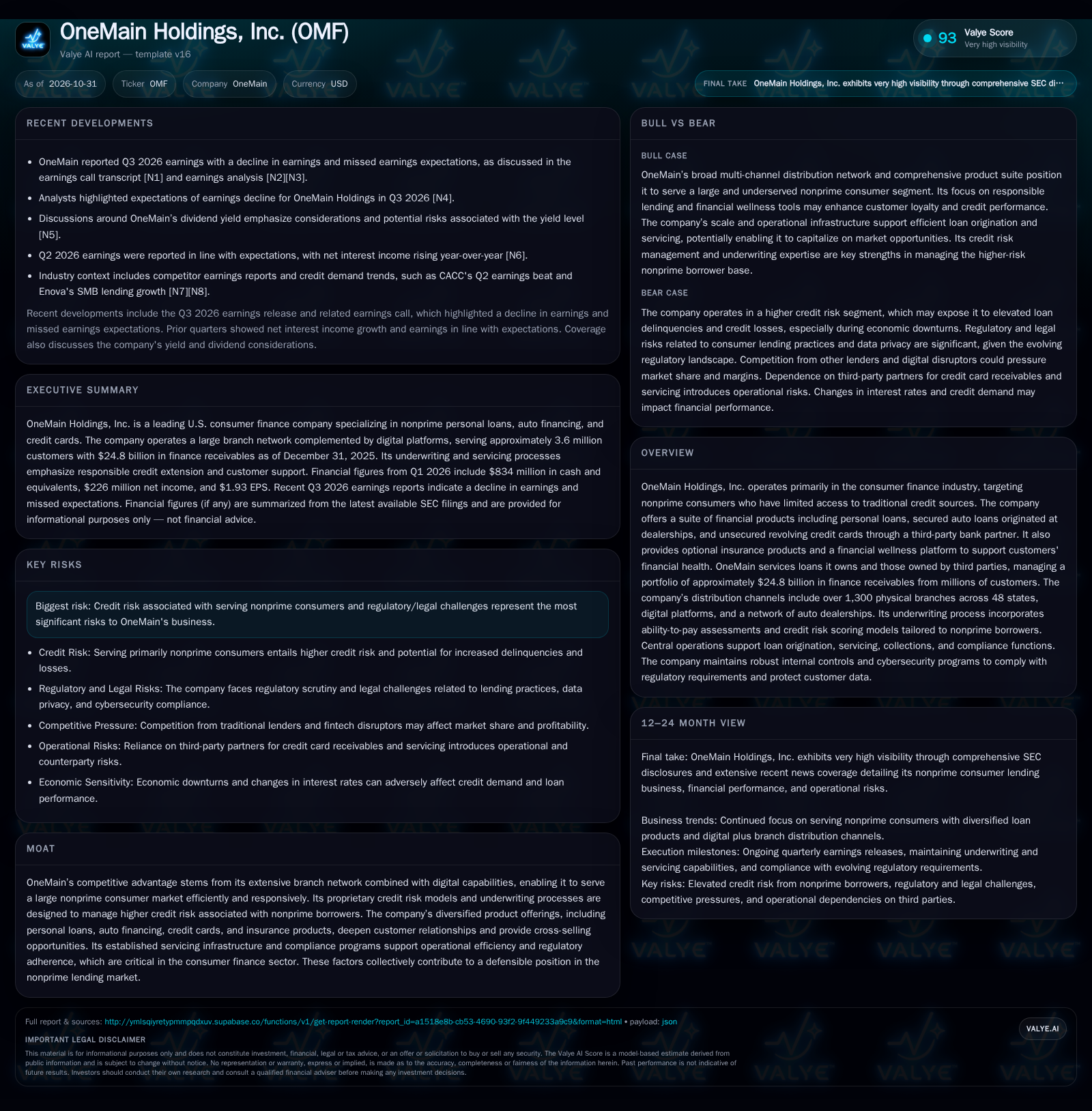
OneMain Holdings, Inc. is a major player in U.S. nonprime consumer lending, operating with $24.8 billion in finance receivables and a nationwide branch network. Its Q3 2026 earnings decline and miss against expectations reflect the sector’s credit risk sensitivity. The company's ability to manage credit losses, leverage its underwriting and servicing scale, and adapt to competitive and regulatory headwinds will determine whether it can sustain growth and profitability in a changing market landscape. [S1] [S2] [N1] [N2] [N3]
OneMain Holdings stands at the intersection of scale and credit risk in the U.S. consumer finance market. With a $24.8 billion portfolio focused on nonprime borrowers, its broad product suite and hybrid branch-digital model position it as a market leader—but also expose it to the full cyclicality and regulatory scrutiny of the sector. The Q3 2026 earnings miss underscores the fragility of margins in a higher-risk credit environment, making execution on underwriting, collections, and customer engagement more critical than ever. Whether OneMain can leverage its infrastructure and risk expertise to create durable shareholder value will depend on its ability to balance growth ambitions with prudent risk management and regulatory adaptation. [S1] [S2] [N1] [N2] [N3]
Earnings Miss and Portfolio Scale Shape Strategic Options
OneMain Holdings reported a decline in Q3 2026 earnings, missing analyst expectations and raising concerns about credit cost trends or top-line momentum. This setback follows a Q2 2026 that met expectations, suggesting recent deterioration rather than a longer trend. As of year-end 2025, OneMain managed $24.8 billion in finance receivables across roughly 3.6 million accounts, supported by $834 million in cash and equivalents at the end of Q1 2026. The company’s extensive branch network (over 1,300 locations in 48 states) and digital servicing channels remain core to its customer acquisition and retention strategy, especially among nonprime borrowers underserved by traditional banks. [S1] [S2] [N1] [N2] [N3] [N6]
These facts matter because they crystallize the tension between scale and risk: while OneMain’s reach and infrastructure allow it to serve a vast addressable market, the Q3 earnings disappointment highlights the volatility inherent to nonprime lending and the need for relentless discipline in credit risk management.
Revenue Drivers and Margin Risks in OneMain’s Lending Model
OneMain’s core economics hinge on originating and servicing nonprime consumer loans—primarily fixed-rate, fixed-term personal loans (secured or unsecured), point-of-purchase auto loans, and revolving credit cards offered via a third-party bank. Revenue is generated through net interest income (the spread between loan yields and funding costs), fees (e.g., late fees, insurance premiums), and ancillary products such as credit insurance. The company reported cash and liquidity metrics for the period; these figures do not by themselves establish operating runway, investment capacity, financial flexibility, or financing capacity.
Cost structure is dominated by credit losses, funding costs, servicing expenses, and regulatory/compliance overhead. Credit losses are structurally higher in the nonprime segment, requiring robust underwriting (including ability-to-pay assessments and proprietary risk scoring) and intensive collections. The branch network adds fixed costs but can support higher loan volumes and cross-selling if utilized efficiently. Digital origination and servicing can improve marginal economics but also demand ongoing technology investment.
Operating leverage is potentially significant if loan growth and credit performance are strong, as incremental loans can be serviced on existing infrastructure. However, if credit deteriorates or loan demand softens, fixed costs and credit loss provisions can quickly erode margins. Capital needs are substantial due to regulatory capital requirements, loan growth funding, and loss absorption capacity.
Branch Network and Credit Expertise: Competitive Strengths and Potential Limits
OneMain’s hybrid branch-digital infrastructure and deep experience in nonprime underwriting offer real competitive advantages against both traditional banks (who often avoid nonprime risk) and digital-first fintech lenders (who may lack servicing scale or robust collections). The branch network enables high-touch customer engagement, cross-selling, and local collection efforts—important for nonprime borrowers who may require more support.
However, these same features can become liabilities if digital adoption accelerates and fixed branch costs outpace revenue growth. Digital-native competitors may offer faster approval, lower overhead, or more flexible products, potentially eroding OneMain’s market share among tech-savvy nonprime borrowers. Additionally, large banks and credit unions may move down-market with tailored products, leveraging lower funding costs and broader customer bases.
OneMain’s proprietary credit models and compliance infrastructure are difficult for new entrants to replicate, but regulatory and technology arms races can quickly narrow the gap. The company’s product suite—including optional insurance and financial wellness tools—supports customer retention and lifetime value, but only if these offerings remain relevant and competitively priced.
Operating Leverage and Cross-Sell Opportunities Under Strong Credit Discipline
A favorable outcome for OneMain would see credit quality stabilizing or improving, perhaps due to effective underwriting, resilient employment among its borrower base, or macroeconomic tailwinds. In this scenario, the company leverages its branch network and digital channels to drive loan growth, deepen cross-sell of insurance and card products, and improve per-customer economics. Fixed costs are spread over a larger portfolio, boosting operating leverage and margins. Regulatory compliance and technology investments sustain trust and reduce headline risk.
Evidence that would confirm this scenario includes a reversal or stabilization in delinquency and charge-off rates, renewed loan growth without yield compression, and sequential improvement in quarterly earnings. Growth in fee income from ancillary products and increased digital engagement would further support the thesis.
Growth Challenges from Margin Squeeze and Rising Credit Losses
The most plausible trajectory is one where OneMain continues to grow its loan book, but faces persistent margin pressure from elevated credit losses, higher funding costs, and intensifying competition. Loan demand among nonprime borrowers remains robust, but underwriting standards must tighten, limiting growth or raising acquisition costs. Digital competitors nibble at the edges, forcing ongoing investment in technology and marketing.
Earnings remain positive but volatile, with quarterly results swinging based on credit performance and macroeconomic conditions. The branch network remains a mixed blessing—supporting collections but pressuring costs. Regulatory compliance absorbs management bandwidth and capital. Evidence for this scenario includes continued earnings volatility, modest loan growth, and stable-to-rising credit loss provisions.
Risks from Credit Decline or Regulatory Changes Could Undermine Performance
A negative scenario would be triggered by a sharp deterioration in credit performance—perhaps due to a recession, unemployment spike, or a sudden shift in borrower behavior. Rising delinquencies and charge-offs force OneMain to increase loan loss provisions, eroding profitability and potentially constraining capital available for new loans. If branch utilization falls or digital competitors accelerate share gains, fixed costs become harder to cover.
Regulatory action or litigation—whether related to lending practices, data privacy, or partner dependencies—could further disrupt operations or require expensive remediation. Evidence confirming this scenario would include a rapid rise in delinquency and net charge-off rates, a spike in provisions, negative earnings, branch closures, or significant regulatory disclosures.
Factors Influencing OneMain’s Stability in Nonprime Lending
Quarterly delinquency and net charge-off rates: If disclosed, these metrics are the earliest warning signals for credit deterioration.
Loan growth and yield trends by product line: A useful metric would be origination volumes and average APRs for personal loans, auto loans, and credit cards.
Branch network utilization and cost efficiency: Data on loan volume or revenue per branch would help test the scalability and relevance of the physical footprint.
Digital channel penetration and customer engagement: Growth in digital originations or servicing activity would reveal competitive positioning relative to fintech entrants.
Fee and ancillary product income: Tracking the revenue contribution from insurance and wellness products would clarify cross-sell effectiveness.
Regulatory actions, legal proceedings, or compliance disclosures: Any new investigations or settlements could impact capital, operations, or reputation.
Funding cost trends and capital ratios: Rising funding costs or declining capital adequacy would constrain growth and resilience.
Third-party partner performance (especially for credit cards): Operational issues or changes in partner relationships could disrupt product offerings or servicing.
Disclaimer: This is research-only, informational analysis and not investment advice. It may include AI-generated interpretation and general industry context. Always verify important details using primary sources.

Comments