
STRATTEC Security: Margin Initiatives, Digital Key Ambitions, and the Realities of Automotive Supply
STRATTEC SECURITY CORP is pursuing margin improvement and digital product expansion in a shifting automotive landscape.
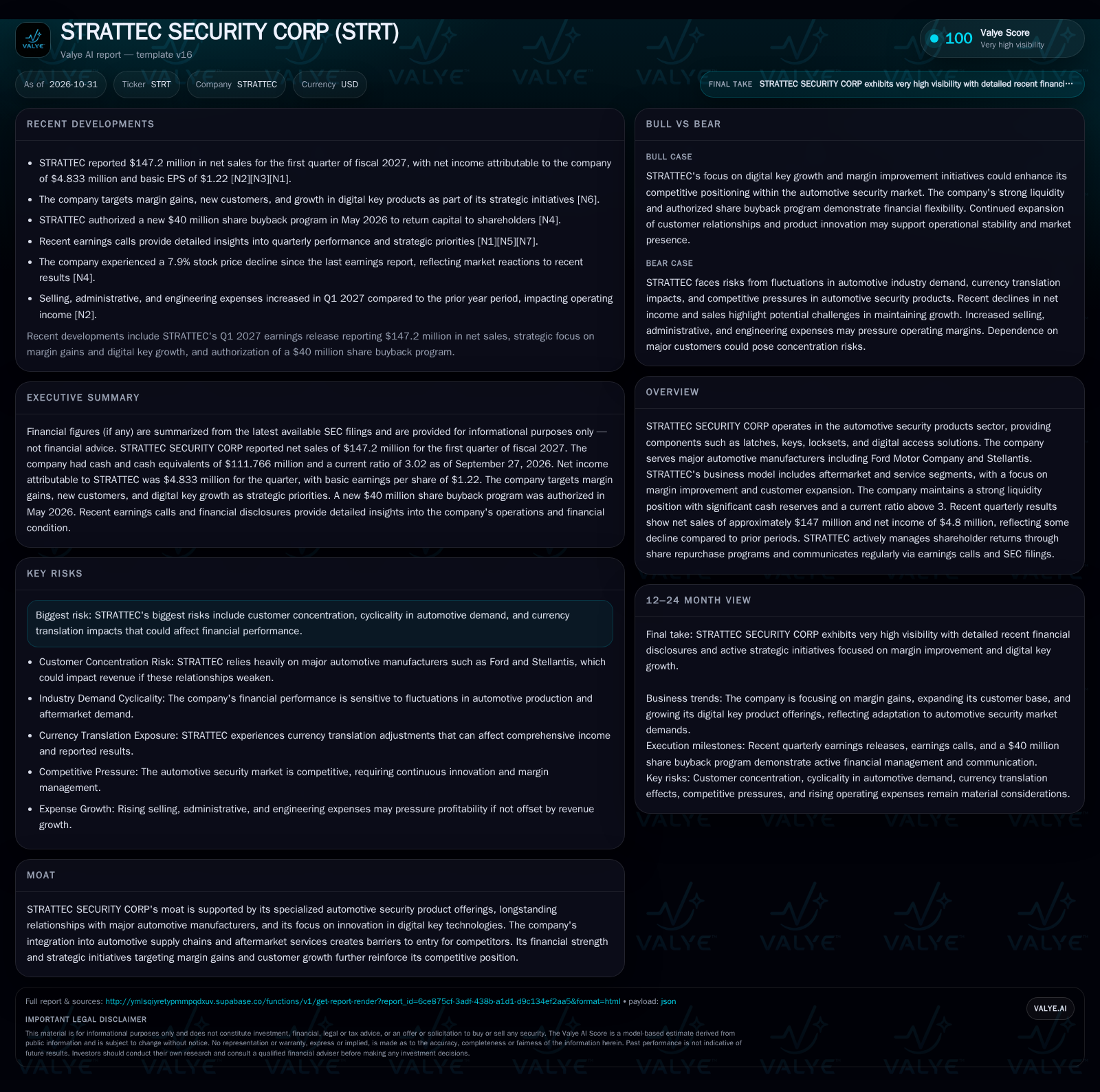
STRATTEC SECURITY CORP reported Q1 2027 net sales of $147.2 million, a modest year-over-year decline, and continues to prioritize margin gains, new customer acquisition, and digital key growth. Strategic execution on digital and aftermarket opportunities could reshape the risk/reward profile as OEM and industry headwinds persist. [S2] [N2] [N6]
STRATTEC SECURITY CORP finds itself at a crossroads typical of legacy suppliers in the automotive sector: the need to deliver on margin improvement and digital transformation while managing the volatility of OEM demand and rising costs. With Q1 2027 net sales registering a slight year-over-year decline and expenses climbing, the company’s resilience will be tested by both industry cyclicality and its exposure to large customers like Ford and Stellantis. Yet, STRATTEC’s reported liquidity position and focus on digital access solutions offer levers for adaptation—if execution aligns with evolving market realities. [S2] [N2] [N6]
Recent Performance: Declining Sales, Rising Costs, and Strategic Shifts
STRATTEC reported Q1 2027 net sales of $147.2 million, down from $152.4 million in the prior year, indicating a softening in automotive sector demand or potential customer volume shifts. At the same time, selling, administrative, and engineering expenses increased to $17.9 million, putting pressure on operating income. The company reported cash and liquidity metrics for the period; these figures do not by themselves establish operating runway, investment capacity, financial flexibility, or financing capacity. STRATTEC continues to target margin gains, new customer acquisition, and growth in digital key products as strategic priorities—moves that could be critical in offsetting both cost inflation and demand cyclicality. [S2] [N2] [N6]
How STRATTEC Earns: Fixed Costs, Mix Shifts, and Margin Management
STRATTEC’s revenue is primarily derived from supplying security components—latches, keys, locksets, and digital access solutions—to major automotive OEMs and the aftermarket. Pricing is typically negotiated in advance for each vehicle program, which can lock in margins but leaves little room to maneuver if costs rise mid-program. The company’s cost structure combines significant fixed costs (engineering, plant operations, and R&D) with variable costs tied to production volume. Rising selling, administrative, and engineering expenses, as seen in Q1 2027, can erode operating leverage if not matched by higher sales or improved product mix.
A major opportunity lies in the digital key and electronic access segment, which typically commands higher margins than traditional mechanical products. If STRATTEC succeeds in expanding its digital offerings and increasing aftermarket penetration, it could achieve a more favorable volume/mix dynamic, supporting both revenue growth and gross margin expansion. However, execution risk is high given the need for continuous investment in technology and customer integration.
The interplay between fixed and variable costs within STRATTEC's operational framework means that volume fluctuations have a disproportionate impact on profitability. In periods of declining production volumes, fixed costs such as plant overhead and R&D investments become more burdensome on a per-unit basis, compressing margins unless offset by pricing adjustments or cost reductions. Conversely, during volume expansions, the company can leverage operating leverage to improve profitability, provided that supply chain constraints and input costs remain manageable. This dynamic underscores the importance of volume visibility and flexible cost management in the company's financial planning and risk mitigation strategies.
Moreover, the negotiated pricing model tied to vehicle programs introduces a lag between cost inflation and price realization, creating potential margin squeeze during periods of rising raw material or labor costs. This rigidity necessitates proactive cost control measures and continuous efficiency improvements. Additionally, the shift toward digital key products may alter the cost structure, as these solutions often require higher upfront R&D and software development expenses but can benefit from scalable production and potentially recurring revenue streams if integrated with software services or updates. Understanding and managing this evolving cost profile will be critical for sustaining margin improvements.
OEM Integration, Aftermarket Reach, and the Challenge of Substitution
STRATTEC’s competitive position is anchored by its deep integration with major automotive OEMs, including Ford and Stellantis. These relationships create switching frictions due to the highly engineered nature of security components and the cost and complexity of qualifying alternative suppliers. However, customer concentration is a double-edged sword: loss of a major program or OEM could materially affect revenue. The competitive landscape includes both traditional mechanical security suppliers and newer entrants focused on digital and electronic access, as well as potential in-sourcing by automakers.
Digital key and electronic access products represent both a competitive threat and an opportunity. The pace at which OEMs adopt new access technologies—and whether STRATTEC can keep up with or outpace competitors—will shape its future relevance. In the aftermarket, brand reputation and channel relationships are important, but price sensitivity and product commoditization can limit pricing power.
If Digital Key Adoption Accelerates and Margin Initiatives Deliver
A favorable scenario for STRATTEC would involve rapid adoption of digital and electronic access solutions by automotive OEMs and end customers, leading to higher-margin product sales and reduced reliance on legacy mechanical components. If the company successfully leverages its existing OEM relationships to win new digital key programs, and simultaneously expands its aftermarket footprint, revenue growth could re-accelerate even in a stagnant automotive market.
Confirmation of this scenario would come from rising digital segment revenue, improving gross margins, new program wins with multiple OEMs, and evidence of share gains in the aftermarket. Falsification would be signaled by continued sales stagnation, margin compression, or loss of key digital contracts to competitors.
Incremental Progress as Industry Cycles and Cost Pressures Persist
The most plausible path is that STRATTEC continues to experience modest revenue fluctuations tied to overall automotive production trends, with incremental gains from digital and aftermarket products partially offsetting declines in traditional segments. Margin improvement initiatives may help stabilize profitability, but ongoing cost inflation and the need for sustained engineering investment will keep operating leverage muted.
Evidence supporting this scenario would include stable or slightly improving gross margins, a gradual shift in revenue mix toward digital products, and limited but steady customer diversification. Signs of deviation would be either a sharp deterioration in OEM demand or a sudden spike in operating expenses outpacing revenue gains.
Customer Loss, Demand Shocks, or Margin Erosion Could Derail Stability
The bear case centers on STRATTEC losing a major OEM customer or program, experiencing a significant downturn in automotive production, or failing to control rising selling, administrative, and engineering expenses. In this scenario, the company’s fixed cost base would amplify the impact of revenue declines, quickly eroding profitability and potentially leading to cash burn despite the currently reported liquidity position.
This scenario would be confirmed by sharp sequential drops in sales, a widening gap between operating expenses and gross profit, or public disclosure of lost contracts with key OEMs. A lack of progress in digital product penetration or aftermarket expansion would further validate downside risks.
Milestones and Metrics Shaping STRATTEC’s Margin and Digital Transition
Quarterly disclosure of digital key and electronic access product revenue, if provided, would clarify the pace and scale of the company’s strategic pivot.
Gross margin trends over the next several quarters will reveal whether margin initiatives are offsetting cost inflation and sales mix headwinds.
Customer concentration metrics—such as percentage of revenue from Ford, Stellantis, and other major OEMs—would help assess diversification progress and risk.
Aftermarket and service segment sales growth, if disclosed, would indicate the effectiveness of channel expansion efforts.
Trends in selling, administrative, and engineering expenses as a percentage of revenue should be tracked for signs of operating leverage or cost control slippage.
Announcements of new program wins, especially in digital access solutions, would serve as leading indicators of future revenue and margin upside.
Updates on currency translation impact, particularly in the context of comprehensive income swings, would help gauge external risk exposure.
Any changes to the company’s capital allocation policy—such as increased R&D or M&A activity—could signal strategic shifts with material impact.
Disclaimer: This is research-only, informational analysis and not investment advice. It may include AI-generated interpretation and general industry context. Always verify important details using primary sources.

Comments