
Employers Holdings in 2026: Underwriting Discipline, Technology Leverage, and the Cycles of Workers’ Compensation
Employers Holdings, Inc. remains a focused underwriter in the workers’ compensation space, emphasizing disciplined risk selection, ongoing technology investment, and selective expansion into adjacent industries. As it navigates market cycles and competitive pressures, the company’s ability to sustain underwriting margins and capitalize on operational efficiencies will be tested by inflation, regulatory complexity, and evolving customer needs.
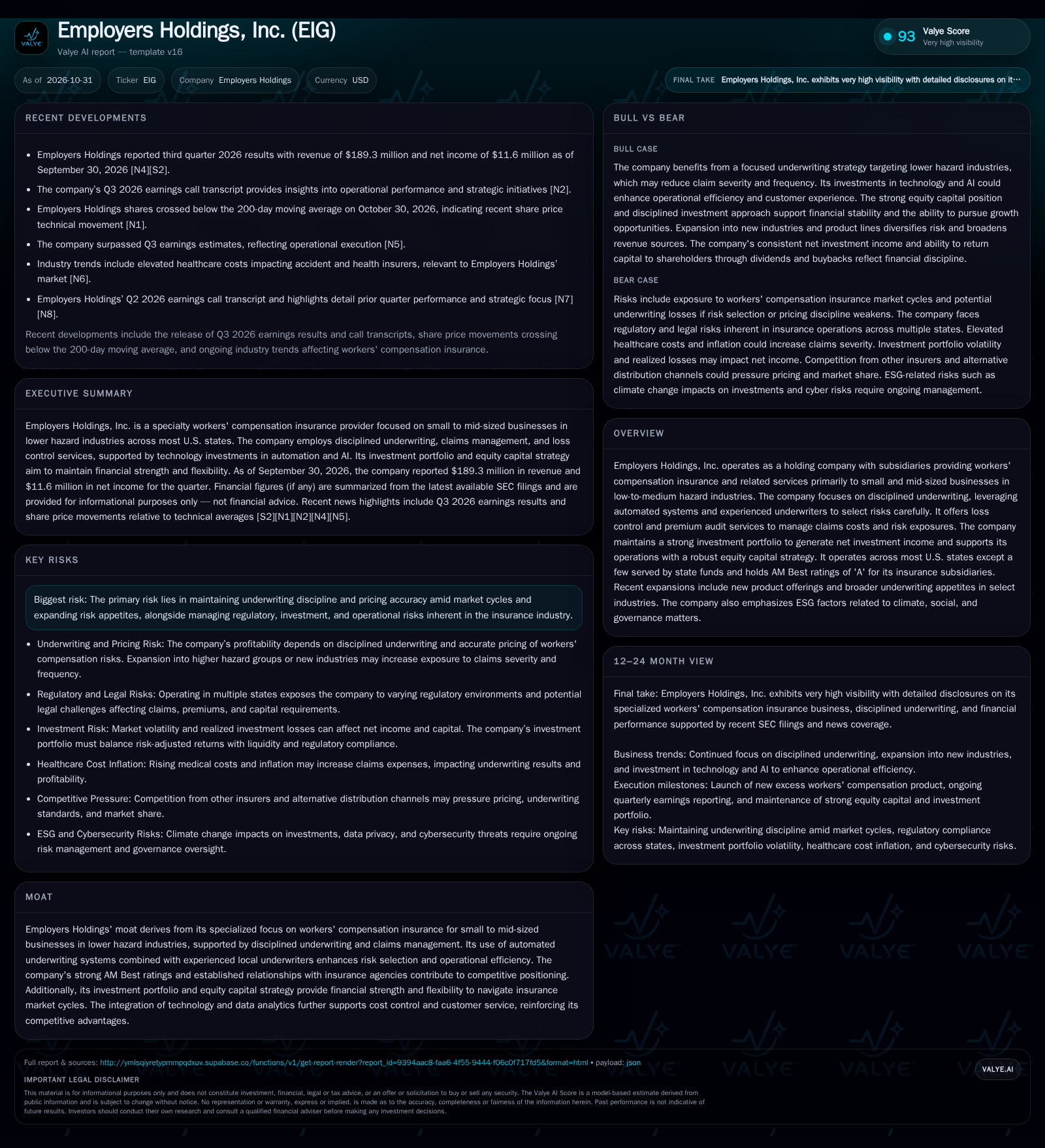
Employers Holdings, Inc. reported Q3 2026 revenue of $189.3 million and net income of $11.6 million, continuing its strategy of disciplined underwriting in low-to-medium hazard industries and expanding selectively into new verticals. Technology investments in automation and AI aim to drive cost efficiency and underwriting accuracy. The company’s strong AM Best ratings and robust investment portfolio underpin its financial strength, but exposure to insurance cycles, healthcare cost inflation, and regulatory risk remain material challenges. Sustained growth depends on maintaining underwriting discipline while adapting to market shifts and leveraging technology for operational advantage. [S1] [S2] [N2] [N4] [N5]
Employers Holdings, Inc. stands as a specialized player in the U.S. workers’ compensation insurance market, targeting small and mid-sized businesses in lower hazard sectors. The company’s Q3 2026 results show steady revenue and profit, signaling resilience in a cyclical and competitive landscape. With a strategy anchored in disciplined underwriting, recent industry expansion, and ongoing investment in automation and analytics, Employers Holdings is betting on technology to drive efficiency and risk selection—yet faces persistent challenges from inflation, regulatory shifts, and competitors seeking to commoditize insurance products.
Recent Financials and Strategic Moves Shape the 2026 Outlook
Employers Holdings reported $189.3 million in revenue and $11.6 million in net income for Q3 2026, reflecting ongoing profitability in a market marked by cyclical pricing and claims trends [S2] [N4] [N5]. The company’s disciplined approach to underwriting remains evident, with a 2% increase in policies in-force at year-end 2025 (133,605 policies) and continued focus on low-to-medium hazard sectors—even as it expands cautiously into new lines such as landscaping, janitorial, and home healthcare [S1]. AM Best 'A' ratings for all subsidiaries reinforce the company's financial strength, while investments in automation and predictive analytics are positioned to enhance efficiency and risk selection. The crossing of the 200-day moving average by company shares in late October 2026 highlights recent market volatility but does not materially alter the operating thesis [N1].
How Underwriting, Claims, and Investments Drive Value Creation
Employers Holdings’ economics hinge on disciplined underwriting, effective claims management, and prudent investment of premium float. Premium revenue is primarily a function of policy volume, average premium per policy, and the company’s ability to select and price risk accurately. The focus on lower hazard industries historically supports lower loss ratios, but as Employers expands into more diverse verticals, average claims severity and frequency could rise if risk selection is not carefully managed.
On the expense side, fixed costs include underwriting, technology infrastructure, and regulatory compliance, while variable costs are largely driven by claims and commissions. Investments in automation, data analytics, and AI may lower per-policy operating costs and improve underwriting accuracy, potentially driving operating leverage if policy volume grows. Net investment income—reported at $116.7 million in 2025—remains a critical earnings contributor, especially during soft insurance pricing cycles [S1].
Capital needs are dictated by regulatory requirements and the need to support policy liabilities, with a $3.4 billion asset base at year-end 2025 providing a cushion against shocks [S1]. The company’s equity capital strategy emphasizes maintaining robust capital ratios and returning excess to shareholders via dividends and buybacks, though these actions are only sustainable if underwriting and investment performance hold up.
Specialization and Technology: Defenses Against Commoditization
Employers Holdings’ competitive position is anchored in specialization—serving small and mid-sized businesses in low-to-medium hazard industries with a disciplined, technology-augmented underwriting process. This niche focus enables tailored risk assessment and customer service, reducing direct exposure to the high-severity end of the workers’ compensation market. However, national and regional insurers, as well as digital-first and alternative distribution platforms, continue to target these segments with aggressive pricing and streamlined digital onboarding.
The company’s use of automated underwriting systems, predictive analytics, and outcomes-based medical networks may provide a cost and accuracy edge, but these advantages are at risk of erosion as technology adoption becomes industry standard. Its AM Best 'A' ratings and agency relationships remain important trust signals in a regulated market, but switching costs for small business customers are modest unless value-added services or superior claims handling can be demonstrated.
Potential substitutes include bundled commercial insurance offerings and emerging insurtech platforms that promise lower friction and dynamic pricing. Employers’ ability to retain and grow policyholders will likely depend on sustaining underwriting discipline, demonstrating claims expertise, and leveraging technology to deliver both cost savings and customer value.
Technology-Driven Efficiency and Profitable Expansion Could Outpace Industry Cycles
If Employers Holdings successfully leverages its automation and AI investments to reduce operating costs and enhance risk selection, it could expand margins even in a flat or modestly growing premium environment. Profitable expansion into new industries—such as artisan contracting and home healthcare—would diversify risk and grow the policy base, provided loss ratios remain contained.
A favorable scenario would see sustained growth in policies in-force, stable or improving combined ratios, and rising net investment income as assets are managed prudently in a higher-rate environment. Evidence supporting this scenario would include disclosed improvements in expense ratios, positive policy growth across new verticals, and management commentary highlighting underwriting outperformance relative to peers. If Employers can demonstrate clear operational leverage from technology and maintain its AM Best ratings, it may outperform more diversified or less focused competitors.
Disciplined Underwriting Maintains Steady Returns Amid Market Cyclicality
The most plausible path is that Employers Holdings continues to deliver moderate growth and stable profitability by adhering to its core competency in disciplined underwriting and claims management. Technology investments incrementally improve efficiency and accuracy, but competitive pricing pressure and gradual expansion into new verticals keep margins in check. Net investment income remains a meaningful but volatile contributor, subject to market conditions.
This scenario would be confirmed by consistent policy count growth in the low single digits, combined ratios remaining within historical norms, and steady AM Best ratings. Evidence contradicting this scenario would include a spike in loss ratios, regulatory setbacks in new markets, or a material deterioration in investment income. The company’s ability to adjust pricing and underwriting standards as market cycles shift will be a key test of management discipline.
Underwriting Slippage or Claims Inflation Erodes Profitability
A negative outcome could arise if Employers Holdings’ expansion into adjacent industries leads to underappreciated risk, resulting in higher-than-expected claims severity and frequency. A breakdown in underwriting discipline—possibly driven by competitive pressure or inadequate data on new verticals—could push loss ratios above target levels and compress margins.
Further downside could materialize if healthcare cost inflation accelerates or regulatory changes increase claims costs and administrative burden. Investment portfolio volatility may amplify earnings swings, especially if realized losses coincide with underwriting shortfalls. Confirmation of this scenario would be a sharp rise in combined ratios, negative policy growth, downward revisions to AM Best ratings, or management guidance indicating deteriorating underwriting results.
Testing the Thesis: Metrics and Milestones That Will Show If Employers Holdings Can Sustain Its Edge
Combined ratio trends—particularly any movement above historical averages or peer benchmarks—would signal underwriting discipline or slippage.
Policy count growth, especially in newly targeted industries, will indicate whether expansion is translating into sustainable premium volume.
Expense ratio changes following technology investment would confirm whether automation and analytics are driving real operational leverage.
Loss severity and frequency by industry segment (if disclosed) would help test the risk-selection thesis as the company enters new verticals.
Net investment income progression and asset allocation shifts will affect earnings volatility and capital cushion.
Retention rates for existing policyholders—a useful metric if disclosed—would give insight into customer satisfaction and competitive churn.
AM Best rating actions or commentary would provide an external signal of capital strength and risk management.
Management commentary or guidance on regulatory developments and their financial impact will be important as the company operates in a complex, multi-state environment.
Disclaimer: This is research-only, informational analysis and not investment advice. It may include AI-generated interpretation and general industry context. Always verify important details using primary sources.

Comments