
Ingersoll Rand in 2026: Aftermarket Resilience, Platform Expansion, and the Stakes of Integration
Ingersoll Rand’s recent earnings outperformance, robust aftermarket revenue, and strategic acquisitions underscore its positioning in mission-critical industrial and life science markets. The company’s ability to sustain growth and margin expansion will hinge on the recurring value of its installed base, successful integration of new businesses, and continued innovation in controls and IIoT solutions.
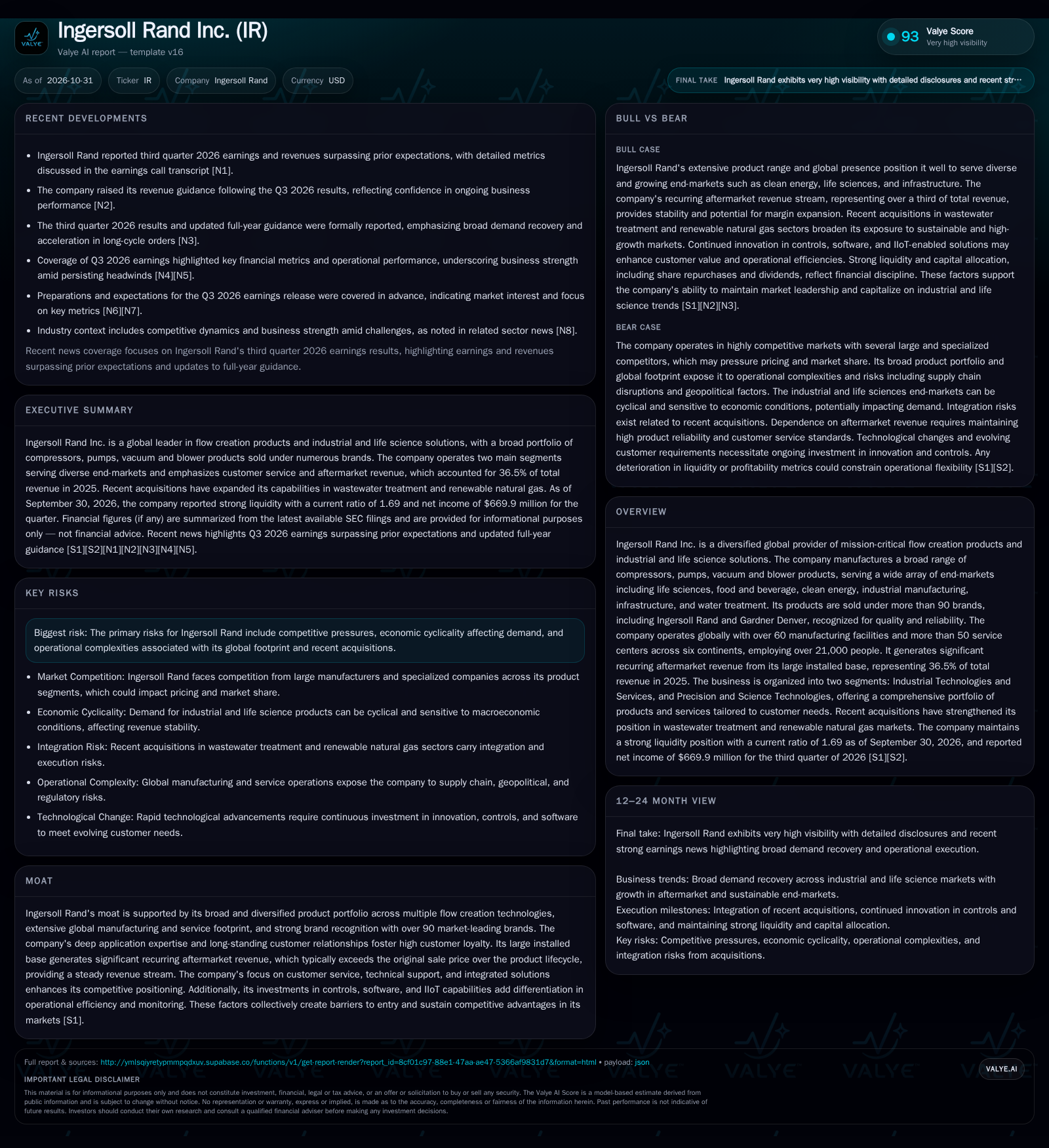
Ingersoll Rand’s Q3 2026 results exceeded expectations, driven in part by steady aftermarket revenue and expanded capabilities following recent acquisitions. The company’s large installed base and focus on software-enabled solutions support recurring revenue, but ongoing integration efforts and competitive intensity remain key variables for future performance. Watch for evidence of margin resilience, aftermarket growth, and successful execution in new end-markets to test the thesis going forward. [S1] [S2] [N1] [N2] [N3]
Ingersoll Rand’s latest quarterly results highlight a business at the intersection of industrial resilience, technological evolution, and strategic expansion. With Q3 2026 earnings and revenue surpassing expectations and full-year guidance revised upward, the company’s performance is underpinned by a large installed base that generates significant recurring aftermarket revenue. Recent acquisitions in wastewater and renewable energy markets aim to extend growth in sustainable sectors. Yet, as the company deepens its focus on software and controls—while integrating new businesses and managing global complexity—the durability of its margin structure, the stickiness of its aftermarket, and the execution of its growth strategy will determine the next phase of value creation. [S1] [S2] [N1] [N2] [N3]
Recent Earnings, Aftermarket Strength, and Strategic Acquisitions Set the Stage
Ingersoll Rand reported net income of $669.9 million for Q3 2026, with basic and diluted EPS of $1.74 and $1.73, respectively. Following this outperformance, the company raised its full-year revenue guidance, reflecting management’s confidence in ongoing demand recovery and operational execution. [S2] [N2] [N3]
Aftermarket revenue—driven by the company’s large installed base of compressors, pumps, and other flow creation products—represented 36.5% of total revenue in 2025, serving as a stabilizing force against cyclical demand swings. [S1]
Recent acquisitions in 2025 (SSI Aeration, Termomeccanica Industrial Compressors, and Adicomp) have expanded Ingersoll Rand’s capabilities in wastewater treatment and renewable natural gas, positioning it for growth in sustainability-focused markets. [S1]
How Aftermarket, Installed Base, and Platform Expansion Drive Economics
Ingersoll Rand’s business model combines original equipment sales with a substantial recurring aftermarket stream, leveraging its large installed base. Aftermarket revenue—parts, service, monitoring, and upgrades—tends to carry higher margins and lower volatility than original equipment, cushioning results during industrial slowdowns. The fact that 36.5% of revenue in 2025 was aftermarket highlights the business’s recurring nature and customer stickiness. [S1]
Upfront equipment sales are typically capital-intensive and subject to cyclical swings, but they seed future service revenue. Pricing in core compressor and pump markets is competitive, placing a premium on differentiation through reliability, energy efficiency, and integration with customer operations. As the company invests in IIoT-enabled controls and cloud-based monitoring, it may unlock new high-margin, software-based recurring revenue streams—though the commercial mechanics (e.g., subscription vs. bundled service) are not fully disclosed.
Recent acquisitions in wastewater and renewable energy typically require integration costs and capital outlays, but offer exposure to higher-growth, regulation-driven markets. Operating leverage can be significant: fixed costs in manufacturing are high, so incremental service or software revenue can disproportionately boost margins if utilization and installed base penetration increase.
Why Brand, Installed Base, and Service Networks Matter Amid Intense Competition
Ingersoll Rand faces formidable competition from both diversified industrial giants and specialized players in compression, vacuum, and precision technologies. Its competitive position rests on several pillars: broad product portfolio, strong global brands (over 90 brands including Ingersoll Rand and Gardner Denver), and an extensive installed base. These factors foster customer loyalty and recurring aftermarket business, as switching core flow equipment can involve significant operational risk and retraining costs. [S1]
Service networks and application expertise are critical: the company’s more than 50 service centers and global reach underpin its ability to provide rapid support and parts availability, which is highly valued in mission-critical industrial settings. However, the rise of IIoT and software-enabled monitoring introduces new competitive dynamics—industrial customers may increasingly expect integrated digital solutions, potentially eroding traditional hardware moats if rivals out-innovate on connectivity or analytics.
In precision and science technologies, barriers to entry may be lower, but vertical integration with OEMs and regulatory requirements for life sciences create switching frictions. The challenge for Ingersoll Rand is to sustain differentiation not only on product reliability but on total lifecycle value, including digital and sustainability attributes.
Margin Expansion via Aftermarket Penetration and Digital Service Adoption
If Ingersoll Rand successfully deepens aftermarket penetration—growing the share of revenue from service, upgrades, and IIoT-enabled monitoring—margins could expand meaningfully. Additional upside could come from accelerating adoption of cloud-based software and controls, especially if these offerings command premium pricing or open new subscription revenue streams.
Recent acquisitions in wastewater and renewable natural gas could deliver outsized growth if integration is smooth and cross-selling into the existing industrial customer base is achieved. Evidence that would confirm this scenario includes sustained or rising aftermarket revenue share, gross margin improvement, and disclosures of software or service contract growth. If customers increasingly adopt IIoT and digital monitoring solutions, and if the acquired businesses deliver above-average growth rates, the case for a structurally higher earnings profile strengthens.
Steady Growth Anchored by Installed Base and Incremental Market Expansion
The most plausible trajectory is that Ingersoll Rand continues to deliver steady growth, anchored by its large installed base and recurring aftermarket revenue. Original equipment sales may fluctuate with macro cycles, but the service business provides ballast, while incremental adoption of digital solutions and new end-market exposure (e.g., wastewater, renewables) adds modest growth layers.
Acquisition integration likely progresses with some friction but no major disruptions. Margins remain stable or improve slightly as the mix tilts toward higher-margin aftermarket and digital services, offset by ongoing competitive pressures and cost inflation. Evidence for this outcome would include a stable or gradually rising aftermarket revenue proportion, steady gross and operating margins, and incremental revenue contribution from recent acquisitions without material margin dilution.
Pressure from Cyclicality, Integration Challenges, and Digital Disruption
A less favorable scenario sees industrial and life science end-markets weaken due to macroeconomic headwinds, reducing original equipment sales and slowing aftermarket growth. If recent acquisitions face integration setbacks—such as operational disruptions or customer attrition—the anticipated growth and margin contribution could fall short.
Additionally, failure to keep pace with IIoT and software innovation could erode aftermarket stickiness, as customers migrate to competitors offering more advanced digital solutions or open platforms. Downside evidence would include declining aftermarket revenue share, margin compression, underperformance or restructuring charges in acquired businesses, and negative customer or channel feedback on digital product offerings.
What Will Determine Ingersoll Rand’s Margin Durability and Growth in 2027?
Aftermarket revenue as a percentage of total sales—rising or falling trends would directly test the thesis of recurring margin resilience.
Gross and operating margin movements, especially in relation to mix shifts toward service, software, and newly acquired businesses.
Growth rates and profitability of wastewater treatment and renewable natural gas segments post-acquisition, if disclosed.
Adoption rates and revenue contribution from IIoT-enabled controls and cloud-based software offerings—either as standalone contracts or as part of bundled service deals.
Customer retention and churn metrics in core compressor and pump platforms—a useful metric would be renewal rates or multi-year service contract penetration, if disclosed.
Integration milestones and synergy realization from 2025 acquisitions—watch for management updates on operational or financial targets.
Competitive win/loss rates in industrial and life science end-markets, particularly against digital-forward rivals.
Disclaimer: This is research-only, informational analysis and not investment advice. It may include AI-generated interpretation and general industry context. Always verify important details using primary sources.

Comments