
Federated Hermes in Late 2026: Asset Mix, Private Market Expansion, and the Stakes of Regulatory and Fee Dynamics
With $884.4 billion in assets under management and a newly expanded private markets platform, Federated Hermes faces the dual challenge of scaling fee-based revenue while adapting to shifting regulatory, operational, and competitive landscapes. The direction of asset flows, fee structures, and technology investment will shape its earnings power and strategic resilience.
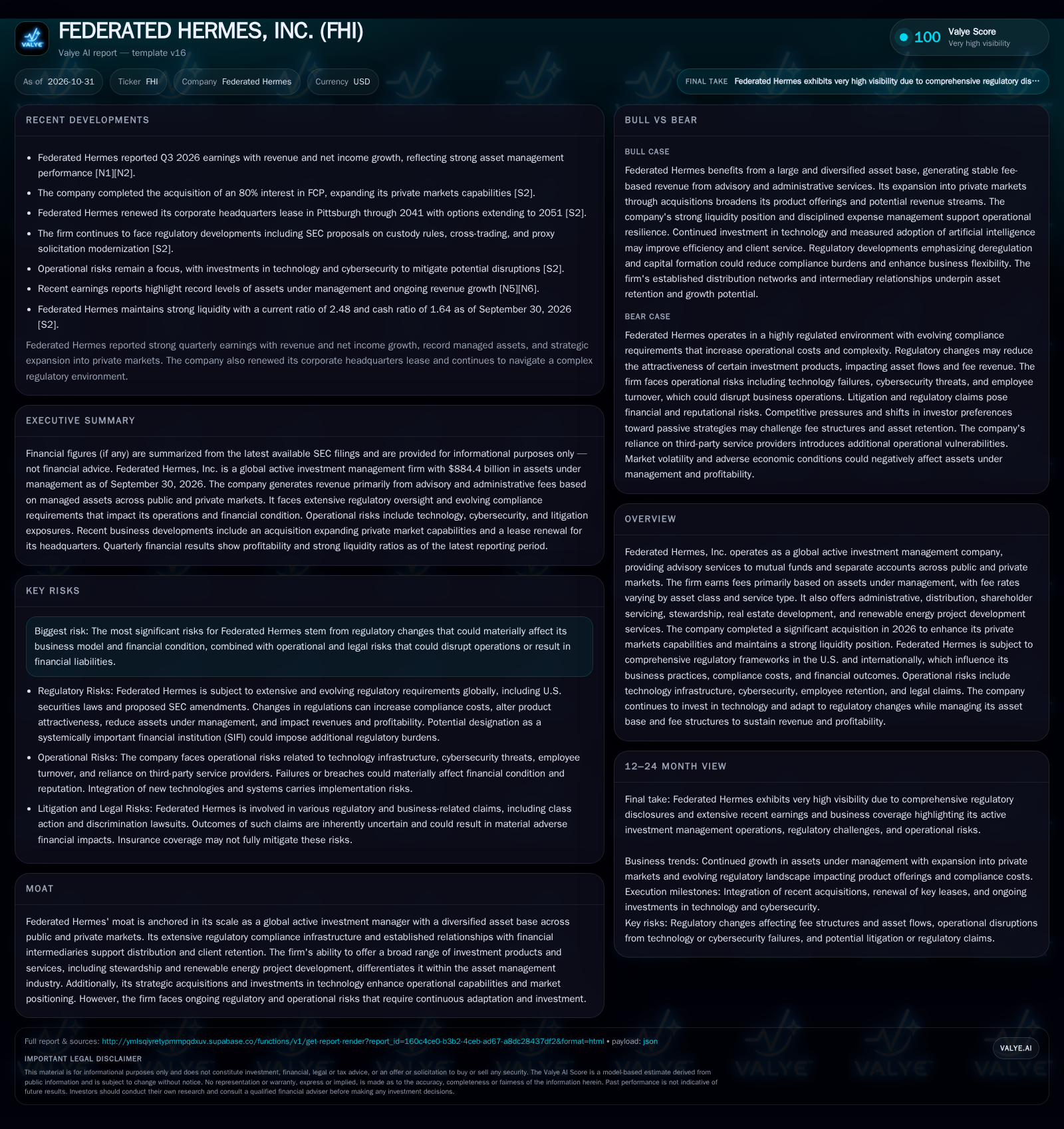
Federated Hermes reported $884.4 billion in AUM as of September 2026, reflecting both organic growth and recent private market acquisitions. Most revenue is tied to advisory and administrative fees, the rates of which are sensitive to asset mix and competitive pressure. The firm's profitability hinges on its ability to sustain AUM growth, manage costs amid regulatory and operational demands, and capture higher-margin mandates in a crowded, rapidly evolving asset management industry. [S2] [N1] [N2]
Federated Hermes enters the final quarter of 2026 as a top-tier global active asset manager, navigating a landscape where scale, asset mix, and regulatory adaptation are critical to long-term value creation. With $884.4 billion in AUM and a recent push into private markets, the firm’s revenue engine remains tightly linked to the direction of client flows and the evolving economics of active management. The stakes are high: ongoing regulatory changes, margin pressures from fee competition, and the need for technology investment all interact to determine whether the company can maintain its profitability and relevance in a shifting asset management ecosystem. [S2] [N1] [N2]
AUM Milestone and Private Markets Expansion Set the Strategic Stage
As of September 30, 2026, Federated Hermes reported $884.4 billion in assets under management, a figure that underscores both organic growth and the impact of recent acquisitions. The company’s completion of an 80% stake in FCP expanded its private markets footprint, positioning Federated Hermes to access new client segments and diversify its fee streams. These facts matter because AUM scale, product breadth, and liquidity directly affect the firm’s earnings power, its capacity for further inorganic growth, and its ability to navigate regulatory and operational shocks. [S2] [N1] [N2]
How Asset Mix, Fee Compression, and Distribution Costs Drive Margins
Federated Hermes earns most of its revenue from contract-based advisory and administrative fees, typically calculated as a percentage of average net assets under management. Fee rates are highest for multi-asset and equity mandates, lower for fixed income and alternatives, and lowest for money market products. This creates a strong incentive to grow higher-fee asset classes, but also exposes the company to competitive fee compression—particularly as passive strategies and large-scale index providers continue to pressure the economics of active management.
Distribution costs, paid to intermediary channels for client acquisition and retention, represent a significant and variable operating expense. The company’s fixed cost base includes technology, compliance, and personnel investments, which must be offset by sufficient scale and asset growth to achieve operating leverage. The acquisition of private markets capabilities via FCP could improve margin profile if Federated Hermes is able to capture illiquidity and complexity premia, though private assets typically involve longer sales cycles and more complex operational requirements.
The economics of the business are thus a function of AUM growth or retention, asset mix, ability to resist or offset fee compression, and the efficiency with which the firm can manage distribution and compliance costs relative to revenues.
Active Management Under Pressure: Differentiation, Substitution, and Scale
Federated Hermes faces competition from a wide spectrum of asset managers, ranging from global diversified firms to specialized boutiques and rapidly scaling passive/index providers. The firm’s competitive advantages stem from its scale, product breadth, and established relationships with financial intermediaries, which help with distribution and client retention. However, these strengths are counterbalanced by secular shifts—such as the continued migration of flows to passive vehicles, the rise of low-cost digital platforms, and the growing sophistication of institutional clients demanding lower fees and more customized solutions.
The recent expansion into private markets may provide some insulation from fee pressure, as private equity, real assets, and credit strategies typically command higher fees and are less susceptible to direct substitution by passive products. However, these segments are also attracting new entrants, and their growth is partially dependent on the ability to deliver differentiated performance and manage complex operational risk. The company’s significant regulatory infrastructure could be a barrier to entry for smaller competitors, but may become a burden if regulatory costs outpace the benefits of scale.
If Private Markets Scale and Active Mandates Stabilize, Margin Expansion Is Plausible
A favorable scenario for Federated Hermes would see sustained growth in higher-fee private and multi-asset strategies, supported by the successful integration of FCP and a stable or improving mix in traditional active mandates. If regulatory changes do not materially increase compliance costs or restrict product offerings, and if technology investments yield operational efficiencies, the company could achieve both top-line and margin expansion.
Evidence that would confirm this scenario includes accelerating net inflows into private markets funds, improved revenue per dollar of AUM (indicating mix shift), and stable or declining distribution and compliance expense ratios. Additionally, signs of successful technology adoption—such as improved client retention, lower operational error rates, or expanded digital distribution partnerships—would support the upside case.
Earnings Stability Depends on Asset Retention and Balanced Mix
The most plausible path is continued growth in total AUM, but with ongoing pressure on average fee rates due to competition and investor preference for lower-cost products. The private markets expansion may partially offset margin pressure, but the time required to scale these offerings could delay material earnings impact. Regulatory and compliance costs are likely to remain elevated, and the company will need to maintain investment in technology and distribution to remain competitive.
This scenario would be confirmed by modest net inflows, stable or slightly declining margins, and continued headline profitability, but without a step-change in earnings power. Evidence of fee compression, increased regulatory costs, or slow private markets adoption would reinforce the base case.
Margin Erosion and Outflows If Fee Pressure and Regulatory Costs Accelerate
The adverse scenario would involve a combination of accelerated outflows from active and money market mandates, fee compression outpacing asset growth, and a significant step-up in regulatory or compliance costs—potentially triggered by new SEC rules or adverse litigation outcomes. If technology or operational failures occur, or if integration of new acquisitions is poorly executed, both expenses and reputational risk could rise, further pressuring margins.
Confirmation of this scenario would include sustained net outflows, a sharp decline in average fee rates, rising expense ratios, or legal/regulatory penalties materially impacting earnings. Signs of client or asset migration to passive competitors or digital-first platforms would also indicate downside risk.
Milestones That Will Shape Federated Hermes’ Strategic Trajectory
Net flows by asset class, especially into or out of higher-fee equity, multi-asset, and private markets products. Detailed disclosure, if provided, would clarify whether mix is shifting favorably.
Average fee rate (basis points of AUM) over time. Monitoring for signs of stabilization, compression, or improvement is critical to margin analysis.
Distribution and compliance expense ratios as a percentage of revenue. A useful metric would be the trend in these costs relative to AUM or revenue, to assess operating leverage.
Progress and financial contribution from the FCP private markets acquisition, including new mandates won, net inflows, and revenue growth attributable to the new platform.
Regulatory developments affecting product structures, fee models, or mandatory disclosures. Timely updates on SEC or other global regulatory actions would help test compliance cost scenarios.
Operational incidents or cybersecurity events, if disclosed, and the company’s response (including any financial or reputational impact).
Management commentary or disclosure on technology adoption—such as AI integration, digital client interface upgrades, or automation—would help gauge efficiency and competitive positioning.
Resolution or escalation of ongoing litigation or regulatory claims, with financial statement impact if material.
Disclaimer: This is research-only, informational analysis and not investment advice. It may include AI-generated interpretation and general industry context. Always verify important details using primary sources.

Comments