
Nicolet Bankshares After Its Transformational Acquisition: Scale, Integration, and the Stakes of Community Banking Expansion
Following the $6 billion MidWest One acquisition, Nicolet Bankshares has doubled its branch footprint and substantially grown assets, loans, and deposits. The challenge now shifts from dealmaking to integrating operations, sustaining earnings momentum, and defending its relationship-driven model in an increasingly competitive Midwest banking landscape.
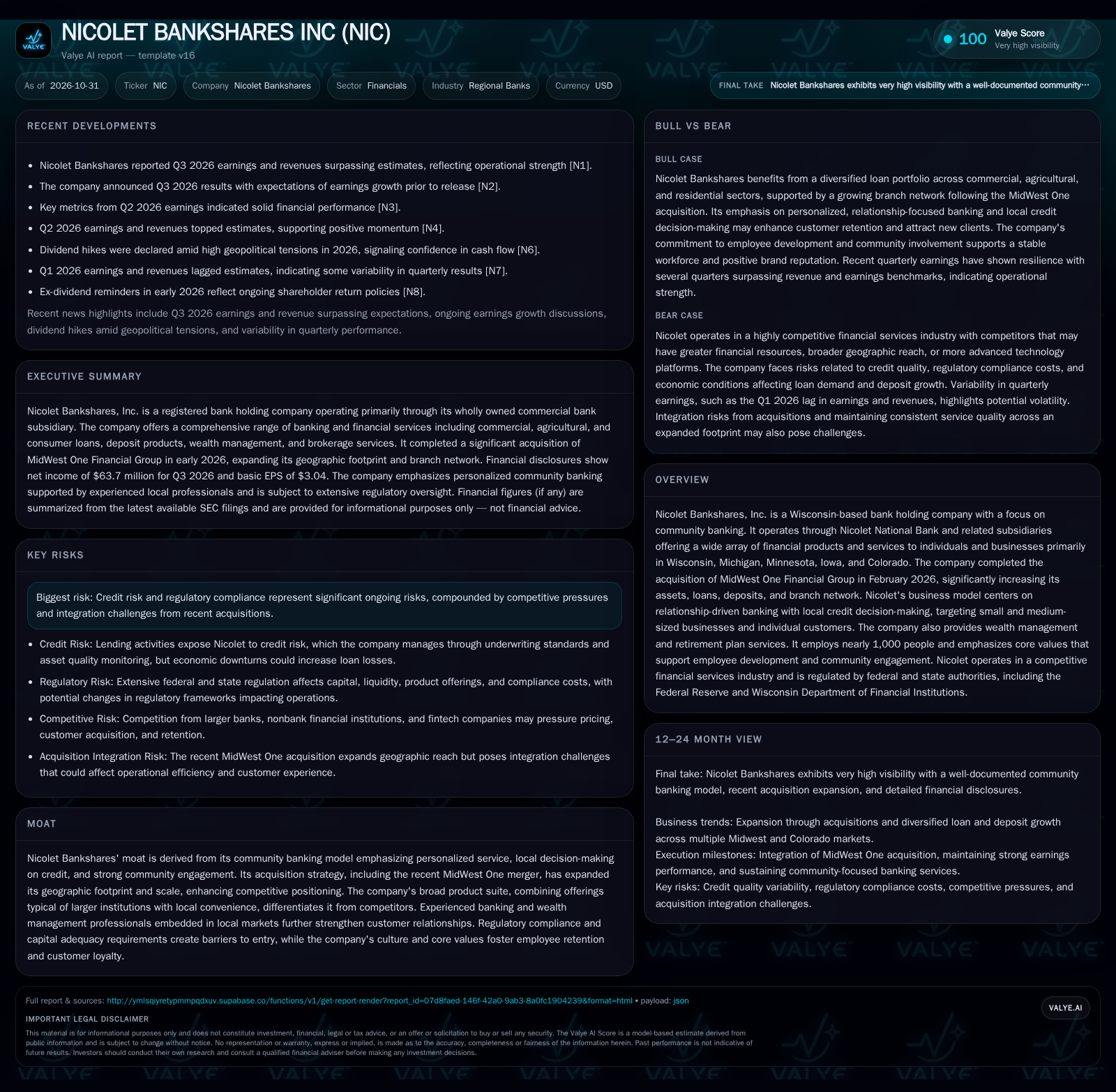
Nicolet Bankshares’ recent acquisition of MidWest One Financial Group has nearly doubled its assets, loans, and branches, positioning it as a major regional player. While Q3 2026 results were strong, the company faces the complex task of integrating operations and maintaining its community-banking edge as it scales. Sustained earnings depend on loan growth, credit quality, and cost controls amid regulatory and competitive headwinds. Investors should focus on integration progress, credit metrics, customer retention, and noninterest income trends as signals for the next phase.
Nicolet Bankshares’ acquisition of MidWest One Financial Group in February 2026 was a watershed moment, nearly doubling its balance sheet and transforming it into a leading regional bank across Wisconsin, Michigan, Minnesota, Iowa, and Colorado. With assets now exceeding $15 billion and a branch network spanning 114 locations, Nicolet’s ability to integrate operations, sustain its community-banking ethos, and manage new credit and compliance risks will be decisive. Early post-merger results are strong, but the coming quarters will test whether scale brings lasting earnings power or exposes new vulnerabilities.
Merger-Driven Expansion Reshapes Nicolet’s Scale and Reach
The February 2026 merger with MidWest One Financial Group was transformative for Nicolet Bankshares, adding approximately $6 billion in assets, $5 billion in loans, and $5 billion in deposits, and expanding its branch count from 57 to 114 across a five-state region [S1]. This move nearly doubled the company’s size and elevated its presence in the Midwest banking landscape. As of September 30, 2026, Nicolet reported quarterly net income of $63.7 million and basic earnings per share of $3.04, with Q3 results generally surpassing market expectations [S2] [N1] [N2] [N3] [N4] [N5]. However, Q1 2026 earnings and revenues lagged estimates, highlighting variability as the company digests the acquisition and navigates integration challenges [N7]. These developments are critical because they set the baseline for the company’s new scale, operational complexity, and earnings power post-acquisition.
Earnings Engines: Interest Margin, Fee Income, and the Cost of Scale
Nicolet’s core revenue stream remains net interest income from its diversified loan portfolio, which now spans commercial, agricultural, and consumer lending across a broader geographic footprint. The acquisition nearly doubled its loan book, enhancing potential for interest income, but also increasing exposure to credit risk and regional economic cycles. Noninterest income—mainly from wealth management, brokerage, and retirement services—provides diversification and an offset to rate-cycle volatility, though its relative contribution is typically smaller for regional banks [S1].
The cost base is expected to rise materially due to integration expenses, branch overlap, and regulatory compliance across new jurisdictions. If Nicolet can achieve cost synergies through branch rationalization, technology integration, and process standardization, operating leverage could improve. However, integration setbacks or elevated credit costs could erode these gains. The company’s capital position ($1.3 billion in equity as of 2025 [S1]) supports growth, but ongoing regulatory requirements may constrain capital deployment or require additional buffers as the bank’s risk profile evolves.
Local Relationships Meet Regional Scale: Defensible Differentiation or Dilution?
Nicolet’s historical edge lies in its relationship banking model—personalized service, local credit decision-making, and community engagement. This has fostered customer loyalty and differentiated the bank from larger, less nimble competitors [S1]. The expanded footprint, however, brings it into more direct competition with both superregional banks and technologically advanced nonbank lenders. Larger banks may offer broader digital capabilities and lower pricing due to scale, while fintech entrants can compete on convenience and product innovation.
The question is whether Nicolet can preserve the intimacy of community banking as it scales, or if operational complexity will dilute its service ethos. Its broadening product suite—encompassing wealth management and retirement services—may help retain business clients and affluent individuals, but only if cross-selling and customer service remain strong. Regulatory compliance creates a barrier to entry for new competitors, but also raises the cost and complexity of doing business at scale.
Successful Integration Unlocks Synergies and Deepens Customer Relationships
If Nicolet rapidly and smoothly integrates MidWest One’s operations—consolidating systems, rationalizing overlapping branches, and harmonizing cultures—it could realize meaningful cost savings and efficiency gains. Enhanced scale may improve the bank’s negotiating leverage with technology vendors, enabling further digital investments to retain and attract customers. With a larger geographic footprint, Nicolet could cross-sell fee-based services (wealth management, retirement planning) to a broader client base, increasing noninterest income and stickiness.
The upside scenario would be confirmed by sustained or improving operating margins, above-peer return on equity, stable or falling efficiency ratios, and growth in noninterest income as a share of total revenue. Evidence of customer retention and increased product penetration in legacy and acquired markets would further validate successful integration and scale benefits.
Integration Progress Amid Competitive and Regulatory Pressures
The most plausible outcome is that Nicolet achieves moderate integration success—capturing some, but not all, anticipated synergies—while encountering typical post-merger challenges. Credit costs may drift higher as the loan book expands and the company absorbs unfamiliar markets, but not to a degree that threatens capital or ongoing profitability. Revenue growth is likely driven by balance sheet expansion and incremental fee income, but offset by higher operating costs and investments in compliance and technology.
Confirmation would come from steady earnings per share, manageable efficiency ratios, and credit metrics (such as nonperforming loan ratios and net charge-offs) remaining within historical ranges. Failure to materially improve operating leverage or grow fee income would suggest that the benefits of scale are being consumed by integration and compliance costs.
Integration Missteps or Credit Deterioration Erode Franchise Value
The primary risk is that integration proves more complex and costly than anticipated—manifesting in customer attrition, cultural clashes, or unanticipated systems issues. If cost overruns persist or branch rationalization lags, efficiency ratios could deteriorate, pressuring profitability. A secondary but significant risk is a regional economic downturn or sectoral credit event (e.g., commercial real estate stress), which could trigger higher loan losses and require additional provisions, directly impacting net income.
Downside confirmation would include rising nonperforming assets, higher provision expenses, declining net interest margins, or negative operating leverage. Loss of key personnel or customer defection in acquired markets would also signal that the bank’s core relationship model is under strain at scale.
Tests for Sustainable Scale: What Will Determine Nicolet’s Next Chapter
Progress on integration milestones, including branch consolidations and systems harmonization—evidence of which would be seen in expense trends and management disclosures.
Nonperforming loan ratios and net charge-off levels, especially in newly acquired loan portfolios, as an indicator of credit risk management post-merger.
Trends in noninterest income—growth in wealth management, brokerage, and retirement services revenue would illustrate success in cross-selling and product penetration.
Efficiency ratio movement (if disclosed), reflecting the company’s ability to control costs and capture integration synergies.
Customer retention rates and deposit growth in both legacy and acquired markets—a useful metric would be customer attrition or account closure rates if disclosed.
Turnover among key personnel, especially in markets acquired from MidWest One, as a qualitative indicator of cultural integration.
Capital adequacy metrics (such as CET1 ratio, if disclosed), as regulatory requirements may tighten with increased scale and risk complexity.
Loan growth by segment—commercial, agricultural, and consumer—to test whether expansion is driving balanced portfolio growth or creating concentration risks.
Disclaimer: This is research-only, informational analysis and not investment advice. It may include AI-generated interpretation and general industry context. Always verify important details using primary sources.

Comments