
Weyerhaeuser in 2026: Timberland Cyclicality, Operational Flexibility, and the Stakes of Housing Market Exposure
Weyerhaeuser’s Q3 2026 results demonstrate disciplined operational adjustment amid a challenging housing and remodeling environment, with improved EBITDA and ongoing capital management. The company’s future hinges on its ability to navigate commodity price volatility, evolving U.S. housing demand, and the emerging potential of renewable energy and carbon markets.
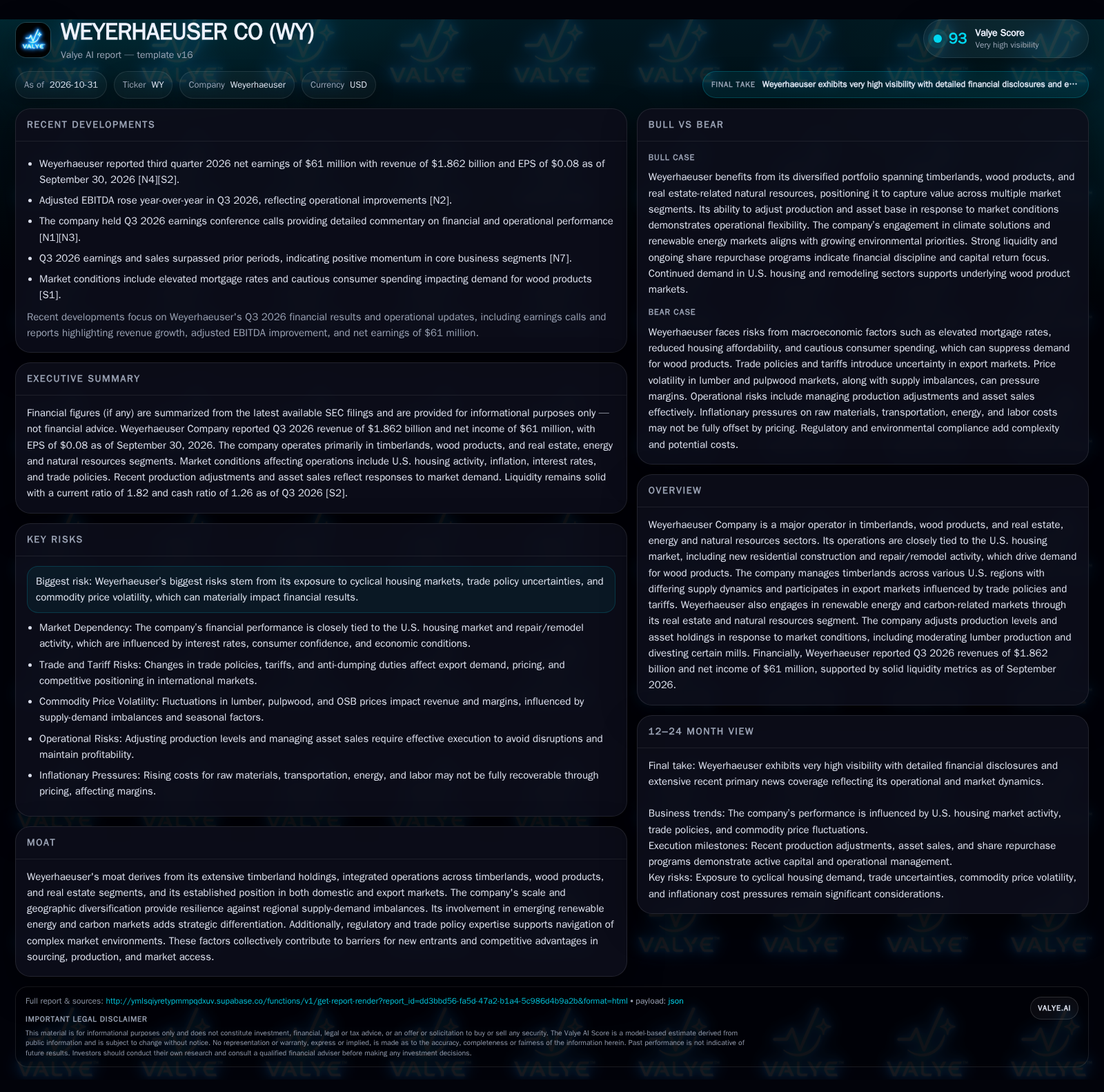
Weyerhaeuser delivered Q3 2026 revenue of $1.862 billion and net income of $61 million, showing resilience despite persistent headwinds from elevated mortgage rates and softer housing activity. Monitoring production discipline, wood product margins, and real estate/energy progress is crucial for thesis validation. [S2] [N2] [N7]
Weyerhaeuser’s latest financial results show the company actively managing through a period of muted housing demand and commodity price uncertainty. However, the company’s fortunes remain tightly linked to the trajectory of U.S. construction and remodeling, as well as the broader macro environment. The real test for Weyerhaeuser will be how effectively it can buffer these cyclical swings, capitalize on emerging carbon and renewable trends, and maintain discipline in capital allocation as the market’s crosscurrents persist.
Recent Results Signal Improvement, but Core Markets Remain Challenged
Weyerhaeuser reported Q3 2026 revenue of $1.862 billion and net income of $61 million, with basic and diluted EPS of $0.08. Adjusted EBITDA increased year-over-year, indicating some operational improvement despite a persistently challenging market environment. The company’s earnings and sales surpassed prior periods, suggesting that recent actions to moderate production and reposition assets have started to take hold. These results matter because they demonstrate Weyerhaeuser’s ability to respond to market softness—particularly in wood products—while maintaining profitability and cash flow. [S2] [N2] [N7]
As of September 30, 2026, Weyerhaeuser reported $349 million in cash and equivalents, a current ratio of 1.82, and a cash ratio of 1.26. The company continues to have $938 million remaining under its $1 billion share repurchase program, providing additional capital management flexibility. The company reported cash and liquidity metrics for the period; these figures do not by themselves establish operating runway, investment capacity, financial flexibility, or financing capacity. [S2] [S1]
Weyerhaeuser’s decision to moderate lumber production and divest a British Columbia sawmill in late 2025, resulting in a 14% decrease in Q4 2025 lumber volumes, reflects its commitment to aligning output with demand and controlling costs in the face of muted housing activity. [S1]
How Weyerhaeuser’s Earnings Power Hinges on Timberland Cycles and Asset Mix
Weyerhaeuser’s revenue model is anchored in three segments: Timberlands, Wood Products, and Real Estate/Energy/Natural Resources. The Timberlands segment generates income primarily from the harvest and sale of logs, with pricing power influenced by regional supply/demand, export market conditions, and global trade policies. Wood Products—encompassing lumber, panels, and engineered wood—contributes significant top-line and margin potential, but is highly sensitive to U.S. housing starts and broader construction trends.
In periods of robust construction activity, high mill utilization and pricing can drive substantial operating leverage, as fixed timberland and processing costs are spread over greater volumes. Conversely, when housing starts falter, as in the current elevated mortgage rate environment, Weyerhaeuser must manage production levels and cost structures to preserve profitability. The company’s recent adjustment of lumber output and asset divestiture suggests a focus on maintaining variable cost discipline and optimizing capital allocation.
The Real Estate, Energy & Natural Resources segment provides counter-cyclical and diversified cash flows, monetizing higher-and-better-use land, mineral rights, and, increasingly, renewable energy and carbon offset projects. While these activities currently represent a smaller share of total revenue, their contribution could grow if carbon markets and renewable projects scale. Capital needs are moderate and largely funded through operating cash flow, but future expansion in renewables or acquisitions could require incremental investment.
Scale, Diversification, and Regulatory Navigation Shape Weyerhaeuser’s Edge
Weyerhaeuser’s competitive position is underpinned by its vast, geographically diversified timberland holdings and integrated operations spanning timber, wood products, and real estate. Scale provides cost advantages in procurement, logistics, and market access, while geographic spread reduces exposure to regional weather or pest events and local market slumps.
However, the sector is structurally cyclical, and Weyerhaeuser faces competition from other large timberland owners, vertically integrated wood products firms, and international suppliers, particularly in export markets where trade policy and tariffs (such as duties on Canadian softwood lumber) play a pivotal role. Substitutes—including steel, concrete, and engineered composites—can erode demand for traditional wood products if relative pricing or regulatory incentives shift.
Weyerhaeuser’s engagement in emerging renewable energy and carbon credit markets may offer a strategic differentiator, especially as ESG and net-zero mandates gain traction. Early-mover advantage in these areas could help offset cyclicality in traditional timber and lumber markets, but the scale and durability of these new revenue streams remain to be proven.
Housing Recovery and Carbon Monetization Could Unlock Margin Expansion
If U.S. single-family housing starts rebound more strongly than expected—driven by lower mortgage rates or improved affordability—Weyerhaeuser could benefit from increased demand for lumber and wood products, resulting in higher mill utilization, better pricing, and operating leverage. A sustained upcycle would likely widen margins in both the Timberlands and Wood Products segments, especially if the company maintains disciplined cost control and capital allocation.
Additional upside could come from successful scaling of the Real Estate, Energy & Natural Resources segment, particularly if carbon markets mature or renewable energy projects on company land generate meaningful incremental revenue. Confirmation of this scenario would include a measurable increase in wood product volumes, improved segment margins, growing contributions from carbon/renewables, and the ability to return more capital to shareholders via repurchases or dividends.
Falsification would occur if housing starts remain sluggish despite lower rates, or if non-timberland diversification fails to scale, leaving Weyerhaeuser overly exposed to commodity price swings.
Disciplined Operations Sustain Performance Amid Prolonged Housing Softness
The most plausible outcome is that Weyerhaeuser continues to operate in a slow-recovering housing environment, with mortgage rates and affordability constraints keeping demand for wood products below historical peaks. The company is likely to maintain its focus on production discipline, asset optimization, and cost control to protect margins. Timberland cash flows remain stable, but wood product pricing and volumes are capped by macro headwinds.
Incremental growth in real estate, energy, and carbon markets provides some diversification, but does not fundamentally alter the cyclical core of the business in the near term. Capital returns continue via the authorized repurchase program, supported by reported liquidity position. Evidence for this scenario includes steady-to-modestly improving EBITDA, stable cash balances, and a continued emphasis on operational flexibility and selective investment.
Falsification would be signaled by a material deterioration in segment margins, persistent inventory build-ups, or an inability to maintain positive free cash flow in the face of ongoing demand weakness.
Deeper Housing Downturn or Commodity Slump Could Pressure Cash Flows
In a more adverse scenario, U.S. housing activity remains muted or declines further, either due to persistently high rates, a broader economic slowdown, or a sharp drop in consumer confidence. This would drive lower demand and pricing for lumber and wood products, reducing mill utilization and compressing margins. If trade frictions or tariffs intensify, export volumes could also suffer, exacerbating domestic oversupply.
Simultaneously, if inflationary pressures on inputs and labor persist, cost recovery through pricing may prove difficult, further eroding profitability. Should the company encounter execution missteps in production adjustment or asset sales, or if emerging carbon/renewable markets underperform, cash flows could come under pressure, potentially constraining capital returns and future investment.
Indicators confirming this scenario would include declining EBITDA, negative free cash flow, increased leverage, or a halt to share repurchases. A sharp drop in segment profitability or asset impairments would further validate downside risk.
Milestones That Will Test Weyerhaeuser’s Resilience and Growth Ambitions
Quarterly changes in U.S. single-family housing starts and residential construction spending, as these directly drive wood products demand and pricing.
Reported wood product production volumes and mill utilization rates—sharp increases or decreases would signal shifts in demand or production discipline.
Segment-level EBITDA and margin trends, particularly in Wood Products and Timberlands, to gauge operational leverage and cost control.
Progress and revenue contribution from Real Estate, Energy & Natural Resources—particularly carbon credit sales, renewable project launches, or land monetization (if disclosed).
Developments in trade policy, tariffs, or countervailing duties affecting Canadian softwood lumber imports and broader export market access.
Input cost trends (raw materials, transportation, energy, labor) and the company’s ability to offset inflationary pressures through pricing or efficiency.
Asset sales, acquisitions, or major capital projects that could reshape the company’s segment mix or geographic footprint.
Disclaimer: This is research-only, informational analysis and not investment advice. It may include AI-generated interpretation and general industry context. Always verify important details using primary sources.

Comments