
Forum Energy Technologies in 2026: Consumable-Driven Model, Backlog Dynamics, and the Stakes of Oilfield Volatility
Forum Energy Technologies (FET) enters late 2026 with strong earnings, a significant backlog, and ambitious targets for revenue and EBITDA expansion by 2030. The company’s mix of consumable-heavy revenues, exposure to oil and gas cycles, and ongoing competition from industry giants set the stage for both opportunity and risk as FET pushes for growth and operational leverage.
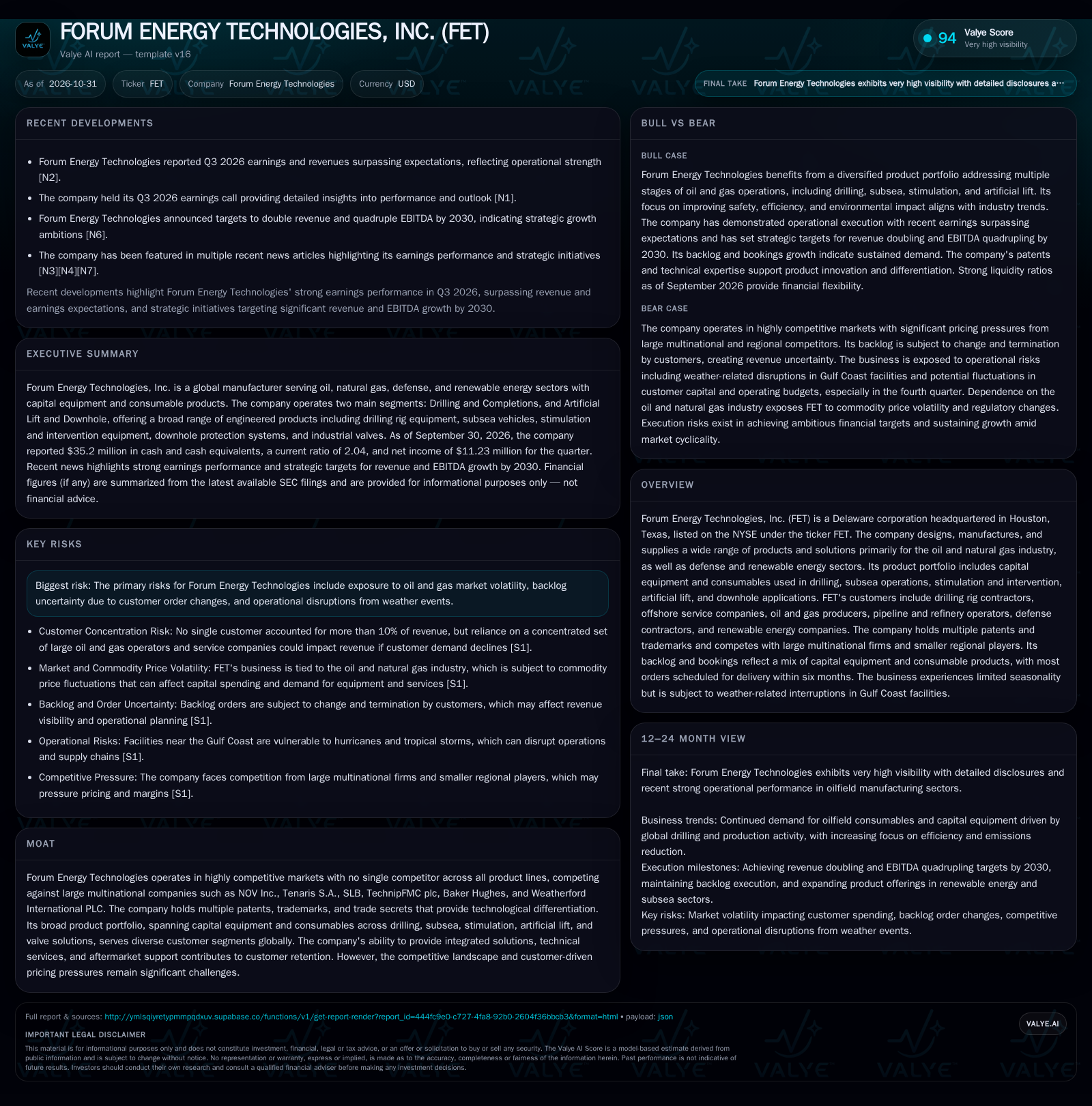
Forum Energy Technologies’ Q3 2026 results exceeded expectations, with net income of $11.23 million and a backlog of $311.6 million, mostly deliverable within six months. The company derives about 80% of its revenue from consumable products and activity-based equipment, reducing reliance on large, lumpy capital sales. With ambitious 2030 growth targets and a diversified customer base, FET faces the dual challenge of executing amid oilfield volatility and maintaining pricing power against major multinational competitors. Backlog order fluidity and market cyclicality remain key variables for the thesis. [S1] [S2] [N2] [N6]
Forum Energy Technologies (FET) has emerged from Q3 2026 with stronger-than-expected earnings, a substantial order backlog, and a business model heavily weighted toward recurring consumable sales. This balance between short-cycle revenues and capital equipment sales provides some insulation from the oilfield sector’s notorious volatility, but leaves FET exposed to the broader swings of global energy investment and the intense pricing pressures of its highly competitive marketplace. As the company sets its sights on ambitious 2030 financial targets, the interplay between backlog execution, product mix, and macro-driven customer spending will determine whether recent momentum can translate into sustained value creation.
Recent Performance and Backlog Trends Shape the Strategic Landscape
Forum Energy Technologies’ Q3 2026 results came in ahead of market expectations, with net income of $11.23 million and diluted EPS of $0.93, reflecting successful operational execution [S2] [N2]. The company’s backlog was $311.6 million at year-end 2025, with most orders scheduled for delivery within six months, but this backlog is inherently fluid—customers can alter or terminate orders, limiting revenue visibility [S1]. Notably, about 80% of 2025 revenue came from consumable products and activity-based equipment, which helps reduce dependence on large, unpredictable capital equipment orders [S1]. FET’s recent announcement of a 2030 target to double revenue and quadruple EBITDA signals management’s intent to aggressively scale the business [N6]. These facts frame a company with positive near-term momentum but with significant execution and market risks embedded in its forward plan.
How FET’s Revenue Mix and Cost Structure Influence Profitability
FET’s business model is distinguished by its heavy reliance on consumable products and activity-driven equipment, which accounted for roughly 80% of revenue in 2025 [S1]. Consumables typically provide more stable, recurring revenue streams and higher gross margins compared to capital equipment, as they are tied to ongoing drilling and production activity rather than new project starts. This model can help smooth revenue through industry cycles, but does not fully immunize the company from sector downturns, as oilfield activity itself remains highly cyclical.
Capital equipment sales—though a smaller share—can drive periodic spikes in revenue and require significant working capital and manufacturing capacity. The company’s cost structure likely features a mix of fixed manufacturing overhead (supporting scale and operating leverage during volume growth) and variable costs tied to materials and labor. As activity ramps and asset utilization improves, FET could benefit from operating leverage, but this also raises the risk of margin compression if volumes shrink or pricing comes under pressure.
FET’s capital needs are closely linked to inventory management, manufacturing flexibility, and the ability to invest in new product development—especially in targeted growth areas like subsea, renewables, and advanced drilling technologies. While the company reported $35.2 million in cash as of September 30, 2026, this metric must be weighed against ongoing working capital demands and the need to fund growth initiatives [S2].
Competitive Landscape: Differentiation Versus Scale in Oilfield Technology
Forum Energy Technologies operates in a fragmented but intensely competitive market, facing both global oilfield service giants (such as NOV Inc., SLB, TechnipFMC, Baker Hughes, and Weatherford International) and smaller regional specialists [S1]. No single competitor spans all of FET’s product lines, but the company faces pricing and innovation pressure across each segment. FET’s portfolio breadth—covering drilling, completions, artificial lift, subsea, and industrial valves—allows it to serve a diverse customer base, but also exposes it to a wide range of direct competitors in each niche.
The company’s competitive edge is supported by a suite of U.S. and international patents, proprietary know-how, and trade secrets, which may help sustain product differentiation and could support premium pricing in select categories [S1]. However, the oilfield technology sector is characterized by rapid innovation cycles, and intellectual property alone rarely constitutes a durable moat. Customer retention is aided by integrated solutions and aftermarket support, but switching frictions are generally low unless equipment is highly specialized or embedded in long-term field operations.
FET’s lack of customer concentration—no single client generating more than 10% of revenue—reduces counterparty risk but means the company must continuously win business across a broad spectrum of operators and service companies [S1]. In periods of sector stress, customers can and do exert significant pricing leverage. The question is whether FET can leverage its technical expertise and product breadth to capture market share and defend margins as the sector evolves.
What Could Unlock Sustained Outperformance: Scaling Consumables, New Verticals, and Margin Expansion
FET’s best-case scenario involves a virtuous cycle of rising oilfield activity, robust demand for consumables, and successful penetration into higher-growth verticals such as renewables and subsea intervention. In this scenario, the company’s consumable-heavy revenue mix delivers recurring, high-margin sales, while capital equipment orders provide periodic upside without overextending working capital. Execution of the 2030 targets—doubling revenue and quadrupling EBITDA—would likely require both market tailwinds (higher drilling and completions activity globally) and internal success in innovation and operational efficiency [N6].
Expansion into adjacent markets—such as renewable energy and defense—could diversify FET’s revenue base and reduce exposure to oil and gas price swings. Margin expansion could be driven by operating leverage as volumes grow, disciplined cost control, and the monetization of new patents or proprietary technologies. Backlog conversion rates and order growth would serve as leading indicators of this scenario. Confirmation would come from sustained double-digit revenue growth, improving EBITDA margins, and evidence of market share gains in targeted segments.
Falsification would be signaled by stagnating top-line growth, declining backlog, or margin compression even amid sector strength—suggesting FET is unable to differentiate or scale as planned.
A Realistic Outlook: Steady Activity, Competitive Pressures, and the Challenge of Execution
The most plausible scenario for FET is one of moderate growth, with consumable sales providing a degree of revenue stability but exposed to fluctuations in global drilling and production activity. The company’s backlog supports near-term visibility, but the fluid nature of customer orders and ongoing pricing pressure from large competitors are likely to constrain both volume growth and margin expansion.
FET’s diversification across products and customers helps mitigate the impact of any single market or client downturn, but the business remains cyclically exposed. In this scenario, FET delivers stable, single-digit revenue growth and maintains current margin levels, but struggles to achieve the scale or profitability implied by its 2030 targets. Execution risk is heightened by the need to continuously innovate, manage working capital, and avoid operational disruptions—such as those caused by Gulf Coast weather events.
Confirmation would come from backlog levels holding steady, modest improvements in profitability, and balanced cash flows. Falsification would be evidenced by a significant drop in order activity, persistent margin erosion, or inability to execute on new product launches.
Where the Model Breaks: Oilfield Downturn, Order Cancellations, and Margin Compression
FET’s downside scenario is characterized by a sharp contraction in oil and gas capital spending—driven by commodity price declines, regulatory shifts, or macroeconomic shocks—which triggers a rapid drop in drilling and completions activity. In this environment, consumable and capital equipment demand both fall, backlog orders are delayed or canceled, and FET faces underutilization of manufacturing assets.
Intensified competition could prompt aggressive price discounting, further pressuring margins. Operating leverage turns negative as fixed costs are spread over a smaller revenue base, and working capital becomes a drag if inventory builds up faster than orders can be fulfilled or converted.
Confirmation of this scenario would come from a steep decline in backlog, negative operating cash flow, or persistent quarterly losses. Early warning signs include a drop in sector-wide rig counts, rising order cancellations, or customer deferrals of major projects.
Milestones and External Factors Likely to Determine FET’s Trajectory
Backlog trend and order conversion rates—watch for sequential changes in backlog and the speed at which orders are fulfilled or canceled.
Revenue mix by product—if disclosed, shifts between consumable and capital equipment sales may indicate changing customer activity or margin outlook.
Gross and EBITDA margin progression—quarterly margin trends will help determine if operating leverage or pricing pressure is dominating.
New product launches and patent monetization—evidence of commercial success in innovation would support the growth thesis.
Market share in key segments—if disclosed, gains or losses versus major peers would test claims of competitive differentiation.
Exposure to oilfield activity cycles—external indicators like global rig counts and E&P capital budgets provide context for end-market demand.
Order cancellation rates—a useful metric would be the proportion of backlog canceled or deferred in periods of market stress.
Progress on 2030 financial targets—management updates on revenue and EBITDA milestones will provide real-time feedback on execution.
Disclaimer: This is research-only, informational analysis and not investment advice. It may include AI-generated interpretation and general industry context. Always verify important details using primary sources.

Comments