
Intel’s AI-Driven Surge, Margin Pressures, and the Stakes of Navigating Semiconductor Cyclicality
Intel’s recent earnings highlight a resurgence in AI-fueled demand and reported liquidity position, yet margin pressures and sector volatility underscore the company’s ongoing struggle to maintain leadership in an intensely competitive semiconductor landscape.
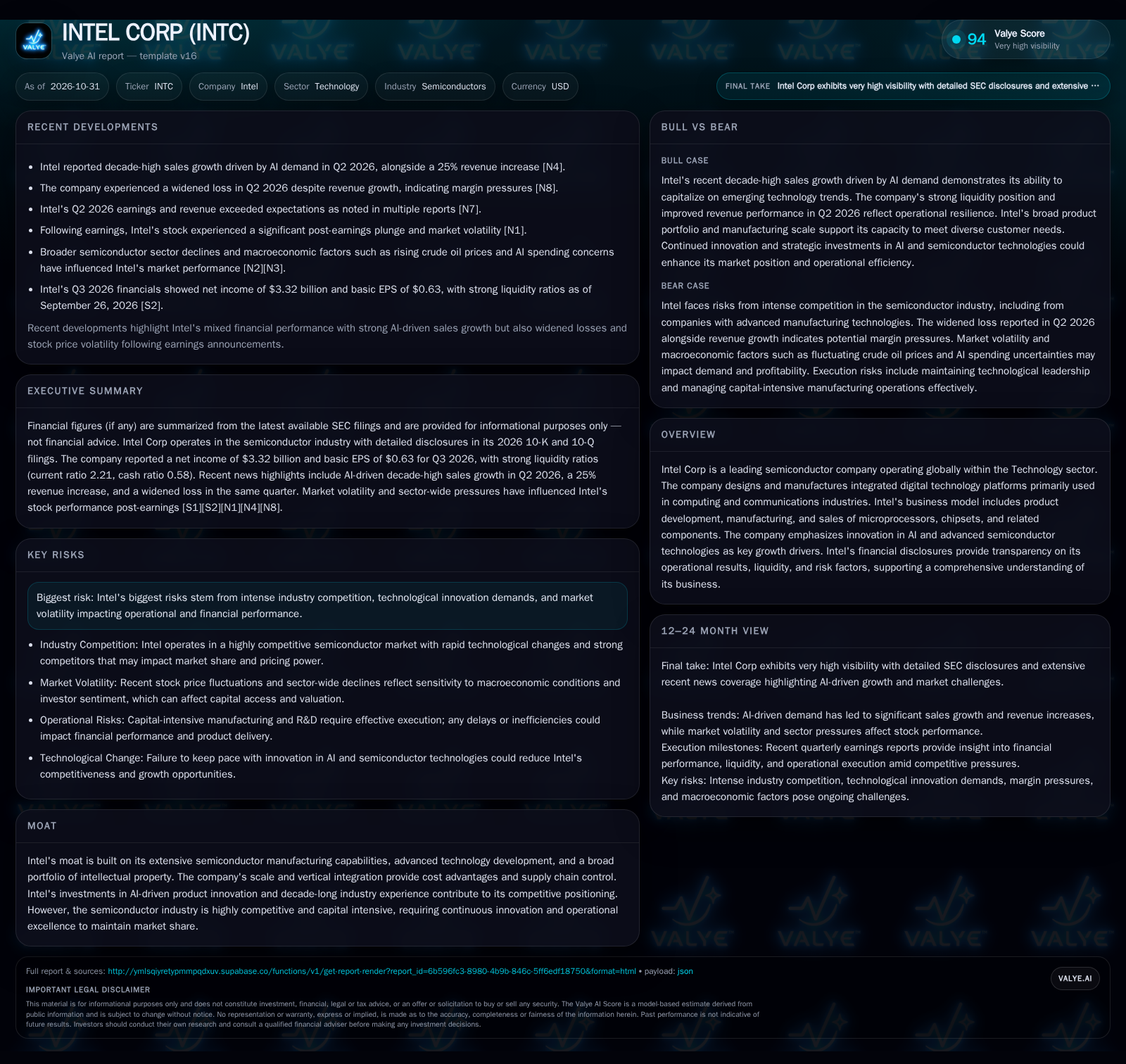
Intel reported a strong Q3 2026 net income of $3.32 billion and maintains a reported liquidity position, but recent earnings volatility and margin pressures reveal the company’s exposure to sector-wide swings and competitive threats. The core question is whether Intel’s investments in AI and advanced manufacturing can offset cyclical and structural headwinds in the coming quarters. [S2] [N1] [N4] [N8]
Intel finds itself at a pivotal crossroads, balancing the tailwinds of surging AI demand against the harsh realities of margin compression and sector volatility. The next several quarters will test whether Intel’s strategic investments in AI and advanced manufacturing can translate into lasting market leadership—or if ongoing competitive and macroeconomic pressures will erode its progress.
Recent Earnings Volatility and Margin Pressures Define Intel’s 2026 Landscape
[S2] However, this snapshot of financial strength is tempered by the previous quarter’s results: despite a striking 25% year-over-year revenue increase, Intel’s Q2 loss widened, signaling that cost pressures or unfavorable mix may be eroding profitability [N8].
The stock’s significant post-earnings plunge and persistent market volatility highlight underlying investor concerns over Intel’s margin trajectory and ability to manage sector headwinds [N1]. AI-driven demand has pushed sales to decade highs, but sustaining this momentum in the face of cyclical swings and competitive encroachment remains a central challenge [N4] [N8].
Further complicating Intel's margin pressures is the interplay between fixed and variable costs inherent in semiconductor manufacturing. When demand surges, higher utilization can spread fixed costs more efficiently, boosting margins; however, sudden demand contractions or product mix shifts can rapidly reverse this effect. This dynamic underscores the sensitivity of Intel’s profitability to short-term market fluctuations and the importance of agile capacity management. Additionally, supply chain constraints or component shortages could exacerbate cost pressures, limiting the company's ability to meet AI-driven demand spikes without sacrificing margin integrity.
How Intel’s Business Model Amplifies Both Opportunity and Risk
Intel’s vertically integrated structure—designing and manufacturing its own chips—enables scale-driven cost advantages and tighter supply chain control compared to fabless peers. This model supports high fixed costs in fabrication and R&D, which can translate to operating leverage when volumes rise. However, it also leaves Intel exposed to sharp margin swings when demand mix shifts or utilization falls.
Pricing power in semiconductors historically hinges on technological leadership, process node advancement, and ability to deliver differentiated solutions for high-growth segments such as AI, data center, and edge computing. The recent surge in AI demand has likely improved product mix, but the Q2 margin compression suggests that cost escalation, legacy product drag, or competitive pricing could be offsetting these gains [N8].
Intel’s vertically integrated model also creates a complex capital intensity profile, where significant upfront investments in fabrication facilities and R&D must be amortized over long periods. This structure can amplify returns when demand aligns with capacity but introduces risk if market cycles lead to underutilization. Moreover, the company's control over both design and manufacturing allows for tighter coordination in product optimization, potentially reducing time-to-market and improving overall system efficiency. However, this integration can also slow adaptation to rapid technological shifts compared to more specialized or fabless competitors, potentially impacting Intel’s agility in capturing emerging AI market segments.
Competitive Dynamics: Can Intel Regain Its Technology Leadership?
Intel’s historic moat has rested on manufacturing scale, integrated design, and a broad portfolio across PC, data center, and now AI-accelerated computing. However, the company faces fierce competition from both fabless chip designers and foundry rivals with advanced process technologies, especially as the industry shifts toward AI-specific architectures and smaller process nodes.
The rise of AI has created opportunities for all major semiconductor players, but also raised the stakes: competitors with earlier access to leading-edge manufacturing or specialized accelerators can erode Intel’s share in critical segments. Switching frictions for large enterprise customers are real, but not insurmountable, especially if performance or total cost of ownership gaps widen.
While Intel’s scale and vertical integration may still confer cost and supply advantage, the company’s ability to set industry standards and capture premium pricing depends on maintaining a cadence of innovation and reliable delivery. The recent margin and volatility signals suggest that this leadership is not unchallenged.
The semiconductor industry’s rapid technological evolution means that maintaining leadership requires continuous innovation not just in process nodes but also in architectural design and software-hardware co-optimization. Intel’s challenge is compounded by the need to balance investments across legacy platforms and emerging AI-specific products. Competitors focusing exclusively on AI accelerators or leveraging more modular fabless models may achieve faster iteration cycles and cost advantages. Intel’s ability to integrate AI workloads efficiently into its broader portfolio, while managing the transition of customers to newer architectures, will be a critical determinant of its competitive positioning in the medium term.
AI Demand and Manufacturing Execution Propel a Sustainable Recovery
If Intel successfully leverages its investments in AI-focused product lines and advanced manufacturing, it could convert recent sales momentum into sustainable margin expansion and market share gains. This scenario would likely involve improved yields on new process nodes, rapid uptake of AI-optimized chips in enterprise and cloud, and efficient absorption of fixed costs through higher utilization.
Confirmation would come from sequential margin improvement, rising operating leverage, and evidence of design wins or major customer renewals in AI/data center segments. A narrowing of the gap with leading-edge foundry competitors on process technology—publicly acknowledged by major customers—would also provide strong validation.
Falsification of this scenario would involve persistent margin erosion despite sales growth, or evidence that AI-driven wins are being offset by aggressive pricing and share loss in other categories.
Cyclical Recovery Offset by Execution Risks and Competitive Pressure
The most plausible trajectory is one where Intel benefits from ongoing AI-driven demand and sector recovery, but faces continued margin volatility as it juggles elevated costs, capital spending, and intense competition. This would manifest as periodic earnings beats driven by top-line growth, punctuated by quarters of margin disappointment or unexpected cost spikes.
Evidence supporting this scenario would include stable or gradually improving net income metrics, steady liquidity, and mixed but not catastrophic stock price reactions to earnings cycles. Falsification would be a sustained return to pre-2023 margin levels or a clear, consistent trend of either margin expansion or contraction across several quarters.
Prolonged Margin Squeeze and Competitive Displacement Threaten Intel’s Core
In a negative scenario, Intel’s margin pressures worsen as cost escalations outpace AI-driven revenue gains and competitors capture share with more advanced or cost-effective solutions. This could occur if next-generation process technology ramps are delayed, if major customers switch to alternative architectures, or if macroeconomic shocks dampen overall IT and data center spending.
Confirmation would come from further net income declines, persistent or deepening losses in successive quarters, or clear evidence of customer defections and pricing concessions.
A falsification trigger would be a rapid, credible recovery in margins, combined with positive customer commentary regarding Intel’s technology roadmap and supply reliability.
Thesis-Testing Developments That Will Shape Intel’s Next Chapter
Quarterly gross and operating margin trends, especially in relation to AI and data center product mix, will indicate whether Intel can convert demand into profitable growth.
Public disclosures of customer design wins, renewals, or losses in AI and cloud infrastructure segments would help test competitive traction.
Updates on process node transitions, yield rates, and manufacturing cost per wafer—if disclosed—are critical to assessing Intel’s technology leadership and cost position.
Evidence of sustained or improving revenue growth in the face of sector volatility would suggest resilience, while abrupt reversals would warrant caution.
Management commentary on supply chain, capital allocation, and R&D investment priorities will offer insights into execution risk and strategic focus.
Sector-wide developments in AI spending trends, macroeconomic shocks, or major competitor advances could materially alter the demand and pricing environment for Intel.
Disclaimer: This is research-only, informational analysis and not investment advice. It may include AI-generated interpretation and general industry context. Always verify important details using primary sources.

Comments