
Republic Services in Late 2026: Capital Returns, Regulatory Headwinds, and the Economics of Scale in Waste and Renewables
Republic Services continues to demonstrate operating momentum with 8.2% revenue growth and a new $5 billion share repurchase authorization, but faces mounting regulatory, environmental, and financial leverage challenges. The company’s strategic push into renewable energy and technology adoption could reshape its economics, yet persistent risks around compliance costs, debt, and environmental liabilities remain central to the investment debate.
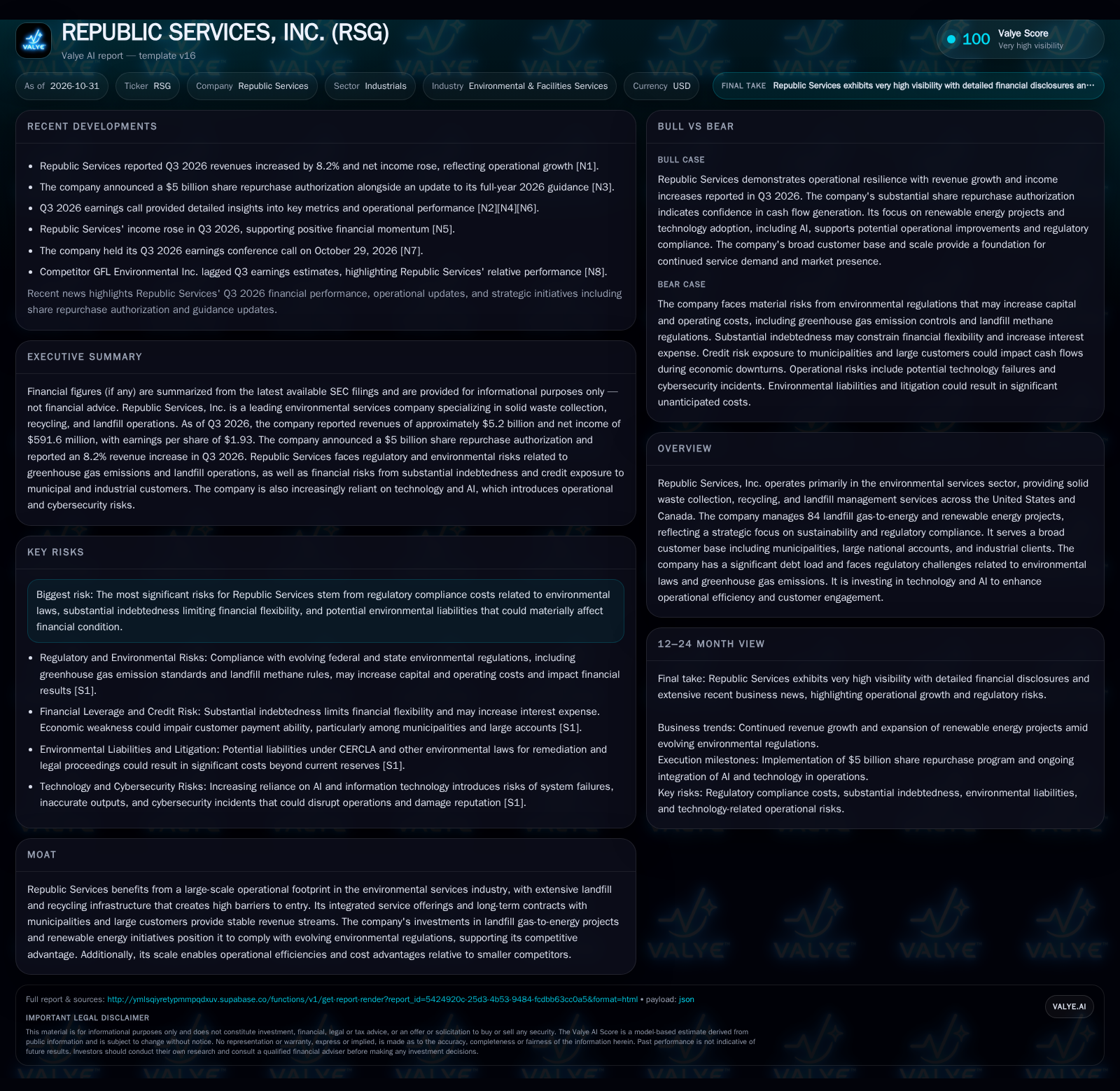
Republic Services reported Q3 2026 revenue of $5.205 billion and net income of $591.6 million, with EPS of $1.93. The company authorized a $5 billion share repurchase and grew revenue by 8.2% year-over-year. However, its current ratio is 0.75 and it holds substantial debt, while regulatory and environmental compliance costs are likely to trend higher. Execution on landfill gas-to-energy projects and technology integration will be critical to maintaining margins and competitive positioning amid evolving industry dynamics. [S2] [N1] [N3]
Republic Services, Inc. enters late 2026 with a blend of operational momentum and mounting structural challenges. The company’s 8.2% top-line growth and robust earnings have been paired with a $5 billion share repurchase authorization, suggesting confidence in its recurring cash flows and market positioning. However, the business remains deeply exposed to regulatory shifts, environmental liabilities, and meaningful leverage, all as it pushes further into renewable energy and technology-driven efficiency. The question for investors is whether Republic’s scale and infrastructure can continue to offset rising compliance costs and debt pressures, or if the industry’s shifting landscape will erode its long-term economic advantages.
Recent Results Highlight Growth and Capital Allocation Moves
Republic Services reported Q3 2026 revenue of $5.205 billion, up 8.2% year-over-year, with net income of $591.6 million and basic/diluted EPS of $1.93. This marks continued operational momentum in core waste and recycling services. In October 2026, the company announced a substantial $5 billion share repurchase authorization, reflecting management’s focus on returning capital to shareholders and possible confidence in future cash generation. However, balance sheet metrics reveal a current ratio of 0.75 and a cash ratio of just 0.03, against a backdrop of roughly $14 billion in debt. These facts frame a company navigating both growth and significant financial obligations, while also accelerating investment in renewable energy and technology-driven efficiency. [S2] [N1] [N3] [S1]
How Scale, Mix, and Regulation Shape Republic’s Profit Model
Republic Services’ core economics are rooted in the collection, transfer, recycling, and landfill management of solid waste—a business with high fixed costs and significant operating leverage. Pricing power is influenced by multi-year municipal and commercial contracts, which can provide revenue stability but limit short-term flexibility if costs spike. Landfills represent both a strategic moat and a source of regulatory risk: they require substantial upfront capital, but once permitted, create local monopolies with high barriers to entry. Variable costs are driven by labor, fuel, and environmental compliance, while capital expenditures are shaped by landfill development, maintenance, and increasingly, renewable energy project investments.
The company’s renewable energy initiatives, including 84 landfill gas-to-energy projects, could provide incremental revenue streams and help offset compliance costs tied to greenhouse gas emissions. However, the economics of these projects are sensitive to federal energy policies and renewable fuel credit prices, which can be volatile. Technological investments in AI and automation aim to improve route efficiency, lower labor costs, and enhance customer engagement, but may require ongoing capital outlays and introduce new operational risks. The company’s significant debt load amplifies both the upside from margin expansion and the downside from adverse regulatory or macroeconomic shocks.
Barriers, Substitutes, and the Stakes of Scale in Environmental Services
Republic Services operates in a highly consolidated industry where scale, infrastructure ownership, and local regulatory relationships are key competitive advantages. The company’s extensive landfill and recycling network creates high barriers to entry for new competitors, especially given the permitting complexity and capital intensity of waste disposal assets. Integrated service offerings and long-term contracts with municipalities and large commercial customers provide some revenue visibility, though these relationships are periodically rebid and subject to political pressures.
Competition comes primarily from other national waste management players and regional operators, as well as potential substitutes such as waste-to-energy technologies or decentralized recycling solutions. Technology adoption—particularly AI-driven route optimization and digital customer platforms—can deliver incremental efficiency and customer stickiness, though these tools are also being deployed by major peers. Regulatory tightening on landfill emissions and recycling standards could shift the competitive landscape, potentially favoring those with the scale and capital to invest in compliance and renewable energy solutions, but also raising the stakes for execution missteps.
If Renewable Energy and Technology Integration Drive Margin Expansion
A favorable scenario for Republic Services would see the company successfully leveraging its landfill gas-to-energy projects and AI-driven operational improvements to expand margins and generate new revenue streams. If federal and state renewable energy incentives remain supportive, and regulatory requirements reward early movers in emissions mitigation, Republic could monetize more landfill gas and benefit from higher renewable fuel credit prices. Technology investments could further drive down labor and fuel costs, improving route density and customer retention.
Confirmation of this scenario would require evidence of rising EBITDA margins, a growing share of revenue from renewable energy projects, and sustained contract win rates with municipalities and large national accounts. Additional signals would include positive updates on project returns from new landfill gas-to-energy installations, and commentary from management or customers about improved service quality and efficiency due to AI or automation integration. Falsification would come from flat or declining margins despite these investments, regulatory setbacks that reduce renewable project economics, or customer churn attributable to service or pricing missteps.
Balancing Growth with Debt and Compliance: The Most Likely Trajectory
The most plausible mid-term path is one where Republic Services delivers moderate revenue and earnings growth, primarily through incremental pricing adjustments, disciplined route management, and selective expansion of renewable energy initiatives. The company’s scale and infrastructure should allow it to absorb rising compliance costs and maintain contract renewal rates, but meaningful margin expansion is likely capped by ongoing regulatory, labor, and fuel pressures.
In this scenario, the company continues to return capital via share repurchases and dividends, but rising interest expense and capital needs for environmental compliance limit flexibility for transformative M&A or outsized technology bets. Metrics to watch for confirmation include steady year-over-year revenue growth in the mid-single digits, stable or modestly expanding operating margins, and manageable leverage ratios. Negative signals would be a sudden escalation in remediation costs, regulatory-driven capex spikes, or a deterioration in customer payment trends—particularly among municipalities and large accounts.
Rising Compliance Costs and Environmental Liabilities Erode Value
A downside scenario would see Republic Services facing sharply higher capital and operating costs due to tightening environmental regulations—such as stricter methane capture mandates, landfill remediation requirements, or more aggressive recycling targets. If renewable energy project economics weaken due to adverse policy changes or volatile credit markets, the expected offset to compliance costs may not materialize. Combined with the company’s high debt load, this could result in margin compression, reduced cash flow, and pressure on covenant compliance.
Confirmation of this scenario would include a spike in environmental remediation expenses, downward revisions to earnings guidance due to regulatory or litigation costs, and rising net leverage. Additional red flags would be contract losses to competitors with newer or more compliant infrastructure, or technology investments that fail to deliver promised efficiency gains. Falsification would be evidence that compliance costs are stable or falling, and that renewable project returns are resilient even as regulations tighten.
What Will Determine Republic Services’ Long-Term Advantage?
Year-over-year trends in EBITDA and operating margin, to gauge the impact of renewable energy and technology investments on core profitability.
Disclosure of revenue or margin contribution from landfill gas-to-energy and other renewable energy projects—if disclosed, this would clarify the scale of the opportunity.
Trends in capital expenditures allocated to environmental compliance and remediation, as a signal for regulatory cost pressures and future margin risk.
Changes in net leverage and interest expense, to assess whether debt levels constrain capital allocation or operating flexibility.
Retention rates and renewal terms for municipal and large commercial contracts, as these underpin revenue stability and pricing power.
Evidence of technology-driven efficiency gains—such as reductions in labor or fuel costs per unit of waste collected—would help test the thesis of operational leverage from AI and automation.
Updates on litigation, regulatory actions, or environmental liabilities, including any large settlements or reserve increases that could affect cash flows.
Any material shifts in federal or state renewable energy policy or landfill emission standards, as these could dramatically alter project economics and compliance requirements.
Disclaimer: This is research-only, informational analysis and not investment advice. It may include AI-generated interpretation and general industry context. Always verify important details using primary sources.

Comments