
Minerals Technologies: Strategic Expansion, Margin Pressures, and the Next Chapter in Specialty Minerals
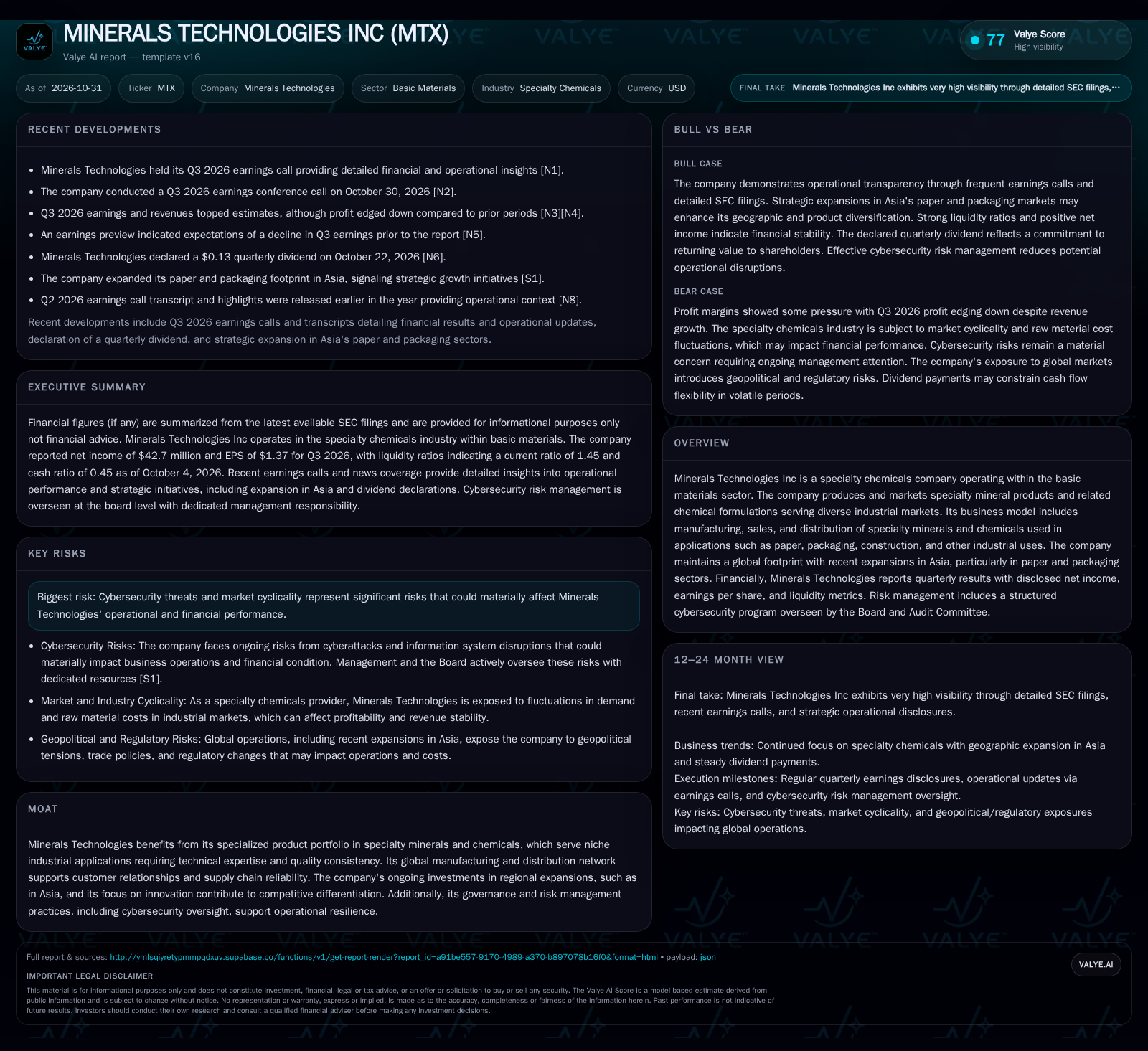
Minerals Technologies Inc. reported strong Q3 2026 revenue and net income alongside an ongoing push into Asian paper and packaging markets. The company's specialty focus, global reach, and risk governance frame both its growth ambitions and exposure to cyclical and geopolitical forces.
Minerals Technologies delivered Q3 2026 results above revenue estimates, maintained a $0.13 dividend, and expanded its Asian paper and packaging presence. Despite reported liquidity position and operational transparency, profit margins softened, underscoring the specialty chemicals sector’s sensitivity to input costs and global demand cycles. Execution in Asia and cost management will shape the next phase.
Minerals Technologies Inc. stands at a crossroads between its stable legacy in specialty minerals and its ambitions for growth in Asia’s high-potential paper and packaging sector. As global demand patterns shift and the company broadens its footprint, Minerals Technologies’ ability to manage costs, innovate, and navigate geopolitical and operational risks will determine whether it can unlock new value or face the limits of its current model.
Recent Results Highlight Expansion and Margin Compression
Minerals Technologies Inc. reported net income of $42.7 million for Q3 2026, with basic and diluted EPS of $1.37, and revenues that exceeded analyst estimates for the period [S2] [N3]. However, profit edged down compared to previous quarters, highlighting ongoing margin pressures despite top-line growth [N4]. The cited source reports dividend-related activity; that disclosure alone does not establish dividend-policy continuity, management confidence, or a material constraint on capital flexibility. [N6] As of early October 2026, the company reported $372.1 million in cash and a current ratio of 1.45 [S2]. The company reported cash and liquidity metrics for the period; these figures do not by themselves establish operating runway, investment capacity, financial flexibility, or financing capacity.
On the strategic front, Minerals Technologies has expanded its paper and packaging operations in Asia, signaling a push to capture new growth opportunities outside its legacy North American and European markets [S1]. The company also continues to emphasize risk management, with a formal cybersecurity oversight structure at the board level [S1]. These facts frame both the company's current health and the key levers that will shape its next phase.
How Minerals Technologies Monetizes Specialty Minerals and Chemicals
Minerals Technologies’ core economics hinge on manufacturing and distributing specialty minerals and chemical formulations. Its product portfolio serves industrial clients in applications like paper, packaging, construction, and environmental remediation. Revenue generation relies heavily on volume contracts with large industrial customers, often underpinned by technical service relationships and long sales cycles. The company’s pricing power is typically limited by the commoditized nature of certain inputs and the cyclical demand patterns in key end markets.
Gross margins are sensitive to raw material costs (notably minerals and energy) and operational scale. Fixed costs for plant operations and R&D create operating leverage, amplifying the impact of volume swings on profitability. When capacity utilization is high and input costs are stable, margins can expand; conversely, margin compression occurs when raw material prices rise or end-market demand softens, as recent results suggest. Expanding into new geographies like Asia could improve the company’s mix by adding higher-growth, potentially higher-margin segments, but also introduces new competitive and regulatory dynamics.
Capital requirements are moderate but persistent, as the company must regularly invest in process innovation, compliance, and capacity expansion to maintain and grow its market position. Dividend payments and potential share repurchases further influence capital allocation decisions, especially during volatile cycles.
Competitive Landscape: Differentiation Versus Commodity Pressures
Minerals Technologies operates in a highly fragmented global specialty chemicals sector, competing with both diversified chemicals conglomerates and regional niche players. Its competitive advantages center on technical expertise, a broad product portfolio tailored to specific industrial processes, and long-standing customer relationships. Proprietary formulations and application know-how can create switching frictions, particularly in paper, packaging, and environmental solutions.
However, these advantages are tempered by several counterforces. Many specialty products face ongoing substitution risk from lower-cost alternatives, evolving customer sustainability requirements, and technological advances (e.g., digital or bio-based materials). Large industrial buyers often wield significant bargaining power, limiting the company’s ability to pass through cost increases. In Asia, new entrants and established local competitors may compete aggressively on price and service, challenging Minerals Technologies to balance global scale with local relevance.
The company’s global manufacturing and distribution footprint, while a source of resilience, also introduces exposure to geopolitical, regulatory, and logistics risks that can erode margins or disrupt supply chains.
Asia-Led Expansion Unlocks Mix and Margin Gains
A favorable scenario sees Minerals Technologies’ Asian expansion delivering both higher revenue growth and improved margins. If the company successfully penetrates the region’s rapidly growing paper and packaging markets, it could benefit from scale efficiencies, better product mix, and stronger customer partnerships. The translation of technical expertise and solutions to these markets may allow the company to secure premium pricing or long-term contracts less vulnerable to commodity price swings.
Confirmation of this scenario would require evidence of sustained revenue growth from Asia, margin expansion attributable to new business, and customer wins with leading regional manufacturers. Additional positive signs would include new product launches tailored to Asian market needs, higher capacity utilization rates, and reduced margin volatility across the cycle.
This trajectory could be falsified if Asian operations fail to scale, if competitive pressures force price concessions, or if expansion costs outweigh incremental profits.
Incremental Growth Amid End-Market Cyclicality
The most plausible near-term scenario is one of incremental revenue growth, with ongoing exposure to cyclical swings in demand and input costs. Minerals Technologies may continue to expand its Asian presence, but growth is likely to be gradual given local competition, regulatory complexities, and the need to adapt products to regional standards. In mature markets, stable customer relationships and steady product innovation could support modest volume and pricing gains.
Margins are likely to remain under pressure as raw material costs fluctuate and buyers push back on price increases.
Falsification would be evident if margin erosion accelerates, if Asian expansion stalls, or if the company is forced to curtail dividends or capital spending in response to external shocks.
Cost Inflation and Geopolitical Shocks Undermine Profitability
The most adverse scenario involves a combination of persistent cost inflation, demand contraction in key end markets, and operational disruptions stemming from geopolitical or regulatory shocks—particularly in newly entered Asian markets. Under this scenario, Minerals Technologies could see further margin compression, forced price concessions, or even facility closures if input costs cannot be passed through to customers.
Additional downside risks include cyberattacks or supply chain interruptions that disrupt operations, as well as tightening regulatory standards requiring unplanned capital outlays. Evidence confirming this scenario would include a sharp decline in net income, dividend reductions or suspensions, negative operating cash flow, or significant restructuring charges.
Falsification of this scenario would be indicated by stable or improving margins, continued cash generation, and successful navigation of regulatory or operational challenges in growth regions.
What Will Determine Minerals Technologies’ Next Phase?
Quarterly revenue and margin trends by business segment and region—especially growth and profitability in Asia—would help test the impact of expansion efforts.
Disclosure of contract wins, customer retention rates, or recurring revenue streams in new markets would clarify the durability of growth.
Tracking raw material and energy cost trajectories, and the company’s ability to pass through these costs, is critical for margin outlook.
Capital expenditure levels and the allocation between maintenance, compliance, and growth projects would indicate strategic priorities.
Updates on cybersecurity incidents or upgrades, if disclosed, would inform operational risk assessment.
Any regulatory developments or geopolitical events affecting the Asian operations would be highly material to growth prospects.
Evidence of new product launches, process innovations, or successful adaptation to local market requirements would support the expansion thesis.
Disclaimer: This is research-only, informational analysis and not investment advice. It may include AI-generated interpretation and general industry context. Always verify important details using primary sources.

Comments