
DXC Technology in Late 2026: AI-Driven Service Model, Margin Pressures, and the Stakes of Competitive Scale
DXC Technology’s latest quarter underscores its commitment to AI integration across consulting, infrastructure, and insurance software services. While the company posts modest profitability and reported liquidity position, the real test is whether its proprietary frameworks and global reach can offset margin pressures and persistent competition from both multinational giants and nimble digital specialists.
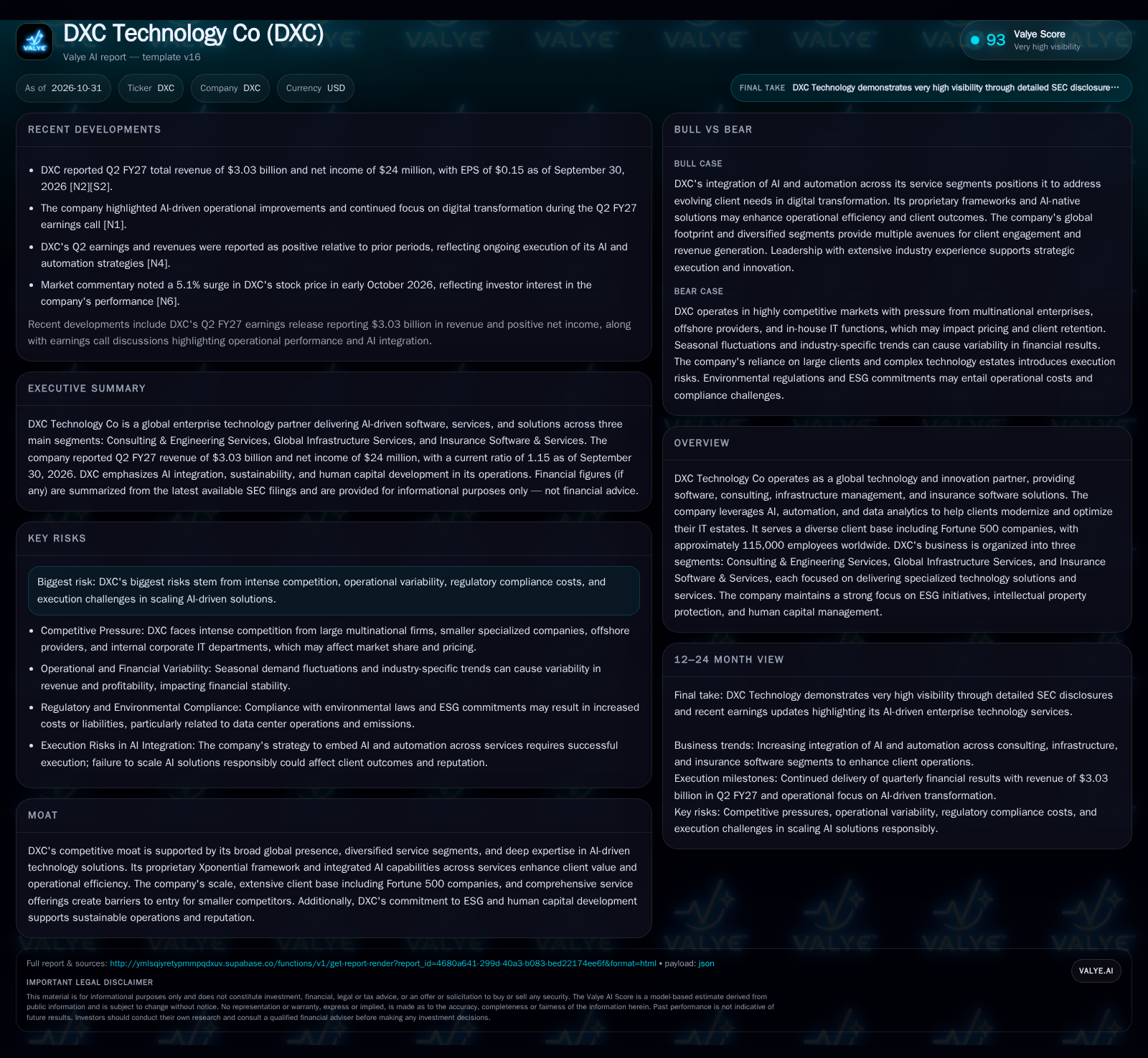
DXC Technology reported $3.03 billion in Q2 FY27 revenue and $24 million in net income, highlighting the ongoing shift toward AI-driven solutions and operational efficiency. The company’s three-segment structure—Consulting & Engineering Services, Global Infrastructure Services, and Insurance Software & Services—targets modernization for a diversified global client base. The question is whether DXC’s scale and proprietary AI frameworks can drive durable margin expansion amid intense competition and execution risk.
DXC Technology enters late 2026 with clear signals of transformation, reporting $3.03 billion in quarterly revenue and a slim but positive net income. Its business mix—spanning consulting, infrastructure, and insurance software—leans heavily on AI and automation to drive client outcomes and operational efficiency. Yet, despite a global presence and deep client relationships, the company’s profit margins remain thin, reflecting the persistent challenge of converting scale and technical investment into sustainable earnings in a fiercely competitive landscape.
Recent Financial Results Reflect Operational Focus and Market Challenges
As of September 30, 2026, DXC Technology reported $3.03 billion in revenue and $24 million in net income for Q2 FY27, translating to basic and diluted EPS of $0.15 [S2] [N2]. This modest profitability comes alongside a cash balance of $1.599 billion, current assets of $4.98 billion, and current liabilities of $4.349 billion (current ratio: 1.15; cash ratio: 0.37) [S2]. The company’s results were met with a positive investor reaction, including a 5.1% surge in stock price in early October 2026 [N6].
DXC attributes its ongoing operational improvements to the deepening integration of AI and automation across its three business segments: Consulting & Engineering Services, Global Infrastructure Services, and Insurance Software & Services [S1] [N1]. However, the scale of net income relative to revenue highlights persistent margin constraints, underscoring the competitive and cost-intensive nature of large-scale IT services.
How DXC’s Segment Structure and AI Focus Shape Its Margin Potential
DXC’s revenue engine is powered by three segments: CES (consulting and software engineering), GIS (infrastructure management), and Insurance Software & Services. Each segment monetizes a mix of project-based consulting, managed services, and software licensing or SaaS offerings. The integration of AI and automation—exemplified by the proprietary Xponential framework—is positioned to drive both topline growth and operational leverage, primarily by automating repetitive tasks, optimizing IT estates, and enhancing client outcomes [S1].
Historically, IT services businesses face a tradeoff between labor-intensive delivery (driving variable costs) and capital-intensive infrastructure (data centers, cloud, mainframes)—with margin expansion hinging on the ability to shift toward higher-value, repeatable, and software-driven engagements. The degree to which DXC can convert its AI investments into standardized, higher-margin recurring revenue will determine its ability to move beyond the modest profitability currently observed [S2].
The company reported cash and liquidity metrics for the period; these figures do not by themselves establish operating runway, investment capacity, financial flexibility, or financing capacity. Sustained margin gains may require further investment in automation, upskilling, and platform development, which could pressure free cash flow if not offset by higher-margin revenue.
Competitive Dynamics: Scale, Specialization, and the Threat of Substitution
DXC operates in a highly fragmented and contested market. Its primary competitors include global IT integrators (e.g., Accenture, IBM, Tata Consultancy Services), focused digital and cloud-native firms, offshore service providers, and increasingly, in-house IT departments at large enterprises [S1]. The company’s broad service portfolio, proprietary IP, and global reach offer some insulation from smaller players, but do not eliminate price-based competition or client churn.
The shift toward AI and automation is a double-edged sword: while it offers operational differentiation, it also lowers barriers for digital-native entrants and could accelerate substitution away from traditional managed services. Switching frictions exist, particularly in mission-critical infrastructure and long-standing client relationships, but are not insurmountable if a competitor demonstrates superior value or innovation.
Talent management, ESG credentials, and the ability to govern complex digital transformations are increasingly important differentiators. However, the presence of large multinational competitors with comparable or greater resources means DXC’s moat is more about breadth and integration than any single proprietary technology.
If AI Integration Drives Standardization and Recurring Revenue Expansion
The most favorable outcome for DXC is that its investment in AI-driven frameworks and automation yields a step-change in service delivery—enabling the company to standardize more offerings, reduce dependence on variable labor, and expand the mix of recurring, software-based revenue. This could lead to durable margin expansion, improved client retention (as automation becomes embedded in client workflows), and the ability to price for differentiated outcomes.
Evidence that would confirm this scenario includes: rising gross and operating margins quarter-over-quarter; increasing percentage of revenue from software and automation-based services (if disclosed); and major client renewals or expansions citing AI-driven value creation. A sustained reduction in cost per engagement and higher win rates in digital transformation projects would also support the thesis.
Falsification would come from stagnant or declining margins despite AI investment, lack of traction in software-based offerings, or continued high client turnover in core segments.
Steady-State: Incremental Efficiency Gains but Persistent Margin Constraints
The most plausible near-term scenario is that DXC continues to grow modestly, achieving incremental efficiency improvements from AI and automation but remaining constrained by intense competition and the labor-intensive nature of much of its service delivery. In this environment, the company’s global reach and segment breadth provide stability, but not breakout profitability.
Confirmation would come from continued low-single-digit net income as a percentage of revenue, stable or slightly rising current ratios, and recurring references to cost optimization and digital transformation wins in earnings commentary. Margin improvement would be gradual and contingent on execution rather than structural change.
Base-case falsification would involve a sharp deterioration in client retention, unexpected cost escalation, or regulatory/compliance costs that outpace operational savings.
Competitive Pricing Pressure and Execution Shortfalls Erode Profitability
In an adverse scenario, DXC is unable to sufficiently differentiate its AI-driven offerings from those of larger or more agile competitors, resulting in sustained pricing pressure and client churn. If clients perceive limited incremental value from DXC’s automation investments—or if digital-native competitors undercut on price and speed—the company could see flat or declining revenue, margin compression, and potential write-downs on technology investment.
Signs of this scenario unfolding would include: declining revenue or negative net income; shrinking cash balances and current ratios approaching or dipping below 1.0; and a rise in restructuring or impairment charges. Loss of major accounts, particularly in the GIS or Insurance Software segments, would further compound downside risk.
Falsification would require evidence of pricing power, margin stability, and new client wins in contested verticals.
Milestones and Metrics That Will Reveal Whether DXC’s AI Strategy Delivers Leverage
Quarterly gross and operating margin trends—evidence of operational leverage from AI and automation.
Revenue mix by segment and by service type (consulting, managed services, software/SaaS)—if disclosed, to gauge progress toward higher-margin offerings.
Client retention rates and average contract duration—a useful metric would be renewal rates in core infrastructure and insurance software segments.
Change in headcount or revenue per employee—if disclosed, as a proxy for automation-driven productivity gains.
Major new contract wins, especially those citing AI or automation as a differentiator.
Cash flow from operations relative to reported net income, to assess underlying earnings quality.
Disclosures on capital allocation to R&D and AI initiatives—would help test the sustainability of investment and innovation.
Disclaimer: This is research-only, informational analysis and not investment advice. It may include AI-generated interpretation and general industry context. Always verify important details using primary sources.

Comments