
Standex International: Portfolio Simplification and Margin Expansion Redefine Industrial Value Creation
Standex’s strategic divestitures and targeted acquisitions have sharpened its focus on high-growth, high-margin industrial segments. The company’s recent performance highlights escalating organic growth in Electronics and Aerospace & Defense, a fortified backlog, and ongoing productivity gains—but integration risks, cost inflation, and execution on new investments remain central to the forward thesis.
Standex International’s recent results reflect the tangible benefits of its portfolio overhaul: double-digit organic growth in core segments, gross margin expansion, and a sizable year-ahead backlog. The company’s disciplined capital deployment and operational focus position it for continued value creation in niche industrial markets, but success will hinge on integrating recent acquisitions and sustaining margin improvements amid ongoing cost and macro risks. [N1] [S2]
Standex International’s transformation from a diversified industrial conglomerate into a more focused, higher-margin manufacturer is visible in its latest results. The company’s portfolio moves—selling off lower-growth assets like Federal Industries and ramping up acquisitions in electronics and aerospace—have begun to reshape its earnings mix, with Q1 fiscal 2027 showing strong organic growth and sharply improved gross margins. A swelling backlog and disciplined capital spending reinforce Standex’s positioning for further expansion, but the challenge now turns to integrating its recent deals and sustaining operational gains in the face of rising interest costs and macro uncertainty. [N1] [S2]
Recent Results Underscore Portfolio Shift and Margin Gains
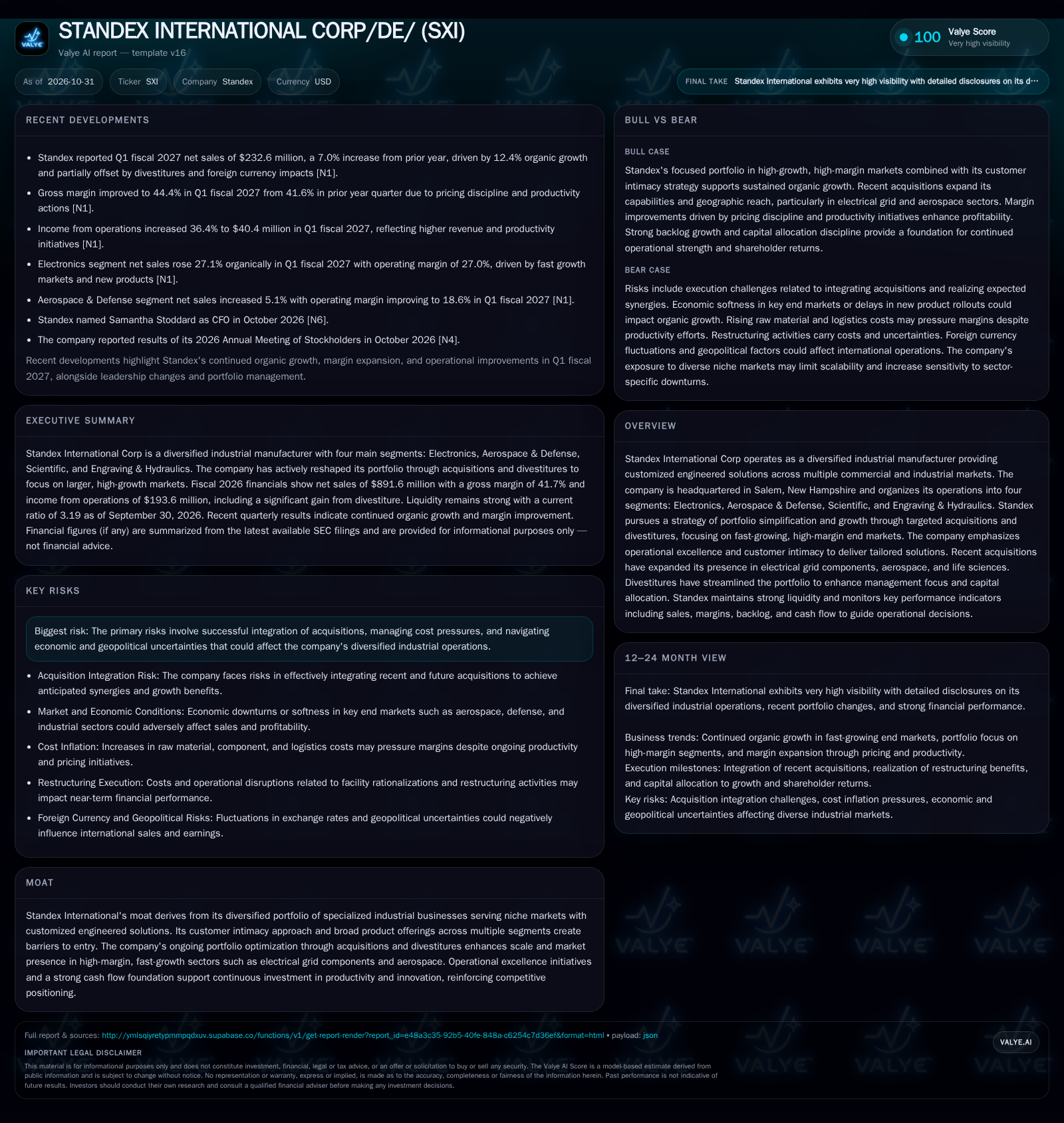
Standex reported Q1 fiscal 2027 net sales of $232.6 million, up 7% year-over-year, with organic growth of 12.4%—a clear signal that its focus on higher-growth end markets is taking hold. The Electronics segment remains the primary engine, delivering 27.1% organic sales growth and a 27% operating margin, while Aerospace & Defense posted 5.1% sales growth and an 18.6% margin. Gross margin reached 44.4%, up from 41.6% a year ago, reflecting pricing power and productivity improvements. The company’s year-ahead backlog rose 37.3% to $338 million, supporting forward visibility. These outcomes follow a series of portfolio moves: the sale of Federal Industries for $68.3 million, and a string of acquisitions in electronics, aerospace, and life sciences. Standex’s interest expense rose to $30.7 million in fiscal 2026, reflecting higher debt from these acquisitions and a 5.71% effective interest rate. [N1] [S1] [S2]
How Standex’s Operating Model Converts Customization into Profitable Growth
Standex’s business model centers on providing customized, engineered solutions—primarily in niche industrial and commercial markets—where product complexity, application specificity, and regulatory requirements limit direct price competition. The company’s shift toward Electronics and Aerospace & Defense tilts its revenue mix toward higher-margin, less commoditized offerings. Gross margin expansion to 44.4% in Q1 fiscal 2027 suggests that pricing discipline and productivity initiatives are translating into improved unit economics, especially as recent acquisitions ramp up. Capital intensity remains moderate: fiscal 2026 capex was $25.2 million (2.8% of net sales), with a planned increase to $45–55 million in fiscal 2027 for growth and productivity projects. This signals a willingness to invest for scale and efficiency, but also requires careful allocation to avoid overextension.
Operating leverage is visible in the improved margin profile, but integration and restructuring costs (e.g., $12.2 million in fiscal 2026) are a counterweight in the near term. The company reported cash and liquidity metrics for the period; these figures do not by themselves establish operating runway, investment capacity, financial flexibility, or financing capacity. The company’s longstanding dividend program suggests disciplined capital allocation, but does not by itself demonstrate excess free cash flow.
Specialization, Customer Intimacy, and the Challenge of Defensible Niche Leadership
Standex’s competitive edge stems from its ability to deliver highly customized solutions, deep application engineering, and responsive service—an approach that could increase switching friction for customers in regulated or mission-critical applications (e.g., aerospace, electrical grid, life sciences). This specialization, coupled with a diversified portfolio across multiple industrial end markets, enables Standex to weather cyclicality in any single sector. However, the company’s niche focus also means that growth is partly contingent on the health and expansion of those specific markets.
Peers in the industrial components and engineered solutions space include both larger diversified conglomerates and smaller, more focused players. The risk is that larger competitors could outspend Standex on R&D or M&A, while smaller, agile firms may undercut on price or innovate faster in select niches. Technology substitution is a latent threat, especially in legacy product lines within Engraving & Hydraulics, but the Electronics and Aerospace & Defense segments are positioned in areas where product complexity and regulatory hurdles slow commoditization. The company’s success will depend on maintaining its customer intimacy strategy while scaling up new platforms and integrating acquired capabilities.
Margin Expansion and Integration Success Drive Outperformance
If Standex is able to fully integrate its recent acquisitions, realize expected synergies, and sustain pricing discipline, the company could achieve structurally higher margins and accelerate earnings growth. Key drivers would include continued organic growth in Electronics and Aerospace & Defense, successful ramp-up of new product platforms, and further backlog expansion supporting revenue visibility. If capital investments yield targeted productivity gains and customer retention remains high, Standex could leverage its improved cost structure into above-peer returns.
This scenario would be confirmed by: margin expansion persisting above 44% gross margin, operating margin steadily rising across segments, backlog growth translating into sequential sales acceleration, and evidence of cross-selling or new market penetration from recent acquisitions. Additional upside would come if the company’s capital allocation discipline allows for both ongoing investment and increased shareholder returns without raising leverage.
Portfolio Focus and Operational Discipline Sustain Steady Value Creation
The most plausible trajectory is that Standex maintains mid-to-high single-digit organic growth, gradually realizes cost and revenue synergies from its recent deals, and keeps gross margins in the low-to-mid 40% range. Backlog remains robust, supporting steady sales, while capital spending is balanced between growth initiatives and maintenance. Integration and restructuring costs persist but diminish over time, allowing operating margins to stabilize.
Confirmation would come from backlog stability, limited negative surprises from integration, and interest expense remaining manageable as earnings grow. Falsification would be signaled by stalled margin improvement, unexpected integration setbacks, or a sharp drop in backlog or order rates.
Integration Setbacks and Cost Pressures Erode Gains from Portfolio Realignment
In a negative scenario, Standex struggles to integrate its recent acquisitions, leading to missed synergy targets, operational disruption, and customer attrition. Rising raw material and logistics costs could outpace pricing and productivity gains, compressing margins. If macro conditions soften in key end markets—especially aerospace or industrials—organic growth could stall, backlog could decline, and revenue visibility would weaken.
Downside confirmation would include operating margin contraction, persistent or escalating restructuring and integration costs, backlog shrinkage, and negative revisions to capital spending plans.
What Will Determine Standex’s Ability to Translate Strategic Moves into Durable Value?
Sustained organic growth rates in Electronics and Aerospace & Defense—quarterly segment disclosures would help test customer traction and end-market momentum.
Gross margin progression—continued improvement above 44% would indicate pricing power and successful productivity initiatives.
Trajectory of backlog realizable within one year—stability or further growth would support forward revenue visibility.
Integration and restructuring cost disclosures—material surprises or missed synergy targets would signal execution risk.
Capital expenditure allocation and returns—tracking spending against productivity or growth outcomes would validate capital discipline.
Interest expense trends relative to operating income—rising financial costs not offset by earnings growth would flag balance-sheet pressure.
Dividends and share repurchase activity—changes in capital return policy could indicate shifting priorities or cash flow constraints.
Progress reports on new product launches or cross-segment synergies—if disclosed, these would provide evidence of innovation and integration success.
Disclaimer: This is research-only, informational analysis and not investment advice. It may include AI-generated interpretation and general industry context. Always verify important details using primary sources.

Comments