
APi Group in 2026: Recurring Revenue, Acquisition Integration, and the Dynamics of Regulatory-Driven Services
APi Group's model leverages regulatory mandates and a diversified, inspection-driven service portfolio to generate recurring revenue across fragmented markets. The company's acquisition-led expansion and decentralized leadership approach remain both its core strengths and principal sources of risk as it seeks to balance growth, integration, and operational discipline.
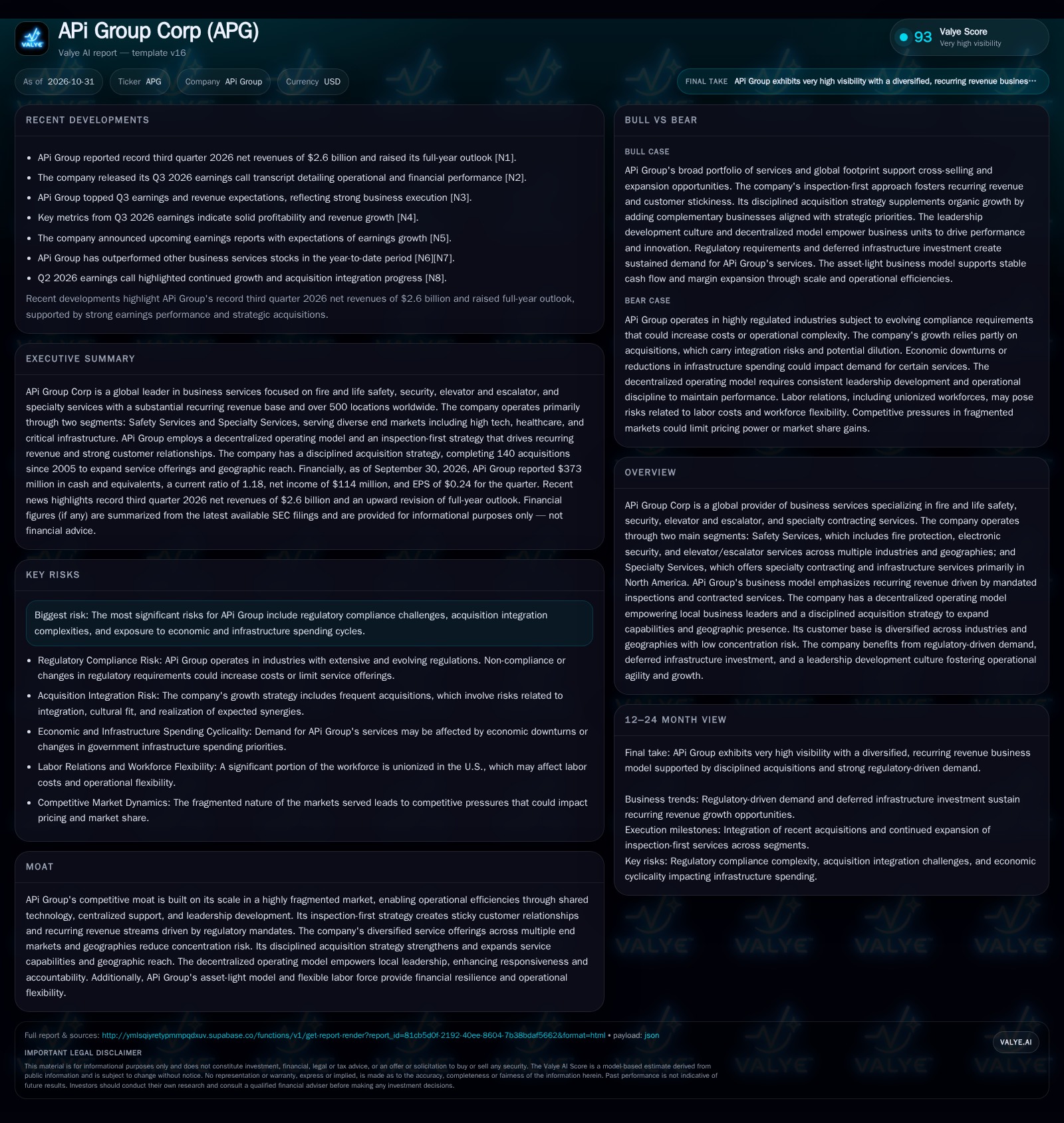
APi Group’s Q3 2026 results highlight a business anchored by recurring, regulation-driven service revenue, a decentralized operating model, and disciplined acquisition activity. Its broad customer base and low concentration mitigate risk, while ongoing acquisition integration and regulatory complexity present persistent challenges. The company’s asset-light, scale-driven economics support stable cash generation, but future performance will hinge on sustaining organic growth, effective integration, and navigating evolving compliance demands. [S1] [S2] [N2] [N3] [N4]
APi Group Corp stands out in the global business services landscape by focusing on fire and life safety, security, elevator and escalator, and specialty contracting services—segments where regulation and recurring inspections are not just features but fundamental revenue engines. As of Q3 2026, the company reported solid profitability and maintains a diversified portfolio buttressed by over 140 acquisitions since 2005. Its decentralized model enables responsiveness and local execution, but the complexity of integrating acquired businesses and navigating regulatory environments remains a persistent challenge. The next phase will test whether APi can sustain organic growth and margin discipline while managing the risks inherent in its acquisitive, multi-segment strategy. [S1] [S2] [N2] [N3] [N4]
Q3 2026 Snapshot: Recurring Revenues, Acquisition Scale, and Low Concentration
APi Group reported net income of $114 million and EPS of $0.24 for the quarter ending September 30, 2026, signaling continued profitability and execution. [S2] [N2] [N3] The company’s recurring revenue base is anchored by regulatory mandates for inspections and contracted services, providing high visibility into future cash flows and reducing cyclicality. [S1] Its diversified customer base—no single customer accounts for more than 5% of revenue—limits concentration risk and supports resilience across economic cycles. [S1] The company’s 140 acquisitions since 2005 have expanded its service footprint and capabilities, but also heighten integration complexity and the need for disciplined management of decentralized operations. [S1]
How Regulatory Mandates and Asset-Light Operations Shape APi’s Cash Flows
APi Group’s economics are fundamentally shaped by its focus on services that are statutorily required—fire and life safety inspections, security system maintenance, and elevator/escalator servicing—which typically translate into recurring, contract-based revenue streams. [S1] This model provides a stable baseline of high-margin service work, with opportunities for cross-selling higher-value specialty services or upgrades during mandated site visits. Pricing power is partly protected by regulatory requirements, though competitive intensity in fragmented local markets can cap upside.
The company reported cash and liquidity metrics for the period; these figures do not by themselves establish operating runway, investment capacity, financial flexibility, or financing capacity. Fixed costs are relatively low, while variable costs—including labor—can be flexibly managed, especially given APi’s mix of unionized U.S. and subcontracted international workforces. [S1] The decentralized structure empowers local business leaders to optimize operational efficiency and customer responsiveness, but maintaining consistency in margins and service quality across hundreds of locations remains a challenge.
Acquisition activity is a double-edged sword for APi: while it enables rapid expansion and portfolio diversification, it also introduces integration costs, potential cultural misalignments, and the risk of overpaying for growth. The company’s ability to realize synergies and avoid dilution from these deals will be a key determinant of long-term margin expansion.
Fragmented Markets and the Quest for Scale Advantages
APi Group’s scale is a potential advantage in highly fragmented business services markets, where thousands of small and regional players compete for inspection, maintenance, and specialty contracting work. [S1] The company leverages shared technology platforms and centralized support functions to drive cost efficiencies, while its broad service offering facilitates cross-selling and deeper customer relationships.
However, regulatory-driven demand also attracts new entrants and keeps local competition fierce, particularly in less capital-intensive and labor-driven niches. Larger, vertically integrated peers—such as multi-national facility services or technical contracting firms—may have similar scale economies and bargaining power with suppliers, but APi’s breadth across fire, security, elevator, and specialty contracting segments provides some insulation from single-market shocks.
Substitution risk is limited by the statutory nature of many core services: building owners and operators have little discretion over fire safety or elevator inspections. Still, the pace of technological change in building automation, remote monitoring, and AI-driven diagnostics could alter the value chain, favoring providers that can integrate new capabilities quickly. APi’s decentralized structure may help it pilot and adopt such innovations locally, but also risks fragmentation if systems and practices diverge.
Margin Expansion and Cross-Selling Fueled by Seamless Integration
The most favorable scenario for APi Group is one where the company successfully integrates recent acquisitions, harmonizes best practices across its decentralized operations, and leverages its inspection-first model to drive higher-margin service and upgrade revenue. In this case, scale efficiencies—such as shared procurement, centralized technology, and leadership development—translate into improved operating margins and accelerated free cash flow generation.
A virtuous cycle could emerge if recurring service contracts lead to more frequent customer touchpoints, enabling APi to cross-sell specialty contracting or infrastructure upgrades, thereby raising average revenue per customer. Regulatory tailwinds—such as tightening safety standards or new inspection mandates—would further bolster demand, while the asset-light model amplifies returns on incremental revenue.
Confirmation of this scenario would include sustained margin expansion, rising service and cross-sell revenue as a share of the total, and evidence of successful acquisition integration (e.g., minimal one-off charges, improved retention of acquired talent, and harmonized customer satisfaction metrics). Falsification would come from persistent integration costs, stalled margin progress, or a slowdown in organic service revenue growth.
Sustained Recurring Revenue with Ongoing Integration and Compliance Complexity
The most plausible outcome is that APi Group continues to generate stable, recurring revenue from mandated inspections and contracted services, with moderate organic growth supplemented by selective acquisitions. The decentralized model enables local adaptation and customer responsiveness, but also requires continued investment in leadership development and operational controls to maintain consistency.
Integration of new acquisitions remains an ongoing process, occasionally resulting in elevated costs or short-term margin dilution, but overall portfolio diversification and low customer concentration support resilience. The regulatory environment remains a double-edged sword: it locks in demand for core services but also requires constant attention to compliance and potential adaptation to shifting standards.
This scenario would be confirmed by steady service and inspection revenue, modest but persistent improvements in operating metrics, and manageable integration costs. Warning signs would include a spike in integration-related expenses, reduced acquisition pace due to lack of attractive targets, or margin compression from competitive or regulatory pressures.
Integration Stumbles and Regulatory Shifts Disrupt Growth Trajectory
The adverse scenario for APi Group centers on failure to integrate acquired businesses, leading to persistent operational inefficiencies, talent attrition, and customer churn. If the company overextends itself with poorly chosen or overpriced acquisitions, expected synergies may not materialize, resulting in margin compression and potential goodwill impairments.
Regulatory environments, while generally supportive, could also turn negative—either through unexpected relaxation of inspection mandates (reducing recurring revenue) or the imposition of more onerous compliance burdens (raising cost structure and complexity). Additionally, if economic or infrastructure spending cycles weaken, demand for specialty contracting and upgrade services may decline, exposing APi to revenue and margin volatility.
Confirmation would include rising integration charges, missed synergy targets, declining margins, customer attrition, or evidence of regulatory changes that reduce core service demand. Falsification would require clear evidence of successful integration, stable or rising margins, and resilient recurring revenue streams despite external shocks.
Milestones and External Factors That Will Shape APi Group’s Thesis
Trends in recurring service and inspection revenue as a percentage of total revenue, if disclosed, to confirm the stability and growth of the core business.
Operating margin trajectory and any one-off charges related to acquisition integration, which would indicate success or difficulty in harmonizing acquired businesses.
Organic revenue growth within core segments versus growth attributable to acquisitions, to assess the underlying health of the business model.
Retention metrics for both customers and key acquired talent, which would signal the effectiveness of integration and leadership development.
Changes in regulatory mandates or enforcement intensity affecting inspection and maintenance requirements in APi’s end markets.
Labor cost trends and workforce flexibility, particularly as union contracts are renegotiated or labor market conditions shift.
Adoption of new technologies in building automation or remote diagnostics, and APi’s ability to integrate and monetize these innovations across its portfolio.
Pipeline of identified acquisition targets and the company’s discipline in valuation and integration planning.
Disclaimer: This is research-only, informational analysis and not investment advice. It may include AI-generated interpretation and general industry context. Always verify important details using primary sources.

Comments