
Insperity in 2026: PEO Economics, Cost Estimation Sensitivity, and the Stakes of AI-Driven HR Service Evolution
Insperity's co-employment PEO model continues to generate revenue through markups on client WSEE payrolls, but a recent net loss and ongoing competitive and cost estimation pressures highlight the sensitivity of margins and the importance of adapting to AI-driven changes in the HR outsourcing landscape.
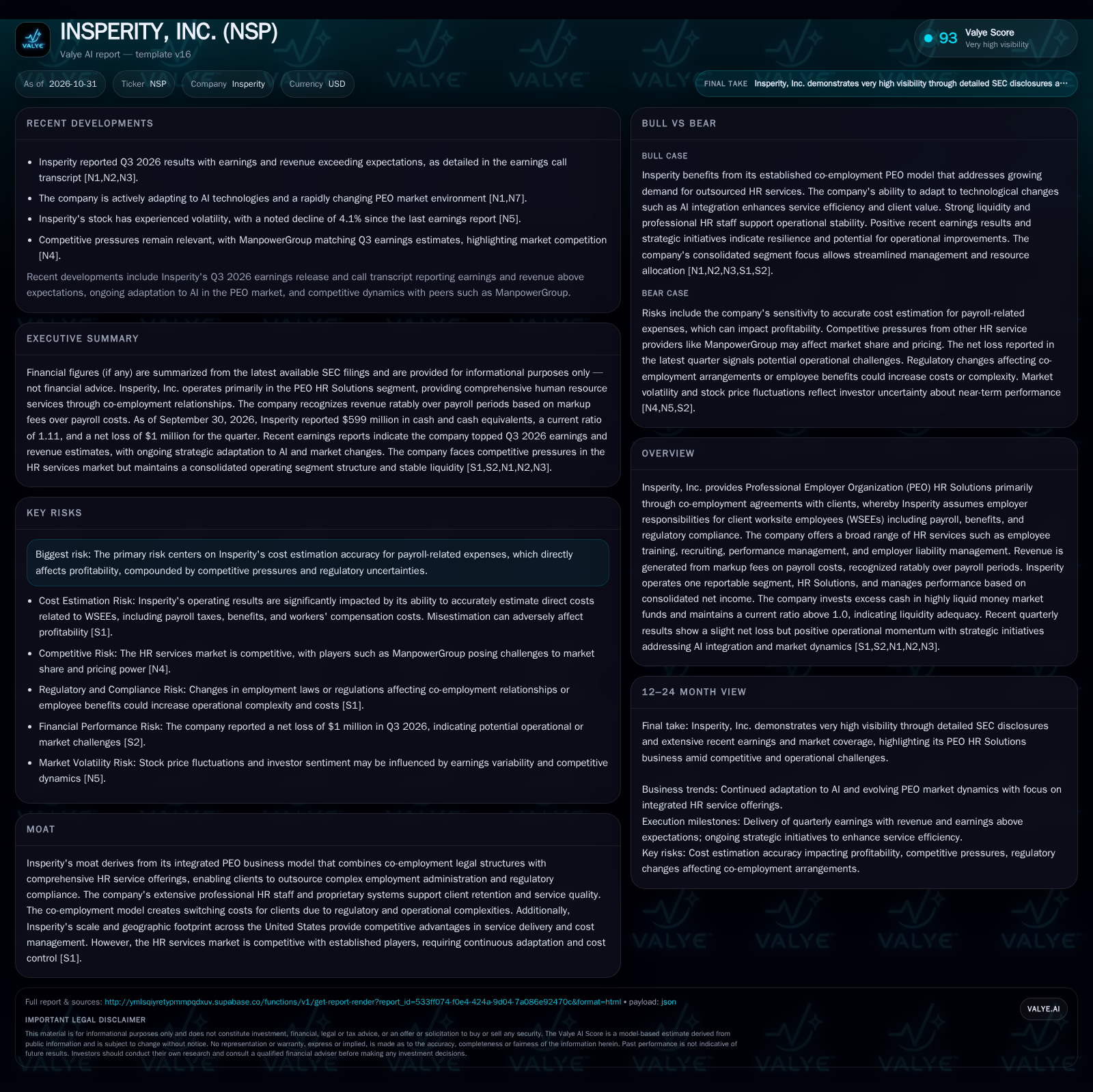
Insperity operates a co-employment PEO business, making money from markups on payroll costs for client employees. Despite topping Q3 2026 revenue and earnings estimates, the company posted a small net loss, underscoring the importance of accurate cost estimation and adaptation to AI and market changes. The critical test is whether Insperity can leverage its HR expertise and technology investments to sustain profitability and defend its market position in a rapidly evolving sector. [S1] [S2] [N1] [N2] [N3]
Insperity stands as a leading provider of Professional Employer Organization (PEO) HR solutions, operating through co-employment agreements that place it at the center of payroll, benefits, and compliance for thousands of client worksite employees. The company's revenue model—dependent on markups over payroll costs—offers recurring potential, but exposes Insperity to the twin risks of cost underestimation and competitive price compression. While Q3 2026 results surpassed analyst expectations for top and bottom line, a modest net loss underscores the margin fragility inherent in the PEO sector. As the HR outsourcing industry is reshaped by AI and evolving client expectations, Insperity's ability to adapt its service portfolio and cost structure will be decisive for long-term value creation. [S1] [S2] [N1] [N2] [N3]
Recent Performance and Strategic Shifts: Q3 2026 in Focus
Insperity reported a net loss of $1 million for the quarter ending September 30, 2026, with basic and diluted EPS of -$0.02. This result comes despite the company topping both earnings and revenue estimates for Q3, as highlighted in recent news coverage and earnings call transcripts. The company reported cash and liquidity metrics for the period; these figures do not by themselves establish operating runway, investment capacity, financial flexibility, or financing capacity. Insperity is actively adapting its business to AI-driven changes in the HR outsourcing market, signaling ongoing strategic adjustments in response to competitive and technology pressures. [S2] [N1] [N2] [N3] [N7]
The company’s PEO model, which generates revenue from markups on client payrolls, remains its core business, but the recent net loss highlights the sensitivity of profitability to cost estimation and market dynamics. Competitive intensity continues, with established HR service providers exerting pricing and retention pressures, while Insperity’s stock has exhibited volatility in response to earnings outcomes and broader market sentiment. [S1] [N5]
How Insperity Monetizes Co-Employment: Revenue Mechanics and Margin Sensitivities
Insperity’s business model is anchored in co-employment agreements, under which it assumes employer responsibilities for worksite employees (WSEEs) of client companies. Revenue is recognized solely on the markup portion over payroll and benefits costs, not on the gross billings that flow through for client employees. These markups are designed to cover the direct costs of employment—payroll taxes, benefits, workers’ compensation—as well as the company’s HR service delivery and corporate overhead. Contracts are generally for 12 months but can be cancelled with 30 days' notice, implying limited revenue visibility and making client retention and service quality crucial for recurring revenue.
The economics hinge on Insperity’s ability to accurately estimate and control direct costs relative to the markup revenue. Small errors in estimating health insurance claims, payroll taxes, or workers’ comp can quickly erode margins, especially since the markup component is typically a modest percentage of total payroll. While the model offers operating leverage if worksite employee (WSEE) volumes grow or if service efficiency improves, it also exposes the company to sudden margin compression if costs spike or if competitive pricing erodes markups.
Capital intensity is low relative to traditional staffing firms, as Insperity’s main investments are in HR technology, professional staff, and working capital to manage payroll flows. The company invests excess cash in highly liquid money market vehicles, reflecting a conservative approach to liquidity management. However, the need to fund payroll and benefits obligations ahead of client remittances can create short-term working capital demands, making liquidity and cash forecasting critical to operational stability. [S1] [S2]
Defending Share in a Crowded HR Outsourcing Arena
Insperity operates in a highly competitive HR outsourcing landscape, facing rivals that range from large PEOs and staffing firms to specialized HR technology and payroll providers. Competitors such as ManpowerGroup offer alternative employment solutions, often with global reach and significant technology investments. The core co-employment structure does create switching frictions for clients—especially those with complex compliance needs—but contracts are cancellable on 30 days’ notice, so retention is not contractually locked-in.
Insperity’s advantages have historically included deep HR expertise, a full-service offering, and the ability to help clients navigate U.S. employment regulations. The company’s scale enables investment in proprietary systems and risk management, which can support service quality and compliance accuracy. However, the HR services sector is seeing increasing technology substitution, with AI-powered platforms and self-service tools eroding some of the traditional value proposition of bundled HR services. Pricing pressure is further intensified by the entry of new tech-enabled HR providers and the commoditization of basic payroll and benefits administration.
To sustain its competitive position, Insperity must not only maintain high service quality and regulatory expertise, but also continuously enhance its technology stack and demonstrate clear value-add versus both low-cost and high-tech alternatives. The question is whether its investments in AI and process automation can defend or expand margins in the face of these counterforces. [S1] [N7]
Margin Expansion Through AI-Driven Efficiency and Value-Added HR Services
The favorable scenario for Insperity is built on successful integration of AI and automation into its HR service delivery, resulting in lower administrative costs per WSEE and improved accuracy in cost estimation for payroll taxes, benefits, and insurance. If Insperity can leverage technology to automate routine HR tasks and provide data-driven insights to clients, it could both enhance retention and justify premium markups, even as basic HR services become increasingly commoditized.
This scenario would be confirmed by sustained or rising operating margins despite competitive pricing pressures, increased client retention rates, and evidence of new value-added service offerings (such as advanced analytics, compliance automation, or personalized employee engagement tools). Additionally, positive trends in WSEE volumes and the ability to upsell existing clients on new services would signal that Insperity’s technology investments are translating into commercial advantage.
A falsification of this scenario would be continued net losses or margin compression despite stable or growing revenue, indicating that technology investments are not yielding the expected efficiency gains or pricing power.
Navigating Margin Volatility in a Mature PEO Market
The most plausible scenario for Insperity is one of stable but pressured economics, with modest growth in WSEE volumes offset by ongoing margin volatility. In this path, Insperity maintains its market share among small and midsize businesses that value bundled HR compliance and benefits, but faces continued pricing pressure from competitors and clients seeking to reduce costs. Technology investments keep the company roughly in line with sector productivity trends, but do not confer a clear cost or service advantage.
Quarterly results are likely to remain sensitive to cost estimation accuracy—especially in health and workers’ comp claims—and to client churn in a market where contracts remain short-term and easily cancellable. Operating margins may fluctuate with changes in benefit cost trends, regulatory adjustments, or shifts in competitive pricing.
Evidence confirming this scenario would include relatively flat or slightly increasing WSEE volumes, stable but unremarkable operating margins, and earnings that fluctuate within a narrow band around break-even. A shift toward either sustained losses or a significant margin rebound would challenge this base case.
Cost Estimation Misses and Competitive Compression Threaten Profitability
The adverse scenario for Insperity involves a combination of cost estimation errors (particularly in health insurance, payroll taxes, or workers’ compensation) and intensified competitive pricing that compresses markup margins. If the company underestimates direct costs for its client WSEEs, even by a small percentage, gross profit can rapidly turn negative given the thinness of the markup layer. This dynamic is exacerbated if competitors aggressively cut prices or if clients migrate to lower-cost or more tech-enabled HR alternatives.
Such a scenario could be triggered by unexpected spikes in healthcare claims, regulatory changes that increase employer liabilities, or a macroeconomic downturn that reduces client payroll volumes. Persistent net losses, declining WSEE volumes, or a sharp drop in client retention would confirm the downside, potentially forcing Insperity to reduce services, restructure operations, or raise external capital if liquidity is insufficient to absorb ongoing losses.
The scenario would be falsified if Insperity consistently demonstrates accurate cost forecasting, maintains stable or improving margins, and avoids significant client attrition despite competitive headwinds.
Testing Insperity’s Thesis: Operational, Financial, and Market Benchmarks to Track
Quarterly operating margin trends, as these directly reflect the balance between markup revenue and cost estimation accuracy. Sustained margin compression would signal underlying weakness.
WSEE (worksite employee) volumes and client retention rates, which are the primary drivers of recurring revenue and a leading indicator of competitive position. A useful metric would be client churn, if disclosed.
Gross profit per WSEE or per client, to test whether technology and service enhancements are translating into higher value capture and efficiency.
New service uptake rates—such as adoption of AI-powered HR modules or advanced analytics—would help confirm the success of technology initiatives.
Trends in payroll tax, health insurance, and workers’ compensation costs relative to revenue, to monitor the company’s ability to estimate and control direct expenses.
Evidence of contract duration shifts or changes in client cancellation rates, which would indicate evolving customer stickiness or competitive pressure.
Disclosure of major regulatory changes or litigation that could affect the economics of the co-employment model.
Disclaimer: This is research-only, informational analysis and not investment advice. It may include AI-generated interpretation and general industry context. Always verify important details using primary sources.

Comments