
Sierra Bancorp’s Record Profitability: What Sustains a Regional Bank’s Earnings Momentum?
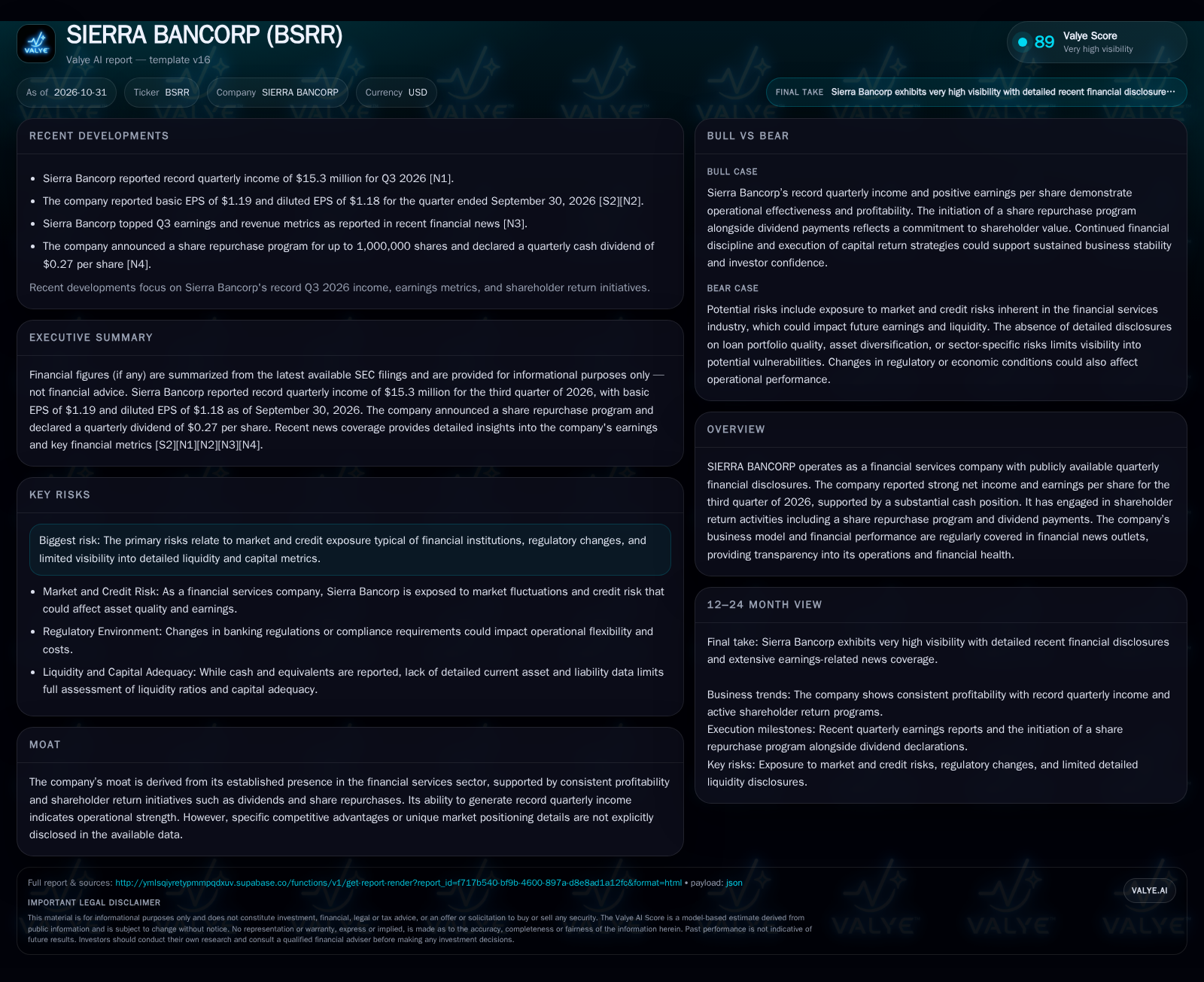
Sierra Bancorp posted record quarterly income of $15.3 million in Q3 2026, but the durability of these results will hinge on loan portfolio robustness, net interest margin management, and the bank’s ability to navigate sector headwinds.
Investors should watch for evidence on loan book health, asset mix, and the bank’s ability to withstand potential regulatory or macroeconomic shocks.
Sierra Bancorp’s record-setting Q3 2026 results—anchored by $15.3 million in net income and $138.3 million in cash—position the bank among the stronger performers in its peer set. Yet, as with any regional financial institution, headline profitability only tells part of the story. The durability of these results will depend on the quality of underlying assets, the bank’s exposure to interest rate and credit cycle swings, and its ability to adapt to regulatory and competitive pressures. While recent quarters have demonstrated operational discipline, investors must probe deeper into asset mix, risk management, and capital allocation to gauge whether Sierra Bancorp’s momentum is built for the long term.
Q3 2026 Results Spotlight: Record Net Income and Cash Reserves
For the quarter ended September 30, 2026, Sierra Bancorp reported net income of $15.3 million—a record for the company—alongside basic earnings per share of $1.19 and diluted EPS of $1.18 [S2] [N1]. The bank also disclosed cash and cash equivalents of $138.3 million at the end of Q3 [S2]. Recent financial news coverage has emphasized Sierra Bancorp’s ability to surpass earnings and revenue expectations, underscoring strong operational execution in the current macro environment [N2] [N3]. These headline numbers point to effective cost control, revenue generation, or both—but without detailed loan portfolio or asset quality disclosures, the sustainability of this performance cannot be fully assessed from the current data.
How a Regional Bank Like Sierra Bancorp Generates Profits—and Where the Leverage Lies
Sierra Bancorp’s core business model is based on traditional banking economics: earning a spread between the interest received on loans and investments and the interest paid on deposits. Net interest margin (NIM) is typically the single most important driver of profitability, with fee income, loan-loss provisions, and non-interest expenses shaping the margin profile. Fixed costs—such as branch operations and regulatory compliance—imply that incremental volume or asset growth can deliver operating leverage, but only if credit quality remains intact.
The reported record income suggests that, at least for Q3 2026, Sierra Bancorp achieved a favorable balance of loan growth, deposit cost management, and credit provisioning. The company reported cash and liquidity metrics for the period; these figures do not by themselves establish operating runway, investment capacity, financial flexibility, or financing capacity. The ability to maintain or expand NIM, control credit costs, and selectively grow assets will determine whether recent profitability can be repeated or improved.
The interplay between interest rate cycles and loan repricing schedules is a critical factor influencing net interest margin sustainability. If Sierra Bancorp’s loan portfolio comprises a significant portion of fixed-rate loans originated during a low-rate environment, the bank may face margin compression as funding costs rise before asset yields adjust. Conversely, a portfolio weighted toward variable-rate loans or shorter-duration assets could allow for more agile margin management. Additionally, the composition of deposits—particularly the ratio of core, low-cost deposits versus volatile market-rate funding—affects the bank's ability to maintain favorable funding costs amid competitive pressures. Thus, the bank’s asset-liability management strategy and its capacity to hedge interest rate risk will be pivotal in preserving profitability.
Competitive Dynamics: Regional Banking Pressures and the Search for Differentiation
Sierra Bancorp operates in a fiercely competitive regional banking landscape, where community and regional banks compete with larger national institutions, credit unions, and increasingly, digital-first financial platforms. Competitive pressures manifest in deposit pricing, loan rates, and the breadth of product offerings. While record profitability indicates recent success, it is not clear from available disclosures whether Sierra Bancorp enjoys a sustainable competitive edge—such as a sticky deposit base, superior underwriting, or specialized local market expertise.
Without explicit data on customer concentration, loan mix, or unique business lines, it is plausible that the company’s performance reflects disciplined execution rather than structural advantages. The risk is that competitors with greater scale or digital capabilities could erode margins or capture share if Sierra Bancorp cannot defend its niche or innovate. Conversely, a well-established local presence and relationship banking model could support stable funding and moderate credit risk, provided customer loyalty remains strong.
The competitive landscape also raises questions about scale economies and technology investment. Regional banks often face challenges achieving cost efficiencies compared to larger national peers who can spread fixed costs over a broader base and invest heavily in digital platforms to enhance customer experience and operational efficiency. If Sierra Bancorp can selectively leverage technology to streamline processes, improve risk analytics, and offer differentiated digital services without disproportionately increasing expenses, it could strengthen its competitive positioning. However, failure to keep pace with technological innovation or to cultivate a distinct value proposition could result in margin erosion or customer attrition, particularly among younger, digitally native demographics.
Moreover, regulatory compliance costs continue to represent a significant fixed expense for regional banks. The ability to manage these costs efficiently without compromising risk management or customer service can create a subtle but meaningful competitive advantage. Banks that develop robust compliance frameworks integrated with technology and data analytics may reduce operational risks and avoid costly penalties. This efficiency can translate into more flexible pricing or reinvestment capacity. Therefore, Sierra Bancorp’s investments in compliance infrastructure and its adaptability to evolving regulatory requirements will materially influence its capacity to maintain profitability amid intensifying sector pressures.
When Record Earnings Become the New Normal: What Would Prolonged Outperformance Look Like?
If interest rates remain favorable and economic conditions support low default rates, the bank could compound earnings growth while deploying excess capital for shareholder returns or selective investments.
Confirmation of this scenario would come from disclosures showing sustained or growing NIM, low non-performing asset (NPA) ratios, and stable or improving efficiency metrics. Evidence of prudent loan growth—without a corresponding spike in loan-loss provisions—would further support the case for durable profitability. Additionally, any demonstration of a differentiated customer franchise (e.g., high deposit retention, unique market share) would bolster the argument for a sustainable earnings base.
Operational Discipline Amid Sector Uncertainty: The Most Likely Trajectory
The most plausible path is that Sierra Bancorp continues to deliver solid, though potentially less spectacular, profitability as it manages through sector headwinds. Earnings may normalize as competitive pressures on deposit pricing and loan yields intensify.
This scenario would be confirmed by moderately positive but stable net income, consistent NIM, and manageable loan-loss provisions in subsequent quarters. Falsifying evidence would include a sharp contraction in NIM, a material increase in non-performing loans, or regulatory actions affecting capital or operations. The test will be whether Sierra Bancorp can maintain its current earnings power as industry conditions revert to a more competitive, less favorable environment.
A Credit Cycle Turn or Regulatory Shock Could Expose Latent Vulnerabilities
In a less favorable scenario, Sierra Bancorp’s profitability could be undermined by deteriorating asset quality, a squeeze in net interest margins, or regulatory tightening. Rising delinquencies or defaults—potentially triggered by macroeconomic stress or sector-specific shocks—would force higher loan-loss provisions, directly impacting net income. Simultaneously, intensified competition for deposits or shifts in interest rates could compress NIM, eroding the operating leverage seen in recent quarters.
Confirmation of downside risk would come from rising NPA ratios, higher loan-loss provisions, or a marked drop in quarterly income. The risk is exacerbated by limited current visibility into loan book composition and sector exposures.
What Will Determine Whether Sierra Bancorp’s Profitability Is Built to Last?
Quarterly net interest margin (NIM) trends, as reported, will be essential for gauging core profitability and the impact of shifts in funding costs or loan yields.
Non-performing asset (NPA) ratios and loan-loss provision disclosures, if provided, would clarify the underlying credit quality and risk-adjusted returns.
Deposit growth and mix (e.g., share of non-interest-bearing deposits), if disclosed, would reveal the durability of the funding base and potential cost pressures.
Loan portfolio composition—by sector, geography, and borrower type—would help assess concentration risk and exposure to cyclical downturns.
Efficiency ratio trends, as available, would indicate management’s ability to control costs and scale operations.
Capital adequacy metrics (Tier 1 capital, leverage ratios), if disclosed, would provide insight into resilience against shocks or regulatory changes.
Evidence of customer retention or core market share, such as repeat business or unique franchise strengths, would help test the thesis of a defensible local moat.
Any announced regulatory actions, consent orders, or changes in compliance requirements could materially alter the risk/reward profile.
Disclaimer: This is research-only, informational analysis and not investment advice. It may include AI-generated interpretation and general industry context. Always verify important details using primary sources.

Comments