
A. O. Smith After China: Portfolio Focus, Margin Dynamics, and the Next Phase of Water Technology Leadership
With the divestiture of its majority China business complete, A. O. Smith faces a strategic moment: can its core water heating and treatment segments, anchored in North America, deliver stable growth and defend margins against intensifying competition and shifting market dynamics?
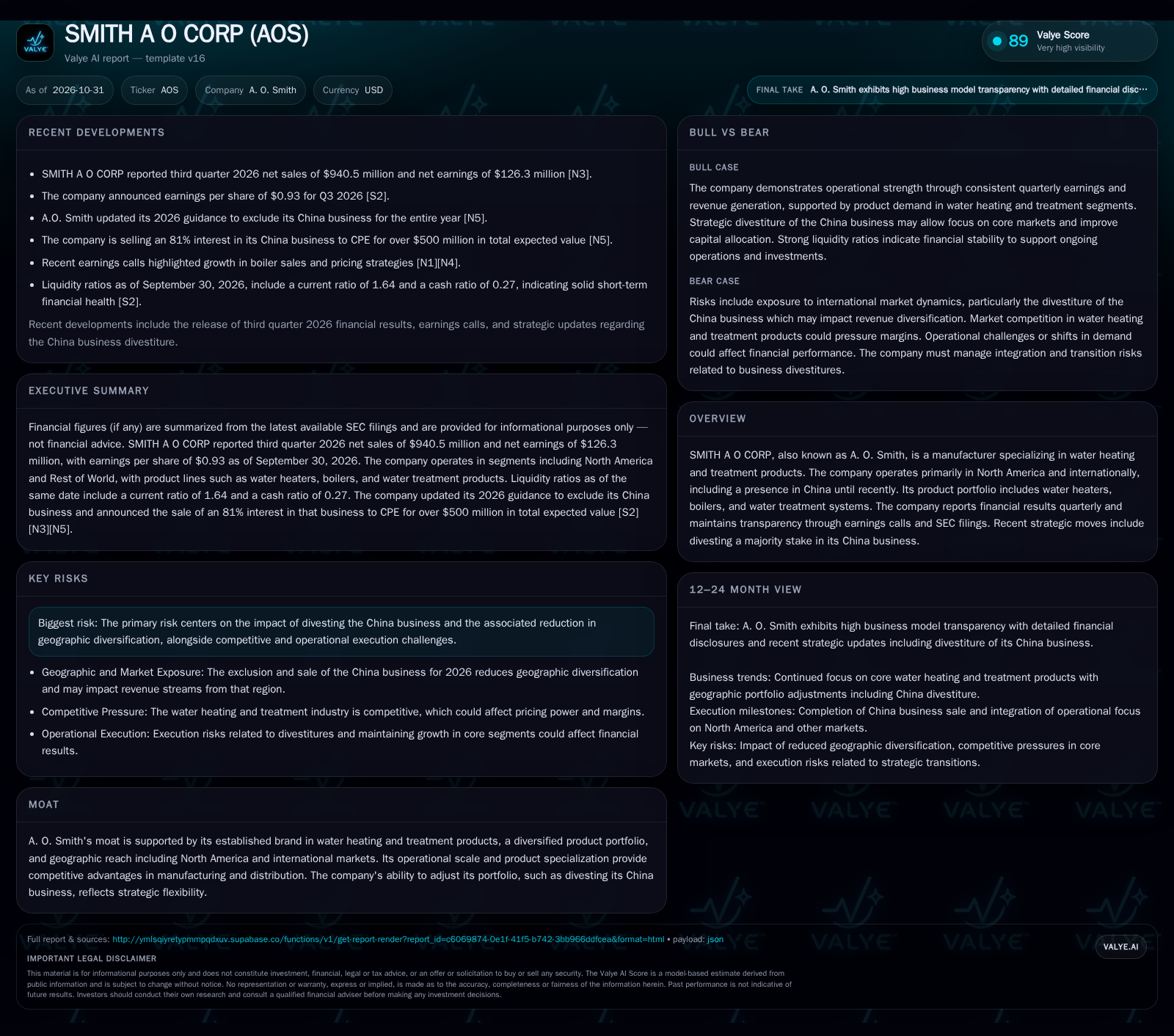
A. O. Smith’s Q3 2026 results reflect robust earnings and a decisive geographic pivot, as the company finalizes the sale of an 81% stake in its China business for over $500 million. This move sharpens the focus on North America and other core markets, but reduces geographic diversification and exposes the company more directly to competitive and cyclical forces in its primary product lines. The critical question is whether operational strengths and product innovation can compensate for the loss of China’s contribution and support sustainable growth and profitability in the coming years. [S2] [N3] [N5]
A. O. Smith’s sale of its majority China business marks a major shift in geographic exposure and capital allocation. With Q3 2026 results showing ongoing profitability and strong sales in core water heating and treatment categories, the company’s future will hinge on its ability to leverage operational scale, product innovation, and pricing power in North America and select international markets. The China divestiture provides capital and strategic clarity, but also heightens exposure to competitive intensity and cyclicality in its remaining segments. The next chapter will test whether A. O. Smith can sustain growth and margin leadership without the diversification and potential growth tailwinds that China once offered. [S2] [N3] [N5]
Strategic Realignment: Divestiture of China Business and Q3 2026 Performance
A. O. Smith reported Q3 2026 net sales of $940.5 million and net earnings of $126.3 million, with basic and diluted earnings per share at $0.93. As of September 30, 2026, the company held $234.5 million in cash and cash equivalents, with current assets totaling $1.411 billion and current liabilities at $862 million, resulting in a current ratio of 1.64 and a cash ratio of 0.27. [S2] [N3]
The most significant recent development is the announced sale of an 81% interest in its China business to CPE, with an expected value exceeding $500 million. The company’s 2026 guidance now excludes the China segment entirely, reflecting a sharper focus on North American and other international operations. [N5]
Earnings calls highlighted strength in boiler sales and the implementation of pricing strategies, which contributed to the quarter’s results. [N1] [N4] The divestiture of China reduces geographic diversification but provides a substantial cash infusion and the opportunity for focused capital allocation.
Core Revenue Streams and the Shifting Economics of Water Heating
A. O. Smith’s business model is anchored in the manufacturing and distribution of water heaters, boilers, and water treatment products. Revenues are primarily generated through product sales to residential, commercial, and industrial customers, with a mix of replacement demand (which tends to be more predictable) and new construction (which is more cyclical). Pricing power is influenced by brand strength, product innovation, and the company’s ability to pass through input cost increases.
Fixed costs in manufacturing and distribution create operating leverage, meaning incremental sales can drive outsized profit gains in periods of volume growth. Variable costs include raw materials (notably steel and electronic components), labor, and logistics. A. O. Smith’s scale in North America provides purchasing and manufacturing efficiencies, but the loss of China may reduce global sourcing advantages and expose the company to higher per-unit costs in certain categories.
The influx of over $500 million from the China divestiture could be used for reinvestment in core operations, targeted M&A in North America or other strategic markets, debt reduction, or capital returns to shareholders. However, the company’s future earnings base will be more dependent on mature, slower-growth regions, raising the stakes for margin management and product differentiation.
Brand Strength Versus Intensifying Competition in Core Markets
A. O. Smith’s competitive advantages include its established brand, broad product portfolio, and deep distribution relationships, particularly in North America. These factors support a degree of pricing power and customer stickiness, especially in the replacement market where product reliability and service support matter.
However, the water heating and treatment industry is highly competitive, with both large multinational peers and regional specialists constantly pressuring margins and innovating on efficiency, connectivity, and price. The company’s exit from China reduces its exposure to a fast-growing but volatile market, but also removes a potential differentiator versus competitors with a more global footprint.
Technology substitution—such as the rise of heat pump water heaters, tankless systems, or integrated smart-home platforms—could erode the company’s traditional product advantages if A. O. Smith fails to keep pace. Additionally, exposure is now more concentrated in regions where regulatory changes, energy standards, and consumer preferences can shift quickly, demanding ongoing investment in R&D and compliance.
Unlocking Value Through Focused Execution and Product Innovation
The favorable scenario is one in which A. O. Smith leverages its capital from the China divestiture to accelerate investment in core product innovation, expand premium offerings (such as high-efficiency or smart-enabled water heaters), and deepen its presence in the North American replacement market. By maintaining or expanding margins through operational efficiencies and effective pricing strategies, the company could offset the loss of China-driven growth.
Evidence that would confirm this scenario includes sustained or rising operating margins, successful launches of new or differentiated products, and above-industry growth rates in key North American and Rest of World segments. Additional signals would be accretive bolt-on acquisitions or share repurchases that drive earnings per share growth, and the ability to retain or grow market share in core categories.
Adapting to a Mature Portfolio: Steady Performance with Lower Growth
The most plausible trajectory is that A. O. Smith delivers stable but modest top-line growth, fueled by replacement demand in North America and incremental gains in selected international markets outside China. The company manages to preserve core margins through ongoing efficiency initiatives and periodic price increases, but faces headwinds from slower growth in mature regions and persistent competition.
Confirming evidence would include revenue and earnings stability in the quarters following the China divestiture, consistent cash generation, and maintenance of current liquidity ratios. Falsifying signals would be a marked decline in sales volumes, margin compression not offset by cost controls or pricing, or a failure to deploy divestiture proceeds in a way that supports long-term growth.
Margin Compression and Cyclical Exposure Amplified by Geographic Concentration
In an adverse scenario, the loss of China’s revenue and earnings contribution exposes A. O. Smith to heightened margin pressure in North America and other remaining markets. Intensifying competition, input cost inflation, and weak new construction activity could erode both top-line and bottom-line performance. The absence of a high-growth geography may limit the company’s ability to offset cyclical downturns or competitive encroachment.
Confirmation of this scenario would come from declining operating margins, negative volume trends, and below-industry revenue growth. Additional warning signs would include increased price discounting, inventory build-ups, or the need to tap additional credit or curtail capital returns due to cash flow constraints.
Milestones That Will Test A. O. Smith’s Post-China Strategy
Execution of the China business divestiture and the final net proceeds realized, including any earn-outs or retained interests.
Quarterly operating margin and gross margin trends in North America and Rest of World, to gauge the company’s ability to defend profitability as geographic mix shifts.
Volume and revenue growth rates by major product category (water heaters, boilers, water treatment), if disclosed, to test demand resilience.
Progress and market adoption of new product introductions, particularly in high-efficiency or smart-enabled segments.
Deployment of divestiture proceeds—whether for M&A, R&D, capital returns, or debt reduction—and the return on these investments.
Competitive pricing trends in core markets, including evidence of increased discounting or share loss.
Changes in working capital and inventory management efficiency, as a signal of demand health and operational discipline.
Disclaimer: This is research-only, informational analysis and not investment advice. It may include AI-generated interpretation and general industry context. Always verify important details using primary sources.

Comments