
Peoples Bancorp Approaches $10B Asset Threshold: Integration, Regulation, and the Stakes of Regional Banking Scale
Peoples Bancorp’s accelerated merger strategy will soon push its asset base above $10 billion, triggering regulatory complexity and new operational demands. With recent earnings growth, a diversified loan book, and substantial investment securities, the bank faces both the promise of scale and the challenge of execution as it navigates integration risk, share dilution, and a shifting regulatory landscape.
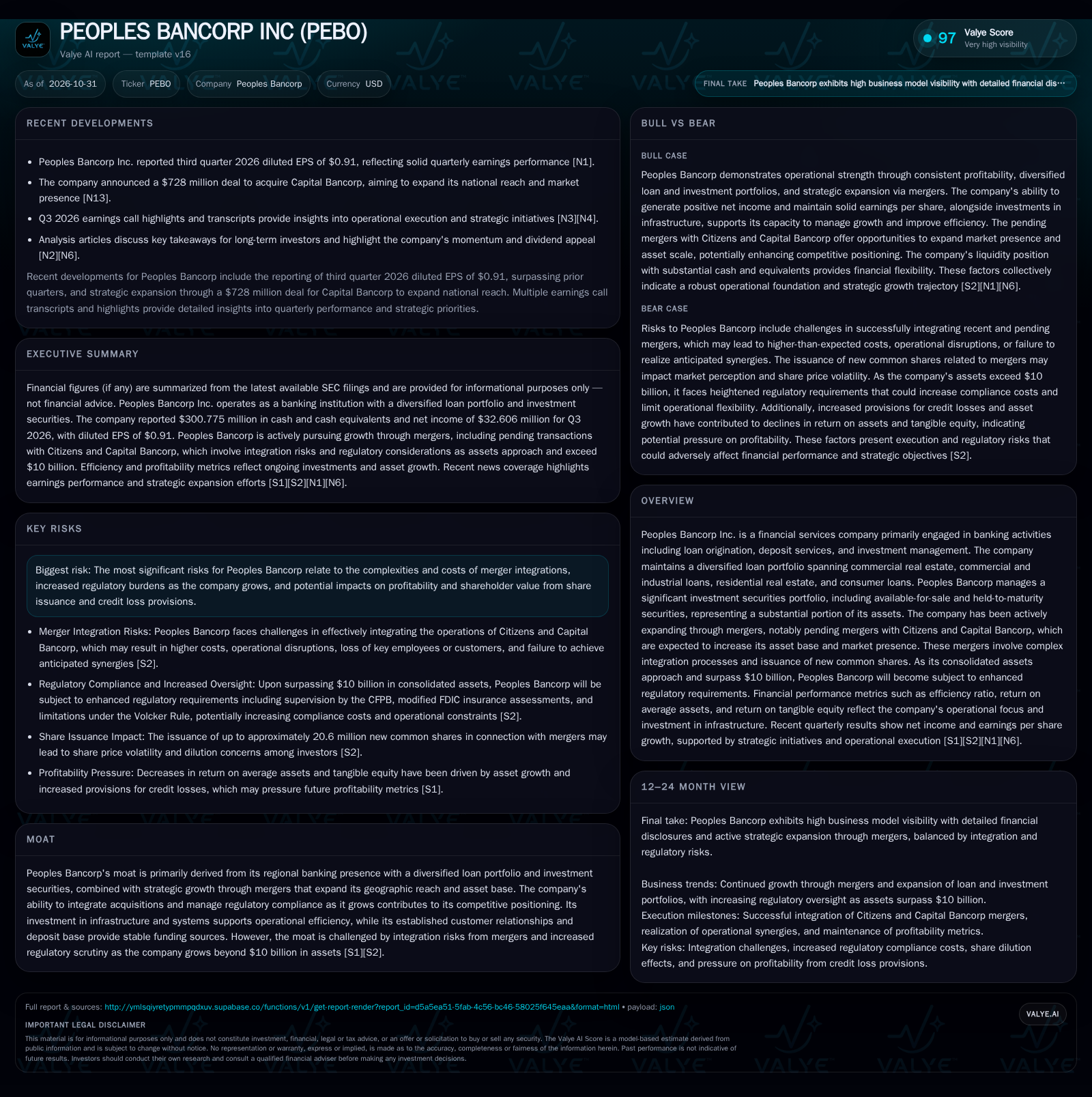
Peoples Bancorp is on the verge of surpassing $10 billion in assets—driven by pending mergers with Citizens and Capital Bancorp—bringing both expanded market reach and heightened regulatory scrutiny. Recent results show solid profitability and a diversified balance sheet, but integration challenges and increased compliance costs may pressure future returns. The coming year will test the company’s ability to realize merger synergies while maintaining efficiency and asset quality as it enters a new regulatory tier. [S2] [N1] [N6]
Peoples Bancorp stands at a strategic inflection point as its asset base is set to cross the $10 billion threshold, propelled by aggressive merger activity. The company’s recent performance underscores consistent profitability and a reported liquidity position, but the real test lies ahead: integrating major acquisitions, absorbing new regulatory burdens, and sustaining returns in a more complex operating environment. As Peoples Bancorp shifts from a regional player to a larger institution, its next moves will reveal whether scale delivers lasting advantage—or brings new vulnerabilities.
Why Peoples Bancorp’s Pending Mergers and Asset Growth Matter Now
Peoples Bancorp recently reported Q3 2026 net income of $32.6 million and diluted EPS of $0.91, sustaining its record of quarterly profitability. The company’s consolidated assets reached $9.65 billion as of September 30, 2026, with the pending Citizens merger expected to boost assets to about $9.9 billion. The subsequent acquisition of Capital Bancorp is projected to push assets above $10 billion—a key regulatory threshold that will subject the company to heightened compliance and supervision. Peoples Bancorp’s $6.76 billion loan portfolio remains diversified across commercial real estate, commercial and industrial, residential real estate, and consumer segments. The company has also disclosed plans to issue up to 20.6 million new common shares related to these mergers, raising questions about dilution and share price impact. These developments set the stage for a period of transformation, operational risk, and increased regulatory scrutiny. [S1] [S2] [N1]
Earnings Power, Balance Sheet Mix, and the Levers of Scale
Peoples Bancorp’s core revenue drivers are net interest income (from lending and securities) and noninterest income (such as fees and service charges). The company’s loan book, diversified across commercial and consumer segments, provides multiple avenues for margin but also exposes it to credit risk cycles. The investment securities portfolio—over $2 billion in cost and about 20.5% of assets—offers liquidity and yield but ties up capital and introduces interest rate sensitivity.
The efficiency ratio, at 58.68% in 2025, reflects ongoing investments in infrastructure and integration costs, suggesting room for operating leverage if synergies from mergers are realized. The company reported cash and liquidity metrics for the period; these figures do not by themselves establish operating runway, investment capacity, financial flexibility, or financing capacity.
If Peoples Bancorp can drive down its efficiency ratio post-merger and extract cost or revenue synergies, incremental earnings could outpace dilution from share issuance. However, reaching the $10 billion asset tier also brings higher regulatory costs (including CFPB oversight and modified FDIC assessments) that may pressure margins unless offset by greater scale or pricing power.
Regional Ambitions Meet the Realities of Banking Consolidation
Peoples Bancorp’s competitive edge to date has been its regional banking presence, diversified lending, and stable deposit base. The pending mergers will expand its geographic footprint, potentially enhancing customer reach and product breadth. However, as it grows, Peoples Bancorp enters a cohort of regional banks where scale brings both opportunity and complexity.
Larger regional peers—often with more advanced digital platforms and broader service offerings—compete aggressively on both price and customer experience. Peoples Bancorp’s moat will depend on its ability to achieve integration without significant customer attrition or operational disruption. The bank’s investment in infrastructure is a double-edged sword: it may support efficiency and compliance, but also raises the bar for returns.
Substitution threats from fintech lenders, digital-first banks, and non-bank credit providers remain ever-present, especially as customer expectations for seamless service rise. The real competitive differentiator may be the company’s ability to deploy its expanded balance sheet into higher-yielding assets while maintaining prudent risk management and regulatory compliance.
If Integration Delivers: How Scale Could Unlock Margin Expansion and Growth
The most favorable scenario sees Peoples Bancorp successfully integrating Citizens and Capital Bancorp, realizing targeted cost and revenue synergies, and leveraging its expanded asset base to drive margin accretion. Achieving a lower efficiency ratio—potentially below pre-merger levels—would signal operating leverage as duplicative costs are eliminated and systems are harmonized.
Enhanced scale could enable better pricing on loans and deposits, access to broader funding sources, and improved negotiating power with vendors. If the bank can maintain or improve asset quality while growing its loan book, returns on assets and equity could rebound, offsetting dilution from share issuance.
Evidence confirming this scenario would include sequential improvements in the efficiency ratio, stable or rising net interest margin, successful retention of key customer relationships post-merger, and minimal credit deterioration. Outperformance on these metrics, alongside positive commentary from management on integration progress, would suggest the thesis that scale is additive rather than dilutive.
What a Measured Transition to the $10B+ Tier Could Look Like
The most plausible path is a transitional period marked by moderate operational disruption and elevated costs as mergers are integrated and the company adapts to new regulatory requirements. Margins may remain compressed in the near term due to overlapping systems, retention efforts, and compliance investments. Return on assets and equity could lag historical levels as earnings growth temporarily trails the rapid expansion of the balance sheet.
Integration risks—employee turnover, customer attrition, and IT challenges—are likely to be manageable but not negligible. Regulatory costs will rise, but the bank’s diversified income streams and prudent credit management may prevent severe profitability erosion.
Confirmation of this scenario would come from stable core earnings, gradual improvement in the efficiency ratio, and asset quality metrics remaining within historical ranges. Any delays in integration or unforeseen credit events could temporarily weigh on results, but the overall franchise would remain intact.
How Integration Setbacks and Regulatory Drag Could Undermine Returns
In a less favorable scenario, Peoples Bancorp encounters significant integration challenges: higher-than-expected costs, operational inefficiencies, and loss of key talent or customers. If merger synergies fail to materialize, the efficiency ratio could deteriorate, and return metrics may fall further as compliance costs mount post-$10 billion in assets.
Share dilution from issuing up to 20.6 million new shares could exacerbate downward pressure on EPS and market valuation, especially if earnings growth fails to keep pace. Adverse credit trends—such as rising nonperforming loans or charge-offs—would further strain profitability.
This scenario would be confirmed by persistent or rising efficiency ratios, sequential declines in ROAA and ROTE, negative surprises in credit quality, or management guidance signaling delays or setbacks in integration. A noticeable drop in customer retention or deposit balances would also indicate franchise erosion.
What Will Reveal If Peoples Bancorp’s Expansion Creates Lasting Value
Quarterly updates on the efficiency ratio, especially post-merger, will show whether integration is delivering expected cost savings.
Net interest margin trends, reflecting both funding costs and asset mix, would help test whether scale is translating into improved profitability.
Nonperforming assets and charge-off rates, if disclosed, will be crucial for assessing credit risk as the loan book expands.
Customer retention and deposit growth metrics post-merger—if disclosed—would indicate franchise stability and the success of integration.
Management commentary on regulatory adaptation and compliance investments will clarify the impact of crossing the $10 billion asset threshold.
EPS trends and return on tangible equity, particularly in the context of share issuance, will reveal whether growth is accretive for shareholders.
Progress on IT system consolidation and integration milestones, as discussed in earnings calls or filings, would provide early signals of operational execution.
Disclaimer: This is research-only, informational analysis and not investment advice. It may include AI-generated interpretation and general industry context. Always verify important details using primary sources.

Comments