
Bandwidth Inc. in 2026: Can Integrated APIs and Financial Discipline Counter Cloud Communications Competition?
Bandwidth’s Q3 2026 results spotlight a profitable quarter, renewed credit flexibility, and ongoing board evolution. The company’s ability to blend network ownership with programmable APIs offers theoretical advantages, but persistent margin pressure, customer concentration, and regulatory complexity mean its path to durable outperformance remains contested.
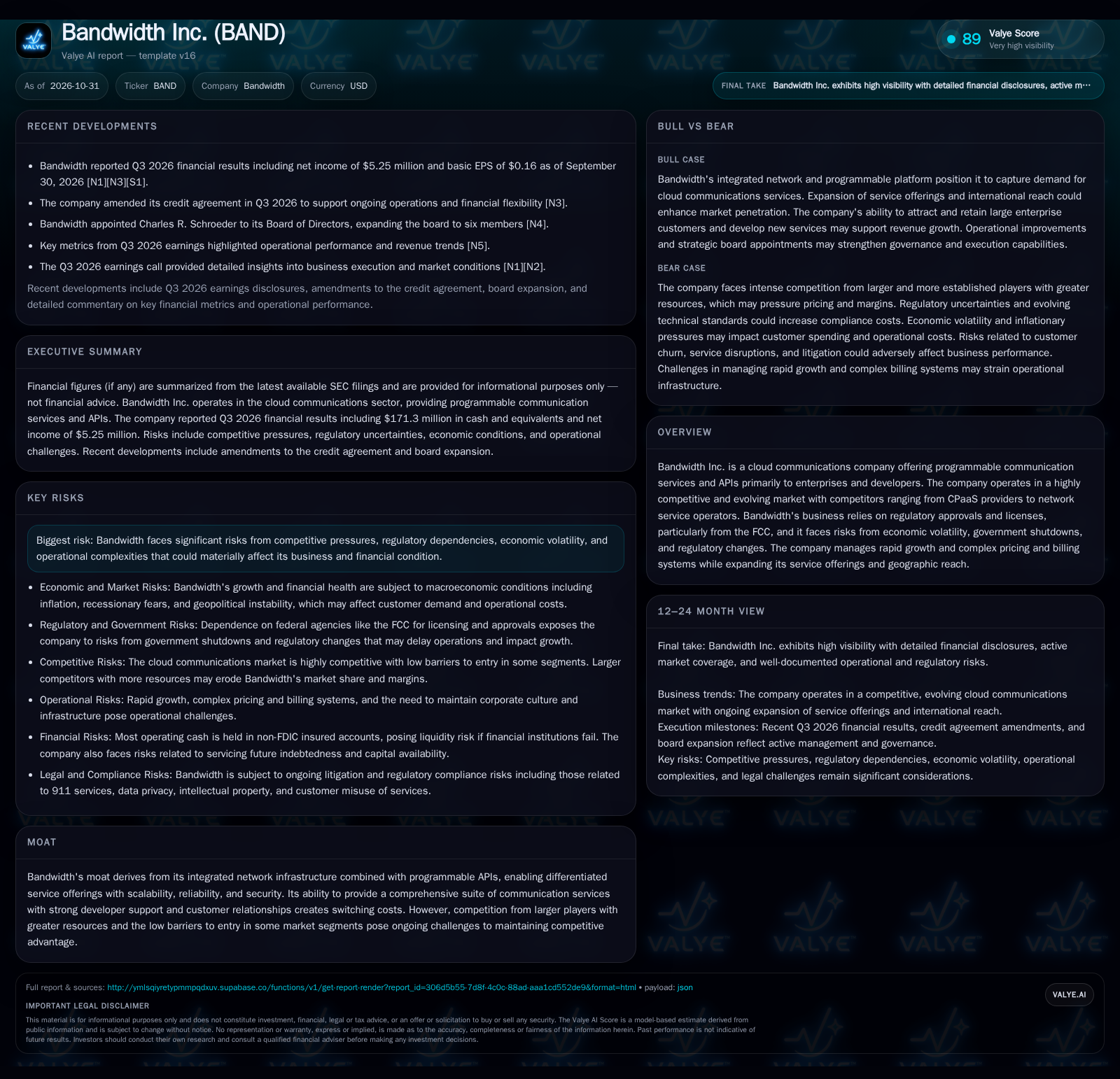
Bandwidth reported Q3 2026 net income of $5.25 million and maintains a reported current ratio of 1.92. Recent moves—such as amending its credit agreement and expanding the board—signal operational focus and governance refresh. Yet, the company’s exposure to intense competition, complex billing, and regulatory hurdles frames its future as a balance between platform expansion and defending margins in a commoditizing space. [N1] [N3] [N4] [S1]
Bandwidth Inc.’s Q3 2026 snapshot demonstrates a company at an inflection point: reporting positive net income, maintaining robust working capital, and actively managing its governance and capital structure. Yet, beneath these headline achievements, Bandwidth faces persistent challenges—chief among them, defending its position in an increasingly commoditized and competitive cloud communications market. As the sector’s economics shift toward scale and integration, Bandwidth’s blend of network ownership and programmable APIs may offer strategic leverage, but only if the company can manage customer concentration, regulatory risk, and the threat of margin erosion.
Recent Financial Results and Strategic Moves: What Changes the Calculus?
Bandwidth reported a net income of $5.25 million for Q3 2026, with basic EPS at $0.16 and a cash and equivalents balance of $171.3 million as of September 30, 2026. The company reported cash and liquidity metrics for the period; these figures do not by themselves establish operating runway, investment capacity, financial flexibility, or financing capacity. [S1] [N1]
Bandwidth amended its credit agreement in Q3 2026, a move that may provide additional potential financial flexibility or improved terms for future operations and growth initiatives. [N3]
Governance saw a refresh with the appointment of Charles R. Schroeder to the Board of Directors, expanding the board to six members. [N4]
These developments matter because they collectively signal a company intent on maintaining operational agility while navigating the demands of a highly competitive, regulated, and rapidly evolving communications landscape.
How Bandwidth’s Economics Reflect Platform Scale and Margin Pressures
Bandwidth’s revenue derives from providing programmable communications services—primarily Voice over IP and related APIs—to enterprise customers and developers. The economics of this model hinge on volume (minutes, messages, API calls), pricing (often usage-based, with some potential for subscription or contract minimums), and the company’s ability to manage network and infrastructure costs.
Owning or operating integrated network infrastructure theoretically allows for better margin capture compared to pure-play CPaaS providers who rely on wholesale arrangements. However, the sector is intensely price-competitive, and the marginal cost of delivering additional communication volume is low, which can lead to price compression and limited gross margin expansion.
Bandwidth faces high fixed costs related to network operations, regulatory compliance (especially 911 and data privacy), and ongoing R&D to keep APIs competitive. Variable costs are driven by network traffic and customer support scaling. The need to continually invest in platform reliability, security, and feature expansion constrains operating leverage, especially if pricing pressure persists.
Customer concentration introduces revenue volatility: the loss or downsizing of a large enterprise client would have a disproportionate impact on both top-line and cost absorption. Meanwhile, as the company expands internationally, tax and regulatory complexity could further affect the cost structure and net margins.
Where Bandwidth Stands in a Fragmented, Fast-Moving Cloud Communications Arena
The cloud communications (CPaaS) market is highly fragmented, with Bandwidth competing against both specialized API providers and large, integrated network operators. Key competitive factors include service completeness, platform scalability, ease of integration, reliability, security, developer support, and global reach.
While Bandwidth’s integrated network and programmable APIs could theoretically could increase switching costs for enterprise customers, the low barriers to entry for many CPaaS functions mean that price-based competition is fierce—especially from global players with greater scale and resources.
In addition to direct CPaaS competitors, traditional telcos and hyperscalers are increasingly embedding communications APIs into broader cloud platforms, raising the risk of Bandwidth’s services becoming commoditized or bundled into larger IT procurement cycles.
Bandwidth’s ability to differentiate may depend on regulatory expertise, feature breadth (e.g., compliance with 911 and data privacy), and customer support. However, these are areas where well-capitalized competitors can also invest heavily, potentially eroding any temporary advantage.
What Would It Take for Bandwidth to Outperform? Platform Depth and Customer Stickiness
A favorable scenario for Bandwidth would see the company leveraging its integrated platform to capture larger, multi-year enterprise contracts—positioning itself as a mission-critical communications partner. If Bandwidth can deepen its service offering (e.g., richer APIs, compliance features, global reach) and demonstrate consistently high reliability, it could increase customer switching costs and reduce churn.
The company’s network ownership could enable margin expansion if it can drive higher utilization and negotiate better interconnect terms, while new international markets offer incremental growth. Operational discipline—reflected in controlled customer acquisition costs and efficient scaling—would support sustainable profitability.
Confirmation of this scenario would come from disclosed metrics such as expanding enterprise contract value, declining churn rates (if disclosed), improving gross margins, and visible traction in new service launches or international markets.
If Competitive Pressures Persist: Defending Share While Managing Margin Compression
The most plausible trajectory for Bandwidth is one where it continues to grow, but at a pace dictated by broader CPaaS market trends and intensifying competition. The company’s integrated platform helps retain a core base of enterprise clients, but pricing pressure from larger players limits material gross margin improvement.
Bandwidth’s international expansion introduces incremental revenue opportunities but also adds complexity and cost. Customer concentration remains a risk, but operational improvements and ongoing product expansion help mitigate churn. Regulatory and litigation risks remain ever-present but are managed as part of the cost of doing business in this sector.
This scenario would be confirmed by steady—but not accelerating—top-line growth, relatively stable (but not expanding) margins, and continued investment in platform capabilities without major step-changes in financial leverage or customer mix.
How Margin Erosion and Customer Loss Could Trigger a Negative Spiral
A negative scenario would unfold if Bandwidth fails to defend its pricing as larger CPaaS and network competitors aggressively undercut rates or bundle communications APIs as loss leaders within broader cloud offerings. Loss of key enterprise customers—given revenue concentration—would amplify the effect, leading to both top-line contraction and under-absorption of fixed costs.
Regulatory shocks (e.g., changes in FCC requirements or international data/privacy laws) could drive up compliance costs or restrict service offerings, while unresolved litigation could result in material settlements or reputational harm.
Signs of this scenario would include declining revenue, shrinking gross margins, customer churn (if disclosed), increased reliance on price promotions, or the need to draw down further on credit lines to fund operations.
Milestones That Will Test Bandwidth’s Platform Advantage and Margin Story
Gross margin trends: Sustained margin expansion would suggest successful platform leverage; margin contraction could indicate intensifying competition.
Enterprise customer concentration: Disclosed changes in top customer revenue share or customer churn would clarify revenue durability.
New international revenue: Growth in international markets, if disclosed, would validate expansion strategy and help diversify risk.
Product adoption and API usage: Increases in usage-based metrics (minutes, messages, API calls), if reported, would indicate customer engagement and platform stickiness.
Operating expense discipline: Trends in R&D and SG&A as a percentage of revenue would reveal scalability and cost control.
Regulatory and litigation outcomes: Updates on major legal or compliance proceedings could change risk assessments.
Credit agreement utilization: Any further amendments or increased borrowing could signal underlying cash flow pressures.
Board and management changes: Additional governance shifts might suggest either proactive refresh or underlying strategic friction.
Disclaimer: This is research-only, informational analysis and not investment advice. It may include AI-generated interpretation and general industry context. Always verify important details using primary sources.

Comments