
Phathom Pharmaceuticals: Exclusivity Battles, Revenue Growth, and Challenges to Sustainability
A 71% Q3 revenue jump and aggressive legal defense of VOQUEZNA’s exclusivity mark a pivotal moment for Phathom Pharmaceuticals. Can the company translate short-term growth—driven by protected market share—into durable economics as legal and competitive threats intensify?
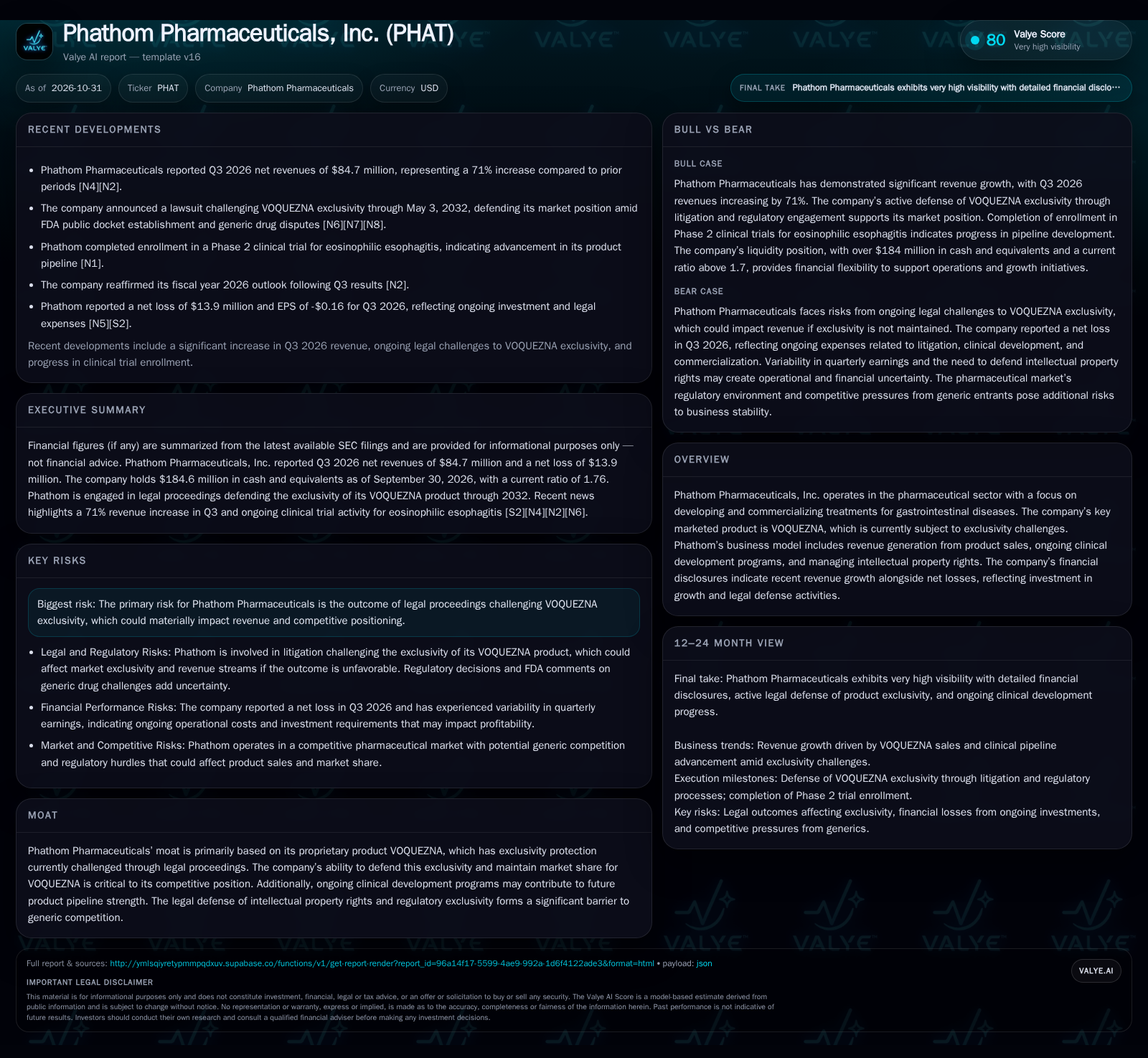
Phathom Pharmaceuticals reported a 71% year-over-year revenue increase to $84.7 million in Q3 2026, but posted a $13.9 million net loss as legal expenses mounted in defense of VOQUEZNA’s exclusivity. With $184.6 million in cash and a current ratio of 1.76, the company faces a defining period: if it sustains exclusivity through 2032, near-term financial momentum could be preserved; but a loss in ongoing litigation may rapidly erode market share and undermine future profitability. The durability of recent growth depends on both legal outcomes and Phathom’s ability to expand its GI franchise beyond VOQUEZNA.
Phathom Pharmaceuticals stands at a strategic crossroads after posting a 71% surge in Q3 2026 revenue, driven by sales of its flagship GI therapy VOQUEZNA. Yet, this momentum is shadowed by a $13.9 million quarterly loss and a looming legal battle that could upend its core market advantage. As the company marshals cash reserves to defend VOQUEZNA’s exclusivity—currently challenged in court with protection at stake through 2032—the question is whether Phathom can convert temporary market insulation into lasting value. The next phase will test whether a single-product moat can withstand both legal and generic threats, and whether pipeline investments will yield a diversified, sustainable franchise.
Q3 2026: Balancing Strengths and Vulnerabilities
Phathom Pharmaceuticals reported Q3 2026 net revenues of $84.7 million, a 71% increase year-over-year, reflecting significant commercial traction for its lead product, VOQUEZNA [N2] [N4] [S2]. However, the company posted a net loss of $13.9 million for the quarter, underscoring the high costs associated with legal defense and ongoing commercialization efforts [S2] [N5]. The company reported cash and liquidity metrics for the period; these figures do not by themselves establish operating runway, investment capacity, financial flexibility, or financing capacity. [S2] The company’s most significant near-term risk is the outcome of a lawsuit challenging VOQUEZNA’s exclusivity, with litigation aiming to secure protection through May 2032 [N6] [N7] [N8]. These facts set the stage for a business model highly sensitive to legal outcomes and the durability of its core product’s market insulation.
Revenue Generation and Cost Structure: Economics Behind VOQUEZNA and Funding
Phathom’s primary revenue stream is sales of VOQUEZNA, a branded therapy for gastrointestinal conditions. Pricing power and gross margins are currently underpinned by regulatory exclusivity, which—if maintained—allows the company to command premium pricing in the absence of generic competition. The surge in Q3 revenue suggests strong uptake, but the business remains exposed to high fixed costs from ongoing R&D, legal, and commercialization expenses. Variable costs are likely moderate relative to revenue, typical for specialty pharma, but the overall cost structure is inflated by the need to defend intellectual property and invest in pipeline expansion.
Profitability is acutely sensitive to the exclusivity window. Should generics enter, ASPs (average selling prices) would likely drop sharply, compressing margins and undermining cash flow. Operating leverage may be positive in the short term if revenue growth persists, but could rapidly turn negative should exclusivity be lost or legal costs escalate unexpectedly.
Future economics will depend on the company’s ability to launch additional indications or products—either extending VOQUEZNA’s lifecycle or bringing new assets to market. Without successful pipeline execution, Phathom risks reverting to a single-product dependency with declining returns as competitive and regulatory pressures mount.
Phathom’s Competitive Edge: Exclusivity, Generics, and Industry Realities
Phathom’s competitive position is currently defined by VOQUEZNA’s regulatory exclusivity, which forms a legal and commercial barrier to generic entry. The moat is therefore both substantial and fragile: substantial because exclusivity allows for premium pricing and market share, fragile because it is under active legal challenge and subject to regulatory interpretation. Should exclusivity be upheld through 2032, Phathom could retain a defensible market niche for several years. However, if the lawsuit is unsuccessful, generic competitors could rapidly erode both price and share.
The broader pharmaceutical landscape is unforgiving to single-product companies. Large pharma players, as well as specialty generic manufacturers, are well positioned to exploit any lapse in exclusivity. The existence of a visible legal dispute may also encourage competitors to invest in challenging both the intellectual property and regulatory status of VOQUEZNA. Downstream, payers and providers may pressure for lower-cost alternatives if generics become available, accelerating the erosion of branded market share.
Phathom’s only clear lever to strengthen its position—beyond legal defense—is to accelerate pipeline development and diversify its portfolio. The company’s ability to convert current revenue into robust pipeline assets will determine whether it remains a one-drug story or evolves into a true GI specialty player.
Growth and Margin Potential from Prolonged Exclusivity
If Phathom prevails in defending VOQUEZNA’s exclusivity through May 2032, the company could continue to enjoy high-margin sales, supporting both near-term profitability and reinvestment in pipeline programs. This scenario would likely see revenue growth maintained or accelerated, as marketing efforts and additional indications drive incremental volume. Operating leverage could improve as fixed legal and launch costs are amortized over a larger revenue base.
Confirmation of this scenario would come from a favorable legal ruling or regulatory guidance explicitly affirming VOQUEZNA’s protection, as well as continued double-digit revenue growth and gross margin stability. Evidence of successful pipeline advancement—such as positive clinical trial data or new product launches—would further reinforce the durability of the growth story.
A falsification of the upside would be signaled by any legal decision curtailing exclusivity, pricing pressure from payers, or a stall in revenue momentum despite exclusivity being maintained, suggesting demand elasticity or market saturation.
Legal Risks and Franchise Expansion in the Gastrointestinal Market
The most plausible trajectory is one in which Phathom faces ongoing legal and regulatory uncertainty around VOQUEZNA’s exclusivity, resulting in revenue and earnings volatility. Near-term sales may remain elevated if exclusivity is preserved, but the company must continue to allocate significant resources to legal defense and pipeline development, limiting margin expansion.
This scenario would be confirmed by continued quarterly swings in profitability, steady cash burn, and incremental—rather than transformative—pipeline progress. The company may achieve moderate growth through label expansions or new GI indications, but the absence of a second major product would keep Phathom exposed to single-asset risk.
Evidence against the base scenario would include a dramatic legal loss, sudden generic entry, or a disruptive new entrant in the GI space, which could force a rapid strategic pivot or capital raise.
Consequences of Exclusivity Loss: Margin Pressure and Strategic Shifts
Should Phathom lose the legal battle over VOQUEZNA’s exclusivity, the market could see swift generic entry, driving down prices and eroding market share. This would likely result in a sudden drop in revenues, negative gross margins, and the need for aggressive cost restructuring. Cash reserves could be depleted rapidly, particularly if legal and operational expenses remain high and revenue declines outpace cost cuts.
In this scenario, Phathom may be forced to scale back pipeline investment, pursue partnerships or licensing deals on less favorable terms, or even consider strategic alternatives such as asset sales or a merger. The company’s negotiating position would be weakened by diminished revenue visibility and compressed margins.
Signs of this scenario materializing would include an adverse legal ruling, public payer moves to prefer generics, or a material guidance cut from management. Rapid inventory write-downs or restructuring charges would further confirm the downside.
Factors Influencing VOQUEZNA’s Prospects and Phathom’s Direction
Progress and outcomes in the ongoing VOQUEZNA exclusivity litigation—court filings, regulatory decisions, or settlements—will be the primary determinant of near-term revenue durability.
Quarterly revenue growth rates and gross margin trends, especially if disclosed by product or indication, would clarify the true drivers of recent momentum.
Pipeline advancement: milestones for new indications, clinical trial readouts, or regulatory submissions would help gauge the likelihood of portfolio diversification.
Product-level sales mix and average selling price (if disclosed) would test the resilience of pricing power as market dynamics evolve.
Guidance updates or management commentary on payer dynamics and formulary status, which may foreshadow pricing or volume pressures.
Any evidence of generic filings, launches, or payer moves to prefer alternatives would be early warning signs for margin compression and share loss.
If disclosed, churn rates or prescription renewal patterns for VOQUEZNA would provide insight into underlying demand stability and competitive response.
Disclaimer: This is research-only, informational analysis and not investment advice. It may include AI-generated interpretation and general industry context. Always verify important details using primary sources.

Comments