
Altisource Portfolio Solutions: Customer Concentration, Mortgage Service Dynamics, and the Challenge of Revenue Diversification
Altisource’s reliance on a single major client and exposure to evolving mortgage market regulations underscore both its revenue stability and its vulnerability. The company’s recent financials and operational disclosures highlight a business at a strategic crossroads, balancing steady service demand with the need to address profitability and concentration risks.
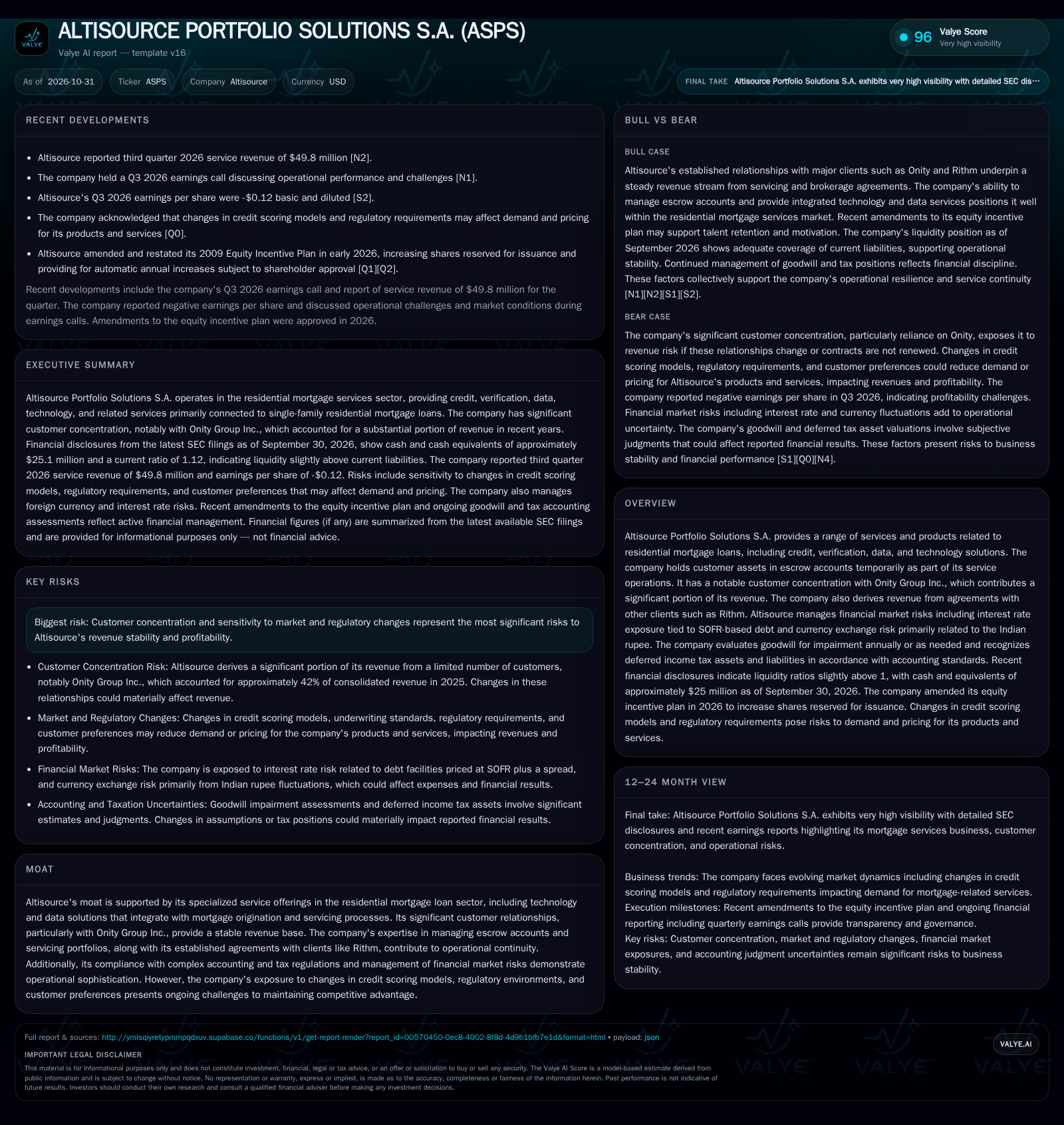
Altisource Portfolio Solutions remains a key player in residential mortgage services, but its 42% revenue reliance on Onity Group Inc. and ongoing losses point to both operational resilience and strategic risk. The company’s reported liquidity position and exposure to market and regulatory shifts present a complex outlook where diversification and margin improvement are increasingly urgent [S1] [S2] [N2].
Altisource Portfolio Solutions occupies a specialized niche in residential mortgage services, providing credit, verification, data, and technology solutions. Its financial disclosures for the third quarter of 2026 reveal a business with steady service demand but mounting challenges: heavy dependence on a single customer, persistent losses, and exposure to shifting regulatory and market dynamics. With liquidity just above minimum comfort levels and a need to adapt to evolving industry standards, Altisource faces a pivotal period where its ability to diversify revenue streams and improve profitability will likely determine its long-term trajectory.
Recent Results Reveal Reliance on Single Customer and Ongoing Losses
Altisource’s latest disclosures underscore two critical realities: a strong dependence on Onity Group Inc., which contributed approximately 42% of consolidated revenue in 2025 ($72.3 million), and continued operational losses, as evidenced by Q3 2026 earnings per share of -$0.12 [S1] [S2] [N2]. Service revenue for the quarter was $49.8 million, indicating a business with meaningful transaction flow but insufficient scale or margin to achieve profitability [N2]. The company’s cash and equivalents totaled $25.1 million as of September 30, 2026, supporting a current ratio of 1.12 and a cash ratio of 1.35 [S2]. The company reported cash and liquidity metrics for the period; these figures do not by themselves establish operating runway, investment capacity, financial flexibility, or financing capacity. Altisource’s reliance on a single large client amplifies revenue volatility risk, while persistent losses highlight the challenge of converting service volume into sustainable earnings.
The operational risks tied to customer concentration extend beyond immediate revenue volatility. A heavy dependence on one client can limit strategic flexibility, as resource allocation and product development may become overly tailored to that client's specific needs, potentially at the expense of broader market applicability. Additionally, this reliance can constrain Altisource's negotiating position, reducing its ability to demand favorable contract terms or pricing adjustments. If the dominant client experiences financial or operational difficulties, Altisource's revenue and cash flow could be disproportionately affected, underscoring the importance of proactive diversification efforts to mitigate systemic risk within its business model.
How Service Mix, Pricing, and Fixed Costs Shape Altisource’s Profitability
Altisource generates revenue primarily through service fees tied to residential mortgage loan processes—credit verification, data provision, and technology-enabled workflow solutions. The economics of this model are influenced by transaction volumes in the mortgage market, the breadth of services provided per loan, and the pricing power Altisource can exert with its clients. With a concentrated customer base, pricing leverage is likely limited, and margin pressure may be exacerbated by client negotiations. Fixed costs—including technology infrastructure, compliance, and personnel—create operating leverage, but this leverage works against the company in periods of sluggish volume or pricing compression. Variable costs are tied to transaction throughput and third-party data or service expenses. [S1] [S2] Future profitability will depend on either volume growth, a shift in service mix toward higher-margin offerings, or successful cost containment.
The interplay between fixed and variable costs in Altisource's service delivery model creates a nuanced profitability landscape. Fixed costs, such as technology platform maintenance and compliance infrastructure, establish a baseline expense that must be covered regardless of transaction volume, meaning that periods of reduced mortgage activity can quickly erode margins. Conversely, variable costs tied to transaction processing scale with volume, offering some operational flexibility. However, the ability to optimize the service mix toward higher-margin offerings is contingent on client acceptance and market demand. Without sufficient pricing power or volume growth, efforts to improve profitability through cost control alone may be insufficient, highlighting the critical role of strategic service innovation and client diversification.
Customer Concentration and Niche Focus: Strength or Structural Weakness?
Altisource’s competitive position is defined by its integration into client mortgage processes and its specialized service portfolio. Its deep relationship with Onity Group Inc. provides revenue stability but also creates a structural vulnerability; the loss or renegotiation of this relationship would materially disrupt results [S1]. In the broader market, Altisource competes with diversified mortgage service providers, fintech data platforms, and technology-driven verification solutions. The company’s value proposition rests on its ability to deliver comprehensive, integrated solutions, yet the lack of broader client diversification limits its negotiating power and may hinder its ability to absorb pricing or regulatory shocks. Technology and regulatory shifts—such as automation in loan verification or changes in credit scoring standards—could further erode the company’s position if it is unable to keep pace with innovation or expand its client roster.
Altisource's niche focus provides both competitive advantages and inherent vulnerabilities. Its specialization enables it to develop deep expertise and tailored solutions that may be difficult for broader competitors to replicate quickly. However, this focus also means the company is more exposed to shifts in its specific market segment, such as regulatory changes or technological disruption. Competitors with more diversified service portfolios or greater scale may be better positioned to absorb shocks or invest heavily in innovation. Therefore, Altisource's ability to maintain its competitive edge will likely depend on continuous investment in technology, agile adaptation to regulatory developments, and strategic efforts to broaden its client base to reduce dependency risks.
Revenue Diversification and Margin Expansion Could Unlock Sustainable Growth
A favorable outcome for Altisource would involve successful expansion of its customer base beyond Onity Group Inc. and Rithm, reducing concentration risk and creating opportunities for cross-selling higher-margin technology and data services. If the company can leverage its existing platform to attract new mortgage originators or servicers—especially as compliance demands and data complexity increase—it could drive higher transaction volumes and improve mix. Margin expansion could also result from automation, tighter expense management, and a pivot toward value-added offerings. Evidence that would confirm this scenario includes a rising proportion of revenue from new or diversified clients (if disclosed), improving operating margins, and stabilization or growth in earnings per share. Signs of successful product innovation or new client wins would further bolster the case.
Incremental Progress Offset by Margin Pressure and Market Headwinds
The most plausible outlook is a continuation of current trends: Altisource maintains its key client relationships and sustains service revenue near current levels, but customer concentration and margin pressure persist. Modest improvements in process efficiency or incremental product enhancements may offset some cost headwinds, but revenue growth remains limited absent new client acquisitions. The company’s ability to navigate regulatory shifts and adapt to evolving credit models will be tested, but unless diversification accelerates, profitability improvements are likely to be gradual at best. Confirmation of this trajectory would include stable but flat or slightly improving revenue, continued negative or marginally improved earnings per share, and no significant change in revenue concentration.
Client Loss or Regulatory Disruption Could Trigger Revenue Shock
A negative outcome would stem from the loss or reduction of the Onity Group Inc. relationship, a significant contract renegotiation, or a sharp decline in mortgage market activity. Regulatory changes—such as new credit scoring models or compliance requirements—could also disrupt Altisource’s service offerings or compress pricing. In this scenario, revenue would drop materially, and the company’s reported liquidity position buffer could be quickly exhausted, forcing restructuring, asset sales, or emergency capital raises. Evidence for this scenario would include a sudden decline in disclosed revenue from major clients, worsening liquidity metrics, or public statements regarding contract losses, regulatory setbacks, or material adverse changes in service demand.
Testing the Resilience and Evolution of Altisource’s Mortgage Service Model
Quarterly disclosure of revenue concentration by client—particularly the share and absolute dollar contribution from Onity Group Inc.—would help gauge diversification progress or risk exposure (if disclosed).
Trends in operating margin and earnings per share should be monitored for signs of margin improvement or further deterioration.
Changes in service mix—such as growth in technology or data-driven offerings versus traditional verification services—would indicate potential for higher-margin revenue streams (if disclosed).
Any new client wins, expansions, or contract renewals—especially with large, diversified mortgage market participants—would signal success in reducing concentration risk.
Regulatory developments impacting credit scoring, mortgage underwriting, or servicing requirements could materially affect Altisource’s addressable market and pricing power.
Announcements on technology platform upgrades, automation initiatives, or new product launches would help test the company’s ability to adapt to industry shifts.
Disclaimer: This is research-only, informational analysis and not investment advice. It may include AI-generated interpretation and general industry context. Always verify important details using primary sources.

Comments