
Garrett Motion in 2026: Turbocharger Leadership, Electrification Bets, and the Stakes of Industry Transition
Garrett Motion’s strong Q3 2026 results underscore its durable position in turbochargers and aftermarket, but the company’s future will hinge on its ability to translate heavy R&D investment in electric and zero-emission vehicle technologies into commercial wins as the mobility landscape evolves.
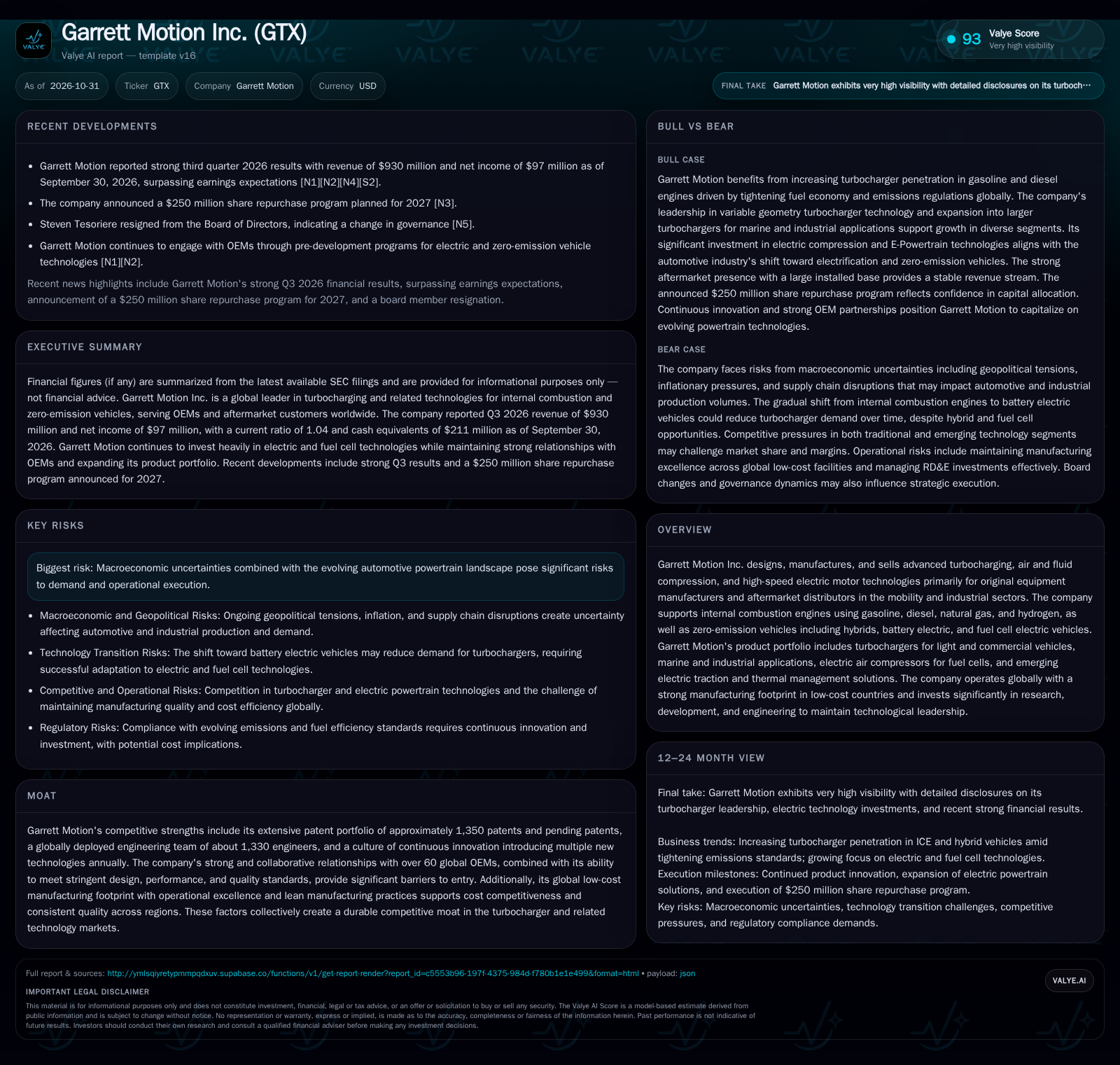
Garrett Motion delivered robust Q3 2026 financials and announced a $250 million buyback, reflecting confidence in its turbocharger and aftermarket business. However, the company’s long-term trajectory depends on its execution in electric powertrain and thermal management, as global regulatory and technological shifts accelerate the transition away from internal combustion engines. The installed base and OEM ties provide a foundation, but the pace of electrification adoption and competitive moves in both legacy and emerging markets remain key variables. [S2] [N3]
Garrett Motion enters late 2026 with strong financial momentum, leveraging its global leadership in turbochargers and a vast aftermarket footprint. While its core business continues to benefit from regulatory-driven turbocharger adoption and operational scale, the company is at a strategic crossroads. Approximately half its R&D investment now targets electric and zero-emission vehicle technologies, revealing both a proactive adaptation strategy and exposure to the uncertain pace of vehicle electrification. The balance between extracting value from the installed base and securing a foothold in the next era of mobility will define Garrett’s competitive and financial future. [S2] [N3]
Recent Results, Capital Actions, and Shifting Technology Focus
Garrett Motion reported Q3 2026 revenue of $930 million and net income of $97 million, exceeding analyst expectations and reinforcing the resilience of its turbocharger and aftermarket segments despite macroeconomic challenges. The company holds a cash balance of $211 million, with a current ratio of 1.04 and a cash ratio of 0.14 as of September 30, 2026. These metrics reflect a stable, if not abundant, liquidity profile. In a notable capital allocation move, Garrett announced a $250 million share repurchase program for 2027, signaling management’s confidence in the underlying business and commitment to shareholder returns. Operationally, the company continues to direct approximately 50% of its research, development, and engineering expenditure toward electric compression and E-Powertrain technologies, highlighting a decisive pivot toward electrification and future mobility platforms. [S2] [N3]
How Garrett Makes Money: Volume, Mix, and the Electrification Investment Equation
Garrett’s core economics are rooted in supplying high-volume, engineered turbocharging systems to global OEMs and servicing a vast aftermarket installed base—nearly 150 million vehicles. The business benefits from scale, recurring replacement demand, and the complexity required by increasingly stringent emissions and efficiency standards. While turbochargers for internal combustion engines (ICEs) remain the primary revenue and profit drivers, the company’s product mix is gradually shifting to include electric compressors for fuel cells and e-turbo solutions for hybrid and zero-emission vehicles.
Pricing power is historically modest in OEM relationships, but Garrett’s technological leadership in variable geometry turbochargers (VNT) and its patent portfolio support some pricing resilience, particularly for advanced or emissions-critical systems. The aftermarket segment is typically higher margin and less exposed to OEM pricing pressure, providing a stabilizing cash flow source.
Operating leverage is present but not extreme—manufacturing is capital-intensive but offset by a global low-cost footprint. Variable costs remain significant due to materials and logistics. The allocation of roughly half of RD&E to electrification is a strategic capital deployment, but near-term returns are uncertain: such investments may not yield material revenue for several years, depending on OEM adoption cycles and the pace of regulatory change. If Garrett succeeds in winning major electric platform programs, the long-term margin and revenue potential could be significant, but the payback period is inherently risky and lumpy.
Defending the Turbocharger Moat While Chasing New Powertrain Opportunities
Garrett Motion’s competitive strengths are multifaceted: an extensive patent portfolio (~1,350 patents and pending), a globally distributed engineering force, and deep integration with over 60 OEMs. Its operational excellence in low-cost manufacturing countries helps sustain cost competitiveness, and the company’s reputation for meeting rigorous performance and reliability standards is a meaningful barrier to entry in the turbocharger market.
However, the competitive landscape is shifting. In ICE and hybrid segments, Garrett faces established global players in turbocharging and increasing price pressure as OEMs consolidate suppliers. In electrified powertrain components, it confronts both traditional competitors and new entrants—many of whom have deep relationships with EV-first OEMs or bring differentiated expertise in high-speed electric motors and thermal management.
Substitution threats are real: as battery electric vehicles (BEVs) gain share, the addressable market for turbochargers could decline, especially in regions with aggressive electrification policies. The company’s ability to leverage its engineering and manufacturing strengths into next-generation products—such as electric compressors and E-Powertrain modules—will determine whether it can defend its moat as the industry transitions.
Electrification Bets Pay Off: From Pre-Development to Platform Wins
In a favorable scenario, Garrett’s heavy investment in electric compression and E-Powertrain translates into significant commercial wins with major OEMs as the market for hybrid, fuel cell, and BEV platforms accelerates. The company’s pre-development programs with OEMs could convert into multi-year supply contracts, leveraging its engineering reputation and global support infrastructure.
Evidence supporting this scenario would include new program awards for electric traction or thermal management systems, public announcements of partnerships with leading EV manufacturers, and a rising share of revenue from electrified vehicle components. Margin expansion could result if these new products command premium pricing due to their technical complexity or regulatory necessity.
This upside depends on the pace of electrification, Garrett’s ability to out-innovate both legacy and new competitors, and OEM willingness to outsource critical electric powertrain components. A surge in hybrid and fuel cell vehicle adoption—where turbo-like technologies remain relevant—would further amplify the opportunity.
Hybrid World: ICE Strength Endures, Electrification Progresses Gradually
The most plausible scenario is a prolonged transition period in which ICE and hybrid vehicles continue to dominate global production, especially in markets outside Europe and China. Turbocharger demand remains robust due to increasingly stringent emissions and fuel economy regulations, and Garrett’s installed base and aftermarket business provide stable cash flows.
Electrification initiatives yield incremental, rather than transformative, revenue in the next 2-3 years. The company’s R&D investment in electric powertrain technologies positions it for future growth, but near-term financials are still driven by legacy products. OEM pre-development programs lead to selected platform wins, but adoption is gradual and margins in new segments may initially lag those of mature turbocharger products.
Confirmation would come from continued strong results in turbochargers, modest but growing revenue from electric products, and sustained aftermarket performance. Falsification would involve a sudden drop in ICE-related demand or failure to secure meaningful electrified platform contracts.
Accelerated Disruption: ICE Decline Outpaces Electrification Revenue
The principal risk is that the pace of ICE vehicle decline—driven by regulatory mandates, consumer adoption of BEVs, or technological breakthroughs—outstrips Garrett’s ability to replace lost turbocharger revenue with new electrified offerings. If OEMs rapidly shift to in-house development or select competitors for electric powertrain components, Garrett could see its core business erode while its new technology investments fail to gain scale.
Other downside triggers include execution missteps in scaling new technologies, delays in OEM program launches, or intensified price competition in both legacy and emerging segments. External shocks—such as geopolitical disruptions affecting the company’s low-cost manufacturing base—could also impair operational continuity and margin structure.
Downside evidence would include declining turbocharger volumes, stagnant or falling aftermarket sales, lack of publicized electric platform wins, or margin compression from failed product launches or cost overruns.
Milestones and Metrics That Will Define Garrett Motion’s Strategic Trajectory
Progression from pre-development to awarded production contracts for electric compression and E-Powertrain systems—especially with top-tier OEMs—would help validate the electrification strategy.
The proportion of total revenue derived from electrified vehicle components, if disclosed, will reveal the pace of business model transition.
Updates on aftermarket sales growth and margin trends will indicate the durability of the installed base as a financial anchor.
OEM customer concentration metrics—especially any changes in share from the largest customers—could signal shifting competitive dynamics or risks.
Operational updates regarding manufacturing efficiency, cost structure, or supply chain resilience, particularly in light of geopolitical or inflationary pressures.
Material announcements of new patents, product launches, or technology partnerships in electric and zero-emission segments.
Board or management changes that may influence strategic direction, capital allocation, or risk appetite.
Disclaimer: This is research-only, informational analysis and not investment advice. It may include AI-generated interpretation and general industry context. Always verify important details using primary sources.

Comments