
West Bancorporation’s Q3 2026: Efficiency Gains and Asset Quality in a Changing Midwest Market
West Bancorporation’s operational improvements and pristine asset quality set it apart in the Midwest community banking sector. The question is whether these strengths can sustain above-peer returns as competitive, technological, and economic forces reshape the region’s financial services landscape.
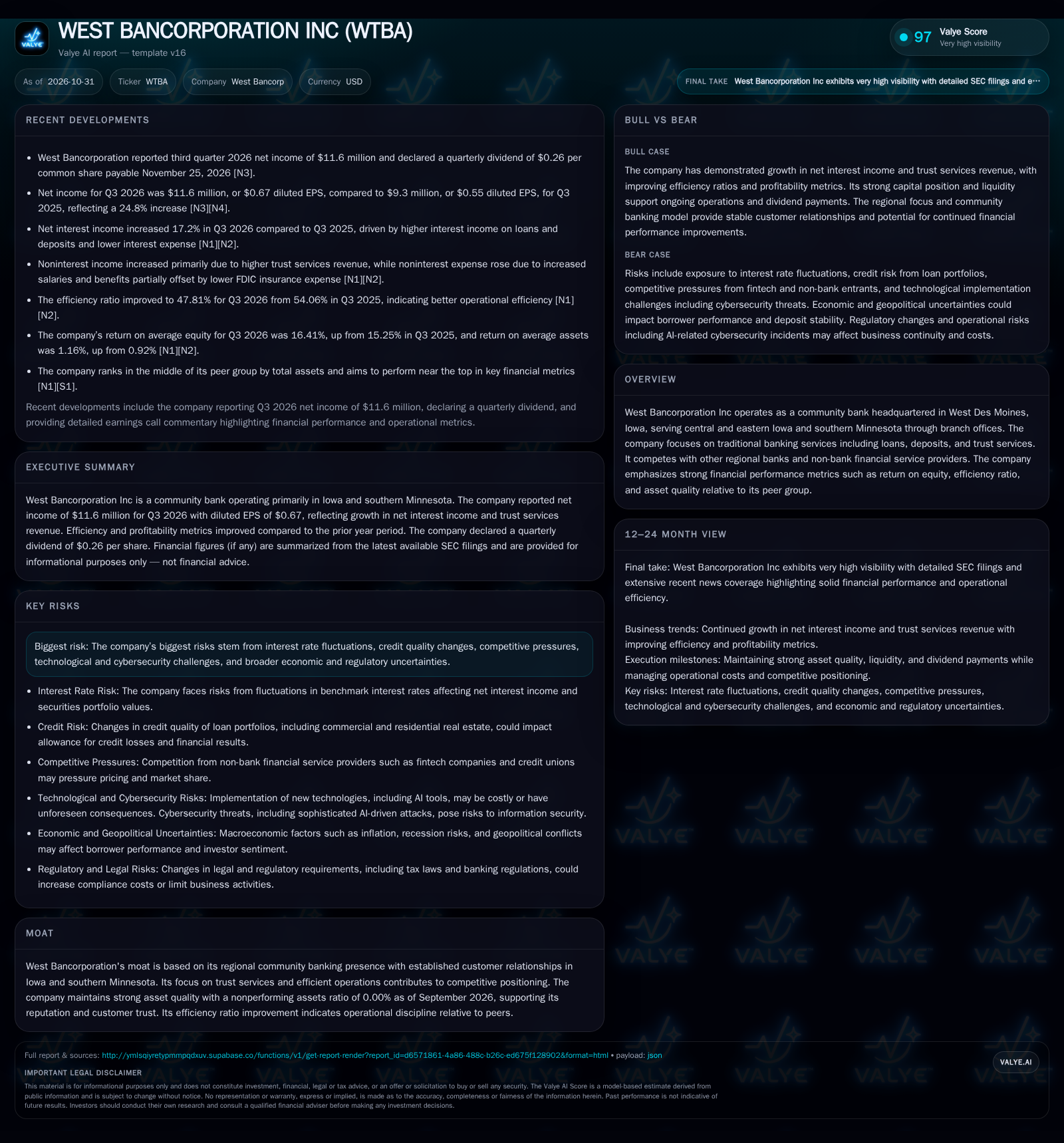
West Bancorporation delivered improved efficiency and profitability in Q3 2026, with net interest income rising 17.2% and nonperforming assets at 0.00%. Operational discipline and strong asset quality have supported above-peer metrics, but the durability of these advantages will be tested by rising salaries, fintech competition, and macro uncertainty. Future outperformance depends on maintaining cost control while adapting to evolving customer and regulatory demands. [N1] [N2] [N3]
West Bancorporation Inc has posted a standout quarter, combining robust net interest income growth, sharp operational efficiency gains, and peer-leading asset quality in its core Iowa and southern Minnesota markets. With a 17.2% year-over-year jump in net interest income and a zero nonperforming assets ratio, the bank has outperformed many Midwestern community peers on core metrics. However, rising personnel costs and intensifying competition from fintechs and non-bank providers test the durability of its current advantage. The next phase for West Bancorp will hinge on its ability to manage cost pressures and technological adaptation without sacrificing its hard-won efficiency and asset quality. [N1] [N2] [N3]
Q3 2026 Highlights: Efficiency and Asset Quality at the Forefront
West Bancorporation reported net income of $11.6 million for Q3 2026, benefiting from a 17.2% increase in net interest income compared to the same quarter last year, with the improvement attributed to both higher interest income on loans and deposits and lower funding costs. The bank’s efficiency ratio improved materially to 47.81% from 54.06%, reflecting greater operational discipline and cost control. Asset quality remains a core strength, as the ratio of nonperforming assets to total assets was 0.00% as of September 30, 2026—a rare achievement among regional peers. However, noninterest expense rose, mainly due to increased salaries and employee benefits, indicating that cost inflation is starting to impact the bank’s expense base. These facts set the stage for a critical debate: can West Bancorporation sustain its high efficiency and asset quality as competitive and economic pressures mount? [N1] [N2] [N3]
Midwest Community Banking: Profitability and Cost Dynamics
Community banks like West Bancorporation generate most of their revenue from net interest income—the spread between interest earned on loans and paid on deposits and borrowings. The 17.2% YoY net interest income growth in Q3 2026 signals successful balance sheet management, likely aided by repricing assets more quickly than liabilities in a shifting rate environment. The net interest margin rose to 2.77% from 2.36% a year earlier, suggesting improved pricing power or liability cost management. On the cost side, the efficiency ratio’s drop to 47.81% reflects both revenue gains and cost containment, though the rise in salaries and benefits highlights the fixed-to-variable cost tradeoff common in banking. As talent costs escalate, operating leverage may compress unless productivity offsets are found. Trust services growth contributed to noninterest income, but this remains a smaller revenue driver. Capital needs are moderate for a bank of this scale, with dividends paid out of current earnings and no disclosure of unusual credit or liquidity stress. However, future capital requirements could rise if regulatory or technological investments become more pressing.
The interplay between asset repricing and liability management is crucial in sustaining net interest margin improvements. In a rising rate environment, the bank’s ability to reprice assets faster than liabilities can temporarily boost margins, but this advantage may erode if depositors demand higher rates or if competitive pressures force the bank to raise funding costs. Additionally, the composition of the loan portfolio—such as the mix between fixed-rate and variable-rate loans—can influence sensitivity to interest rate changes. A higher proportion of fixed-rate loans might limit margin expansion in rising rate cycles but provide stability during downturns. Conversely, variable-rate loans can enhance margin responsiveness but may increase credit risk if borrowers struggle with higher payments.
On the cost front, the bank faces a structural challenge in balancing fixed and variable expenses. While rising salaries and benefits reflect competitive labor markets, the extent to which these costs can be offset by productivity gains or technology-driven efficiencies will determine operating leverage. Investments in automation and digital platforms may initially raise expenses but could reduce the per-unit cost of servicing accounts over time. However, the effectiveness of such investments depends on successful implementation and customer adoption. If technology fails to streamline operations or attract new business, cost pressures may outweigh efficiency gains, compressing margins and returns.
Protecting Market Position: Regional Strengths and Fintech Competition
West Bancorporation’s competitive position is anchored in its deep relationships across central and eastern Iowa and southern Minnesota. Its community focus and established regional trust support sticky deposit bases and longstanding loan relationships—critical moats in local banking. The bank’s efficiency and asset quality metrics currently place it near the top of its 19-member Midwestern peer group. However, the competitive landscape is shifting: fintech firms and non-bank financial service providers are increasingly targeting small business and consumer banking with digital-first offerings, potentially eroding the stickiness of traditional relationships. Credit unions and larger regionals also compete aggressively on rates and digital convenience. Technological adoption—including AI tools—could become a double-edged sword: necessary for customer retention and efficiency, but costly and risky to implement. West Bancorp’s challenge will be to sustain its peer-leading metrics while adapting to these evolving threats and opportunities.
The bank’s entrenched community relationships provide a defensible moat, but the evolving preferences of customers—especially younger demographics—pose a challenge. Digital-first competitors often offer seamless mobile experiences, faster onboarding, and innovative financial products that appeal to tech-savvy consumers. If West Bancorporation cannot match these capabilities, it risks losing share in both deposits and loans. Moreover, fintech entrants frequently operate with lower cost structures and can undercut pricing or provide value-added services such as real-time payments and personalized financial advice. The bank’s strategic response will need to balance preserving traditional relationship banking strengths with investing prudently in technology to remain relevant.
Furthermore, regulatory compliance costs and risk management requirements may disproportionately impact smaller community banks relative to larger institutions and fintech firms. As regulatory frameworks evolve to address emerging risks—such as cybersecurity and data privacy—West Bancorporation must allocate resources effectively to maintain compliance without sacrificing innovation. Collaborative partnerships or selective outsourcing of technology functions could mitigate these challenges, but such strategies introduce new operational risks and dependencies. The bank’s ability to navigate this complex environment will be critical in sustaining its competitive position and operational efficiency.
Operational Excellence and Asset Quality as Drivers of Long-Term Success
If West Bancorporation maintains its current operational discipline—keeping the efficiency ratio below 50%—and preserves pristine asset quality, it could continue to deliver above-peer returns on equity and assets even as the regional bank sector faces margin compression and rising costs. Continued growth in trust services and noninterest income streams would provide diversification, while careful loan underwriting could insulate the bank from credit cycle shocks. Evidence that would support this scenario includes sustained or improving net interest margin, further gains in trust services revenue, and continued zero or near-zero nonperforming assets. Adoption of cost-effective digital solutions that enhance customer experience without materially raising expenses would further confirm the upside path.
Projected Performance Under Moderate Margin and Expense Challenges
The most plausible path is one of steady but less spectacular performance. As wage inflation and technology investments continue, West Bancorporation may see some upward drift in its efficiency ratio, moderating the recent gains. Net interest margin could stabilize or compress slightly if competitive deposit pricing intensifies or if loan growth slows due to macroeconomic headwinds. Asset quality is likely to remain strong, but may revert to peer norms if the credit environment weakens. The bank should be able to sustain solid, if not top-decile, returns on equity and assets. Confirmation would come from stable efficiency and asset quality metrics, a modest but consistent dividend, and incremental growth in both loan and deposit balances. Signs of mild margin compression or slower trust services growth would not derail the thesis but would cap near-term upside.
Risks to West Bancorporation’s Competitive Advantage: Margin, Costs, and Credit Quality
The risk scenario centers on a convergence of negative forces: if interest rate trends or competitive dynamics force deposit costs higher without a matching rise in loan yields, net interest margin could compress sharply. If wage inflation persists or if technological investments prove more expensive and less effective than anticipated, the efficiency ratio could deteriorate, eroding profitability. A deterioration in local economic conditions—such as a regional recession or sector-specific shocks—could elevate nonperforming assets, requiring higher loan loss provisions and weakening returns on equity and assets. Adoption of new technologies that fail to deliver operational or customer benefits would further weigh on results.
Key Elements Influencing West Bancorporation’s Future Competitiveness
Net interest margin trends—continued improvement, stability, or compression will directly affect profitability and competitive standing.
Efficiency ratio movements—whether the bank can keep this metric below 50% as wage and technology costs rise.
Nonperforming assets ratio—any uptick from zero would signal credit quality pressure and potential future losses.
Growth in trust services and noninterest income—evidence of successful revenue diversification beyond core lending if disclosed.
Trends in salary and employee benefit expenses—whether cost inflation is accelerating or being offset by productivity gains.
Deposit growth and composition—shifts in deposit mix or pricing could reflect competitive pressure or customer stickiness.
Implementation and effectiveness of technology initiatives—if disclosed, evidence that digital investments are supporting efficiency and customer engagement.
Disclaimer: This is research-only, informational analysis and not investment advice. It may include AI-generated interpretation and general industry context. Always verify important details using primary sources.

Comments