
Century Communities in 2026: Incentives, Lot Strategy, and the Stakes of Affordable Housing Amid High Rates
Century Communities, Inc. is responding to persistent affordability pressures and elevated mortgage rates with aggressive use of incentives, a preference for move-in-ready homes, and strategic lot management. The recent HistoryMaker Homes acquisition expands its Texas presence, but margin compression and uncertain demand remain key risks as the company seeks to balance market share growth with disciplined capital allocation.
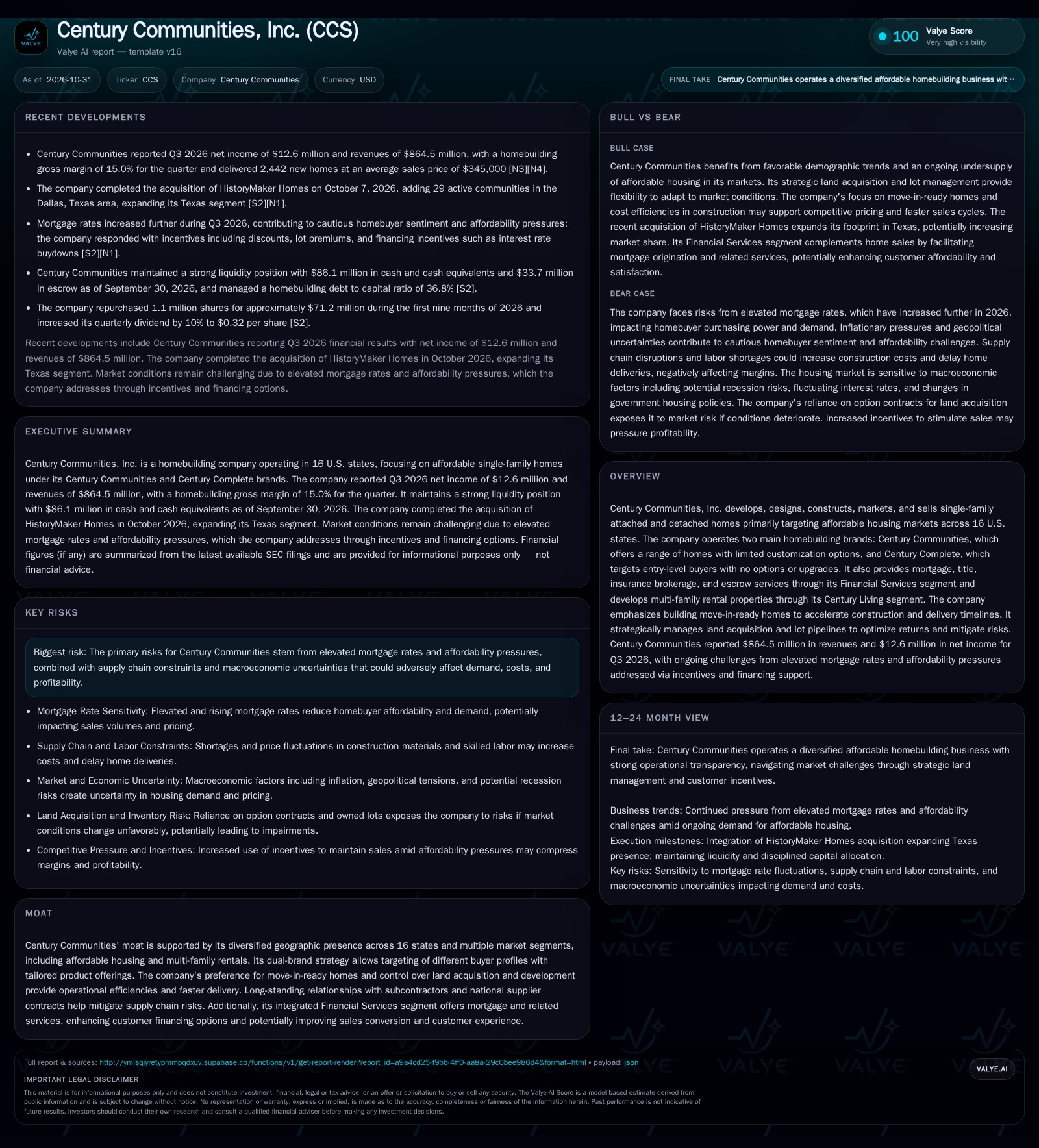
Century Communities is navigating a tough homebuilding market by focusing on affordable, move-in-ready homes, deploying incentives to sustain volume, and expanding its Texas footprint via acquisition. While strong lot control and a diversified footprint provide flexibility, sustained high mortgage rates and ongoing affordability challenges threaten margins and demand. The next phase will test whether the company’s operational discipline and acquisition integration can offset macro headwinds and support profitable growth. [S2]
Century Communities is at a pivotal moment as it contends with a housing market buffeted by high mortgage rates, inflation, and cautious consumer sentiment. The company’s operational focus on move-in-ready, affordable homes has kept volumes high, but at the cost of increased sales incentives and compressed margins. The October 2026 acquisition of HistoryMaker Homes deepens its Texas exposure, but also raises the stakes for successful integration and market share gains. As affordability remains central to its value proposition, the company’s ability to balance disciplined lot management, incentive spending, and capital allocation will shape its performance through the next cycle.
How Century Communities Is Tackling Affordability and Demand in 2026
Century Communities delivered 6,961 homes in the first nine months of 2026, with 96% priced below FHA-insured mortgage limits and 98% built as move-in-ready properties. This underscores a strategic focus on affordability and rapid delivery to attract cost-conscious buyers in a challenging rate environment. Revenues for Q3 2026 were $864.5 million, with net income of $12.6 million and a homebuilding gross margin of 17.0% (adjusted margin of 19.7%). However, these results reflect the impact of widespread incentives—including discounts, lot premiums, and interest rate buydowns—needed to maintain sales velocity amid elevated mortgage rates. The company also completed the acquisition of HistoryMaker Homes in October 2026, adding 29 active communities and expanding its Texas footprint. Century Communities maintained a homebuilding debt to capital ratio of 36.8% and held $86.1 million in cash as of September 30, 2026. [S2] [N3] [N4] [N1]
Fixed Costs, Margins, and the Economics of Move-In-Ready Homes
Century Communities’ business model centers on high-volume, lower-cost home sales targeting entry-level and move-up buyers, with a strong emphasis on move-in-ready inventory. This approach enables faster construction cycles (typically three to four months) and improved subcontractor pricing, reducing holding costs and enhancing capital deployment efficiency. The reliance on move-in-ready homes also allows the company to offer greater certainty on pricing and financing, which is particularly valuable in volatile rate environments.
Margins, however, are under pressure from the need to deploy incentives—including rate buydowns and closing cost concessions—to offset affordability challenges. The reported homebuilding gross margin of 17.0% for the first nine months of 2026 (19.7% adjusted) is above some industry peers but vulnerable to further compression if incentives rise or input costs escalate. Fixed costs—land, labor, and materials—are partially mitigated by the company’s strategic lot pipeline, which blends owned and optioned lots (60,969 as of September 30, 2026) to balance risk and flexibility. However, high leverage to volume means that any sustained drop in closings could quickly erode profitability, while capital intensity remains high due to ongoing land investments and inventory needs. [S2]
The Financial Services segment (mortgage, title, insurance) provides some fee-based revenue diversification and can enhance conversion rates, but its economics are also sensitive to origination volumes and rate-driven refinancing activity.
Can Century’s Scale and Lot Discipline Offset National Builder Pressures?
Century Communities competes in the highly fragmented U.S. homebuilding market, with national public builders, regional privates, and local players all vying for share—particularly in the affordable and entry-level segments. Its dual-brand strategy (Century Communities and Century Complete) enables targeting of both move-up and entry-level buyers, but also exposes the company to intense price-based competition.
A key advantage is the company’s control over a large, diversified lot pipeline and its preference for move-in-ready homes, which can reduce build times and enhance pricing transparency for buyers. However, this strategy can be mimicked by larger national builders, many of whom are now also prioritizing inventory turns and offering similar incentives to address affordability. The recent acquisition of HistoryMaker Homes may provide regional scale in Texas, where population growth and housing demand trends have been relatively robust, but integration risk and potential culture clash could offset some of these gains.
Switching costs for homebuyers remain low, especially as most competitors now offer similar financing incentives, online sales tools, and quick move-in inventory. Brand differentiation in entry-level housing is modest, so sustained volume growth may depend more on local execution, lot availability, and incentive efficiency than on any durable moat.
If Incentives Sustain Volume and Texas Expansion Pays Off
A constructive scenario for Century Communities would see its aggressive use of incentives and financing support successfully maintaining or even growing order volumes, despite persistent high mortgage rates. If the integration of HistoryMaker Homes proceeds smoothly and delivers anticipated cost and revenue synergies, the company could strengthen its Texas market share and improve operating leverage through higher community count and better absorption rates.
Further, if demographic tailwinds (such as millennial household formation and migration to lower-cost Sun Belt markets) continue, Century’s focus on affordable, move-in-ready homes could allow it to capture incremental demand from both first-time buyers and renters seeking to transition to ownership. Evidence supporting this scenario would include a stabilization or increase in net new orders, improving absorption rates per community, and margin resilience even as incentives remain elevated.
Confirmation would come from steady or growing community count, successful integration milestones in Texas, and the maintenance of gross margins at or above current levels despite ongoing incentives. Falsification would be a sustained decline in orders, margin erosion beyond peers, or integration delays/disruptions in the Texas segment.
Navigating a Margin Squeeze While Defending Market Share
The most plausible outcome is that Century Communities sustains volumes near current levels by continuing to deploy incentives, but at the cost of further margin compression. Order growth may be muted as affordability remains stretched for many buyers, and elevated mortgage rates persist through at least the next several quarters. The company’s lot pipeline and focus on move-in-ready homes support operational efficiency, but do not fully insulate it from industry-wide pressures on pricing and costs.
The integration of HistoryMaker Homes likely proceeds without major disruption, adding some incremental scale in Texas but not fundamentally transforming the overall margin profile. Financial Services contribution remains modest, with origination volumes flat to slightly down as refinancing activity stays low. The company maintains prudent capital allocation—prioritizing liquidity, measured buybacks, and a stable dividend—while pausing on major new land investments until demand visibility improves.
Confirmation of this scenario would be continued delivery volumes in line with recent quarters, sustained (but pressured) gross margins, and stable leverage ratios. Evidence to the contrary would include a sharp fall-off in sales pace, significant margin deterioration, or signs of inventory overhang in key markets.
When Incentives Fail and Demand Softens Further
A negative scenario could materialize if elevated mortgage rates and macro uncertainty drive a sharper-than-expected contraction in homebuyer demand, overwhelming the company’s ability to stimulate sales through incentives. In this case, order rates and deliveries would decline, leading to inventory build-up and downward pricing pressure. Gross margins could fall below historical averages as incentives escalate and fixed costs are spread over fewer closings.
The Texas expansion via HistoryMaker Homes could exacerbate risk if local market conditions deteriorate or integration issues arise, creating operational distractions and potential impairments. The company’s option-heavy lot strategy, while flexible, could backfire if land values reset downward, leading to write-offs or missed absorption targets. Financial Services revenues would decline further as originations dry up.
Evidence confirming this downside would include sequential declines in net new orders and closings, significant inventory increases, margin compression below peer averages, and any indication of impairments or restructuring charges tied to land or recent acquisitions. Conversely, resilience in sales pace or margins, or an unexpected improvement in mortgage affordability, would help falsify this scenario.
How to Assess Century Communities’ Resilience as Market Conditions Shift
Monitor net new orders and absorption rates per active community for signs of demand stabilization or further softening, especially in newly acquired Texas communities. If disclosed, monthly or quarterly order trends would help test the thesis.
Track reported homebuilding gross margin (both GAAP and adjusted) for evidence of further compression or stabilization, particularly as incentives remain widespread.
Watch the pace and success of HistoryMaker Homes integration, including community count growth, absorption rates, and any disclosed cost/revenue synergies.
Assess the mix of mortgage originations, especially the share of adjustable-rate mortgages, as a proxy for buyer affordability and risk tolerance.
Observe changes in inventory levels and finished unsold homes, which could signal either healthy turnover or emerging overhang and pricing risk.
Monitor local market conditions and builder incentives in key Century Communities geographies, as competitive dynamics may shift rapidly if rates or demand change.
If disclosed, track cancellation rates and reasons to gauge buyer confidence and the effectiveness of incentive programs.
Disclaimer: This is research-only, informational analysis and not investment advice. It may include AI-generated interpretation and general industry context. Always verify important details using primary sources.

Comments