
Chipotle’s Growth Playbook: Margin Pressures, Digital Expansion, and the Stakes of Supply Chain Discipline
Chipotle’s latest quarter highlights a dual narrative: robust revenue growth and digital channel momentum offset by ongoing margin pressures and a liquidity profile that warrants scrutiny. The company’s ability to sustain operational excellence and navigate supply dependencies will shape the durability of its high-growth thesis.
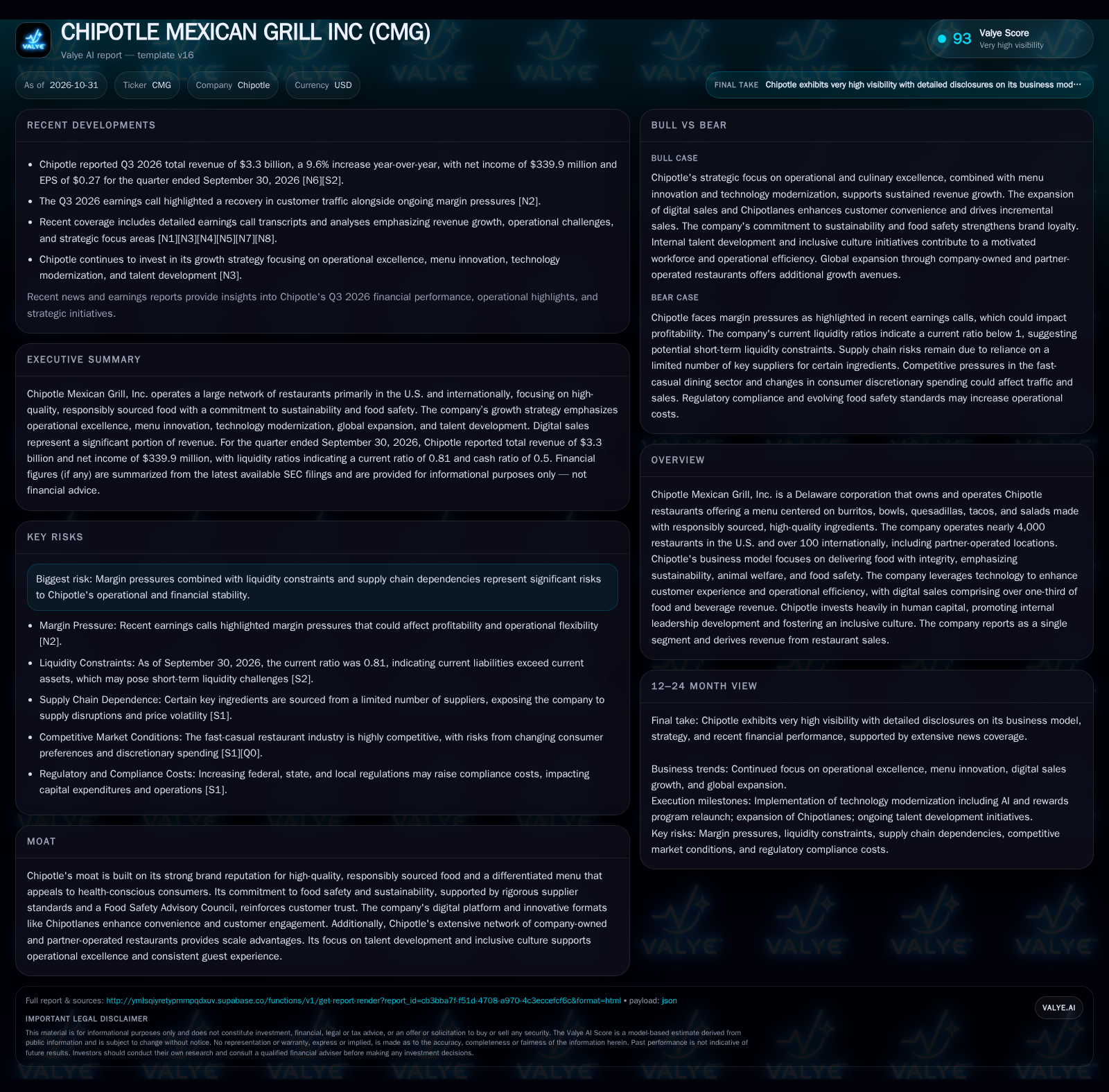
Chipotle reported Q3 2026 revenue of $3.3 billion, up 9.6% year-over-year, with customer traffic recovering but margin pressures persisting. Digital sales comprised 36.7% of food and beverage revenue, reflecting continued technology-driven engagement. The company’s growth strategy leans on operational excellence, menu innovation, and supply chain discipline, but competitive and supply risks remain material [S2] [N2] [N6].
Chipotle Mexican Grill’s latest quarterly results reinforce its position as a high-velocity, innovation-driven restaurant operator, with revenue and digital channel growth continuing to outpace much of the industry. Yet, the company faces a persistent tug-of-war between ambitious expansion, evolving customer expectations, and the realities of margin compression and supply chain complexity. As Chipotle pushes forward with its Recipe for Growth strategy—emphasizing operational excellence, digital engagement, and menu innovation—the real test lies in its ability to convert topline momentum into sustainable, defensible economics amid tightening liquidity and intensifying competition.
Recent Quarter: Revenue Upside Meets Margin and Liquidity Friction
For Q3 2026, Chipotle reported total revenue of $3.3 billion, marking a 9.6% year-over-year increase, with net income of $339.9 million and EPS of $0.27 [S2] [N6]. Digital sales comprised 36.7% of food and beverage revenue, highlighting the continued shift in consumer ordering behavior and the relevance of digital platforms and Chipotlanes [S1]. The earnings call pointed to a recovery in customer traffic, but also underscored margin pressures that are not yet fully resolved [N2]. [S2] These developments set the stage for a business model that is both scaling and exposed to operational and financial friction.
Menu Economics, Digital Leverage, and the Cost Structure Dilemma
Chipotle’s core economics are driven by high-volume, streamlined operations, with most revenue coming from company-owned restaurant sales [S1]. The menu’s limited scope allows for operational efficiency, inventory simplicity, and relatively rapid throughput. Digital channels—now accounting for over a third of revenue—can offer margin benefits through higher average order values and labor efficiency, especially when orders are picked up via Chipotlanes rather than delivered. However, third-party delivery introduces commission drag and potential margin dilution.
The company’s cost structure is heavily influenced by food input prices, labor, and occupancy. Its commitment to 'Food with Integrity'—sourcing premium, responsibly raised ingredients—creates both brand equity and cost headwinds, especially as supply chains tighten or commodity prices spike. Fixed costs are significant at the restaurant level (rent, management, base staffing), but incremental sales, particularly digital, can drive operating leverage if traffic and ticket size grow faster than variable costs.
Capital needs are ongoing: new store openings, technology investments (including AI and rewards relaunch), and food safety enhancements require sustained reinvestment. With a current ratio below 1, Chipotle must balance growth ambitions with disciplined cash management, particularly if margin pressures persist or if external shocks disrupt cash flow.
Brand Strength, Digital Differentiation, and the Challenge of Replication
Chipotle’s competitive edge is anchored in its strong brand association with clean-label, customizable fast-casual Mexican fare and its visible commitment to sustainability, animal welfare, and food safety [S1]. These factors have fostered a loyal customer base, particularly among health- and values-conscious diners. The company’s early investment in digital platforms, loyalty, and drive-through Chipotlanes has set it apart from many fast-casual peers, enabling both convenience and operational data capture.
However, the moat is not insurmountable. Fast-casual and QSR competitors—including those with large digital footprints and delivery partnerships—continue to invest aggressively in menu innovation, digital ordering, and sustainability messaging. Supply chain discipline is a double-edged sword: while it supports quality, the reliance on a limited set of suppliers for key ingredients exposes Chipotle to disruption and price volatility, which competitors with broader sourcing may partially mitigate.
Switching costs for consumers are low; while loyalty is strong, alternative fast-casual and QSR options are abundant. The real competitive advantage may hinge less on product uniqueness and more on operational consistency, digital convenience, and the ability to sustain superior supply chain execution at scale.
Sustained Digital and Store Expansion Translate Into Margin Reacceleration
A favorable scenario sees Chipotle successfully executing its Recipe for Growth playbook: continued expansion of Chipotlanes, further penetration of digital ordering, and effective menu innovation drive both traffic and average ticket size. If digital orders shift more toward pickup (reducing delivery commission drag) and operational investments (such as AI and new rewards) lower labor and marketing costs per transaction, margin recovery could outpace recent pressures.
Supply chain initiatives—such as diversifying suppliers or leveraging scale for better terms—would help stabilize input costs, while brand investments maintain customer loyalty and traffic resilience. Success in international expansion, though presently a small base, could provide incremental growth optionality.
Confirmation would come from sequential margin improvement, sustained double-digit digital sales growth, and evidence that new store openings deliver attractive unit economics without cannibalizing existing locations. Falsification would be signaled by continued margin erosion despite topline growth or by a slowdown in digital engagement.
Growth Continues but Margin Volatility and Liquidity Constraints Temper Returns
The most plausible path is one where Chipotle maintains above-industry revenue growth through a mix of new restaurant openings, digital engagement, and menu refreshes. However, wage inflation, persistent input cost volatility, and the costs associated with premium sourcing and food safety keep margins below historical peaks. Digital sales remain robust, but the mix between pickup and delivery stabilizes, limiting further margin upside from channel shift.
The company continues to invest in technology and operational improvements, but must be disciplined in capital allocation. Confirmation would be continued high-single-digit revenue growth with stable but unspectacular margins, while evidence of stress would include further deterioration in liquidity or margin compression despite revenue momentum.
Margin Compression and Supply Chain Shocks Disrupt the Growth Thesis
In an adverse scenario, input cost inflation—especially for premium proteins and produce—accelerates faster than Chipotle can offset through menu price increases or operational savings. Labor costs rise due to market dynamics or regulatory changes, and operational hiccups (such as food safety incidents or supply disruptions) force temporary store closures or reputational damage.
If digital sales growth stalls—due to competition or consumer fatigue with delivery fees—and store-level margins fall, the company may be forced to slow expansion or scale back menu innovation. Confirmation would come from negative operating leverage (costs rising faster than sales), declining store-level margins, or a further weakening of the current ratio. Evidence against this scenario would be rapid margin recovery or stabilization despite cost headwinds.
What Will Determine Chipotle’s Enduring Economics and Growth
Same-store sales growth, particularly the balance between transaction count and average check, will clarify whether traffic or pricing is driving topline momentum.
Quarterly restaurant-level operating margins, if disclosed, would reveal the effectiveness of cost-control and pricing strategies.
Digital sales mix (pickup versus delivery) and the impact of Chipotlanes on average order value and margin should be monitored.
Trends in input cost inflation for key ingredients (beef, chicken, produce) will signal supply chain pressure or relief.
New restaurant openings and performance of recently opened units, especially in international markets, would help test the scalability of the model.
Progress on supplier diversification and food safety program enhancements, if disclosed, would address vulnerability to supply shocks.
Employee turnover rates and internal promotion metrics, if available, would provide insight into operational stability and culture.
Disclaimer: This is research-only, informational analysis and not investment advice. It may include AI-generated interpretation and general industry context. Always verify important details using primary sources.

Comments