
Alphabet in 2026: AI Investment, Cloud Ambition, and the Stakes of Regulatory Headwinds
Alphabet’s 2026 trajectory is defined by aggressive AI and cloud infrastructure investment, robust capital allocation, and substantial legal and regulatory pressures. The company’s ability to convert these investments into durable profit streams—while managing mounting risks—remains central to its long-term value.
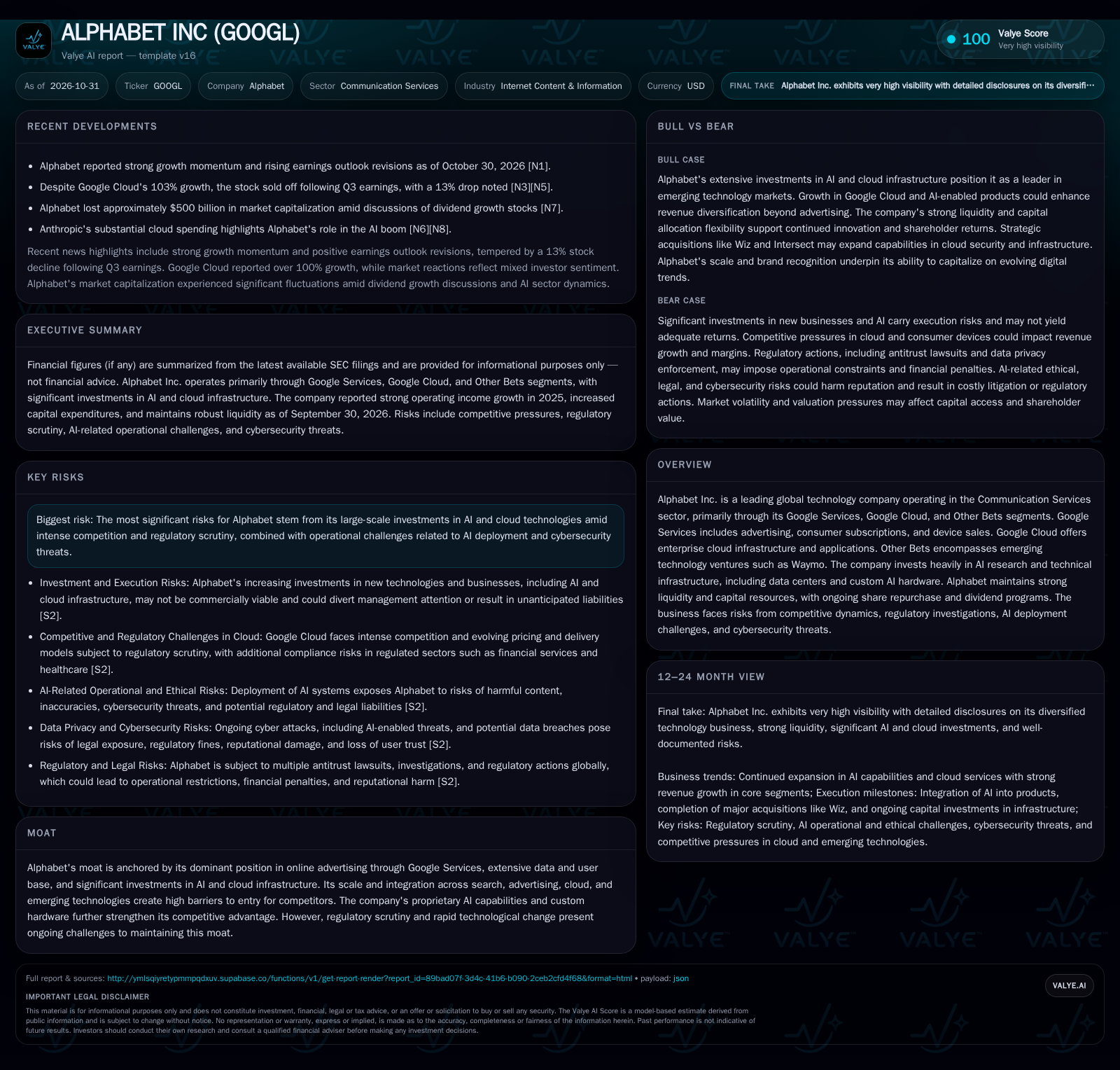
Alphabet reported $26.5 billion in net income on $127.6 billion in nine-month revenue, with reported liquidity position and a continued push in AI and cloud infrastructure. However, the company lost $500 billion in market cap amid dividend stock rotation and faces intensifying regulatory and competitive pressures. The central question is whether Alphabet’s scale and innovation can offset growing risks and deliver sustainable returns [S2] [N7].
Alphabet’s 2026 business profile reflects both the power and vulnerability of digital platform scale. The company continues to generate enormous operating cash flow from its core Google Services and is investing at an unprecedented rate in AI and cloud infrastructure. Yet, Alphabet’s market value has come under pressure, reflecting investor skepticism about the near-term returns on massive capital outlays and the mounting drag of regulatory and legal risks. The core question is whether Alphabet’s technological and financial scale can continue to outpace the intensifying headwinds—and what could tip the balance in either direction.
Alphabet’s 2026 Operating Snapshot: Surging Investment, Margin Pressure, and Market Reaction
Alphabet reported $127.6 billion in revenue and $26.5 billion in net income for the nine months ended September 30, 2026, with basic EPS of $2.14 per share [S2]. The company’s liquidity position was significant, with $56.3 billion in cash and equivalents and a current ratio of 2.79 as of the same date [S2].
Capital expenditures reached $91.4 billion in 2025, driven by aggressive investment in technical infrastructure—primarily data centers and AI hardware [S1].
Despite strong operating metrics, Alphabet lost $500 billion in market capitalization in late 2026, amid post-earnings disappointment and a rotation into dividend growth stocks [N7] [N5]. This market reaction highlights investor uncertainty around the payback of Alphabet’s infrastructure bet and the durability of its profit engines given mounting regulatory and cost pressures.
How Alphabet’s Profit Engine Works—and Where Leverage and Risk Accumulate
Alphabet’s core economics hinge on the outsized profitability of Google Services—primarily search and YouTube advertising—which generate high-margin cash flow at scale. This segment continues to subsidize heavy investment in both Google Cloud and speculative Other Bets [S1].
Google Cloud has achieved operating profitability, but the segment’s margin remains lower than advertising—reflecting high infrastructure, employee, and acquisition costs [S1]. The cloud business model is characterized by high fixed costs (data centers, R&D, AI hardware) but potential for strong incremental margins if revenue growth sustains. However, price competition and the need for continual capacity upgrades limit short-term operating leverage.
Alphabet’s capital allocation strategy is aggressive: $91.4 billion in 2025 capex, major share buybacks ($45.4 billion in 2025, with $139.5 billion authorized), and a growing dividend. While this supports shareholder returns and innovation, it heightens the stakes of execution risk—particularly as new bets (AI, autonomous vehicles, cloud) are capital intensive and may not yield near-term returns [S1] [S2].
Scale, Data, and AI Investment: Alphabet’s Moat—and Where It’s Under Threat
Alphabet’s competitive advantage historically stems from its massive user base, proprietary data, leading search algorithms, and differentiated advertising reach. Its integration of AI across services and custom hardware further raises barriers to entry.
In cloud, Alphabet is a top-tier player, but trails the market leaders in share and faces intense pricing and compliance competition, especially in regulated sectors. AI infrastructure investment is both a differentiator and a vulnerability: while Alphabet’s technical depth can drive superior products, it also requires relentless capital outlay and exposes the company to new forms of regulatory and reputational risk [S2].
The core Google Services moat is under sustained attack from regulatory authorities globally, with antitrust cases, privacy rules, and content moderation demands threatening both product flexibility and margin structure. Meanwhile, cloud and AI may be more vulnerable to rapid technological shifts and customer churn than the legacy ad business.
If AI and Cloud Bets Deliver Scale Returns: Pathways to Alphabet’s Next Profit Cycle
The bullish case for Alphabet is that its massive AI and cloud investments create a new layer of high-margin, recurring revenue—offsetting maturing search and advertising growth. If Google Cloud can expand share in enterprise and regulated sectors while maintaining or growing margins, the company could unlock powerful operating leverage.
Confirmation would come from sustained double-digit cloud revenue growth, margin expansion in the cloud and AI-driven services, and evidence that Alphabet’s AI products outcompete rivals in both accuracy and commercial adoption. Reduced legal settlements and regulatory fines would also help validate the upside case [S1] [S2].
Falsification would be signaled by flat or shrinking cloud revenue, persistent margin compression, or major AI product failures—especially if paired with escalating regulatory or compliance costs that erode overall profitability.
Profitability Amidst High Spend: The Most Likely Alphabet Outcome
The most plausible scenario is that Alphabet continues to generate substantial profit from Google Services while cloud and AI investments deliver incremental, though not transformative, returns. Operating margins may remain compressed relative to historical highs due to elevated capex, R&D, and ongoing legal and compliance expenses.
This scenario would be confirmed by steady ad revenue, moderate cloud growth with stable margins, and no material negative surprises from regulatory or legal actions. The company’s capital return programs (dividends, buybacks) would likely persist, but at a measured pace given the need to balance investment and shareholder returns [S1] [S2].
Downside to this scenario would emerge if the cost of compliance, regulation, or AI-related liabilities outpaces the incremental profit from new investments—or if a material shift in consumer or advertiser behavior undermines the core profit engine.
When Regulatory and Cost Pressures Outrun Scale: Alphabet’s Vulnerability
The adverse scenario is that Alphabet’s heavy outlays in AI and cloud fail to generate sufficient returns, while regulatory and legal costs escalate sharply. This could lead to structurally lower margins, negative operating leverage, and a further erosion of investor confidence.
Confirmation would include a notable decline in Google Services profitability, sustained cloud losses, or a surge in legal settlements and regulatory fines that materially impact free cash flow. Major AI mishaps—such as high-profile content failures, data breaches, or regulatory bans—would also support this scenario [S2].
A further sign would be the need to materially curtail buybacks or dividends in order to fund ongoing capex or legal obligations, signaling a shift from offense to financial defense.
What Will Determine Alphabet’s Long-Term Value Creation Potential?
The trajectory of Google Cloud revenue growth and segment operating margin—especially in regulated sectors—would help test the scalability of Alphabet’s cloud strategy.
The level and trend of annual capital expenditures, particularly the mix between maintenance and growth infrastructure, would clarify the sustainability of current investment rates.
Disclosure of AI-driven product adoption metrics (if provided), such as user engagement, enterprise wins, or monetization rates, would be valuable in assessing the commercial payoff of Alphabet’s AI bets.
Tracking the frequency and financial impact of regulatory fines, settlements, or adverse legal outcomes would indicate the mounting cost of compliance and legal risk.
The evolution of core Google Services (ad revenue, user growth, engagement) remains critical to understanding the resilience of Alphabet’s profit engine.
If disclosed, retention rates and churn among large Google Cloud enterprise customers would provide insight into the stickiness and competitive position of the cloud platform.
Announcements related to data privacy, cybersecurity breaches, or major AI product incidents would help gauge operational risk and reputational resilience.
Disclaimer: This is research-only, informational analysis and not investment advice. It may include AI-generated interpretation and general industry context. Always verify important details using primary sources.

Comments