
Ford’s Capital Reallocation and EV Retrenchment: Navigating Industry Transition with Legacy Strengths and Structural Risks
Ford’s Q3 2026 results reveal a company at a crossroads—balancing robust legacy operations and Ford Credit with a scaled-back EV roadmap amid intensifying competition, evolving demand, and rising cost pressures.
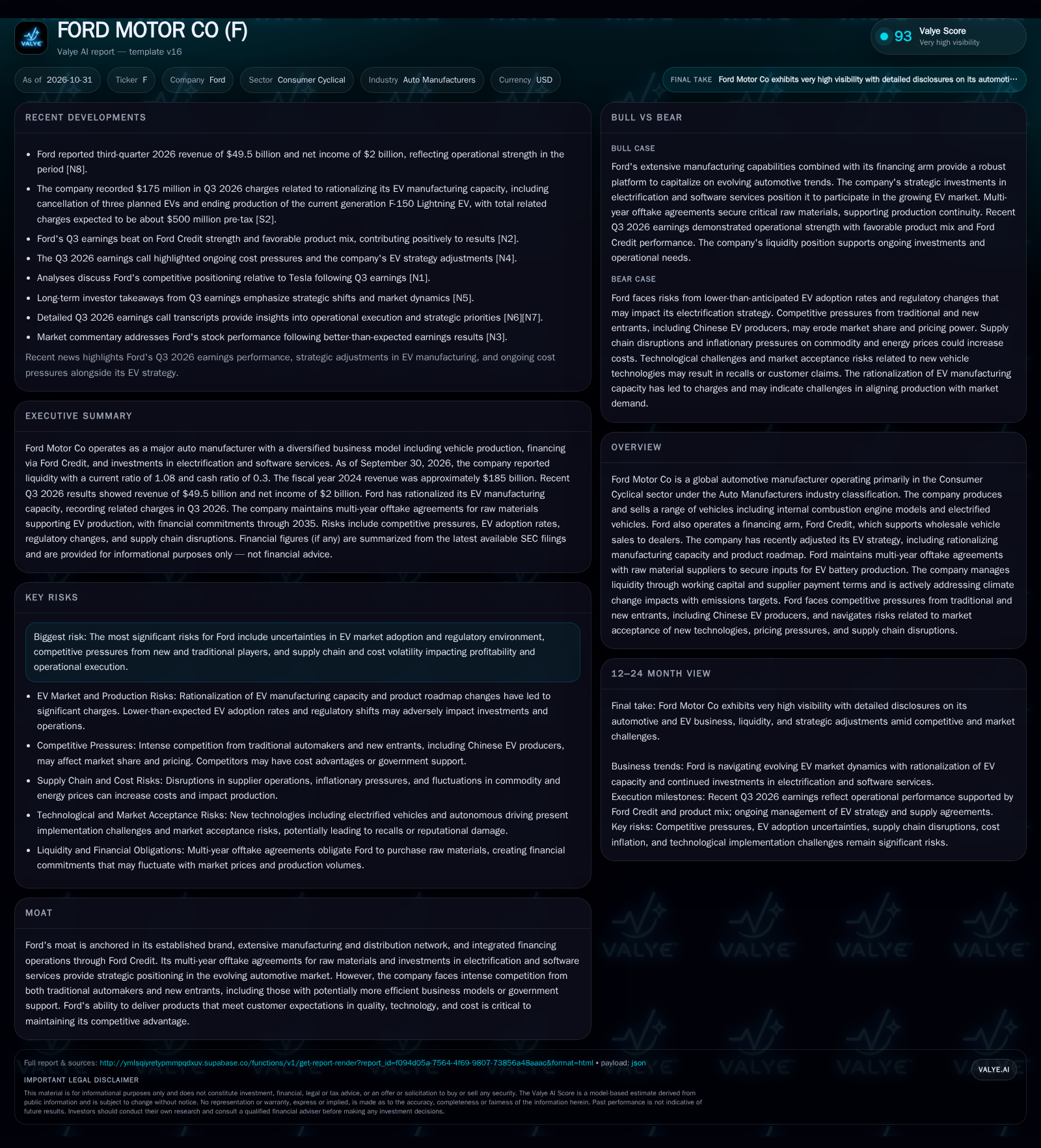
Ford’s latest quarter highlights strong earnings performance, driven by Ford Credit and product mix, but also a decisive retrenchment in its EV ambitions, including the end of the current F-150 Lightning and cancellation of three planned EVs. With significant capital tied up in multi-year supply deals and industry-wide overcapacity risks, Ford’s next chapter hinges on disciplined capital allocation, competitive response to both legacy and new entrants, and its ability to align product strategy with shifting electrification demand signals. [S2] [N2] [N8]
Ford Motor’s most recent quarter underscores a pivotal industry moment: the company delivered stronger-than-expected earnings on the back of its traditional vehicle business and Ford Credit, even as it took a step back from its prior electric vehicle ambitions. With $175 million in Q3 charges for EV capacity rationalization and a plan to cease the current F-150 Lightning and three future EVs, Ford is signaling caution in the face of uncertain demand and competitive intensity. The company’s multi-year supply commitments and ongoing cost pressures add complexity to capital allocation decisions at a time when both legacy strengths and disruptive risks are in sharp focus. [S2] [N2] [N8]
Retreat from Aggressive EV Expansion Alters Ford’s Risk and Opportunity Landscape
Ford’s Q3 2026 financials reflect a resilient legacy business: $49.5 billion in revenue and $2 billion in net income, buoyed by Ford Credit and a favorable product mix. However, the company is absorbing $175 million in charges this quarter (with $500 million pre-tax expected in total) as it rationalizes its EV manufacturing footprint—ending the current F-150 Lightning EV and canceling three planned EVs. These actions mark a notable shift from aggressive electrification toward a more measured, risk-managed approach. At the same time, Ford remains committed to multi-year offtake agreements for EV battery raw materials, representing $4.7 billion in potential obligations through 2035 and exposing the company to future demand and pricing uncertainties. [S2] [N2] [N8]
How Ford’s Mixed Model Drives Cash—But Raises Capital Discipline Stakes
Ford’s business economics hinge on a blended portfolio: high-volume internal combustion engine (ICE) vehicles, a growing but recently trimmed EV segment, and the profitable Ford Credit financing arm. Traditional auto manufacturing is capital intensive with significant fixed costs—factories, tooling, and labor—providing operating leverage when volumes are high but creating downside risk when demand softens. Ford Credit enhances overall returns by generating interest and fee income, supporting dealer inventory, and providing a counter-cyclical earnings stream.
The company’s recent EV retrenchment signals a recalibration of capital allocation: by ending unprofitable or slow-moving models, Ford aims to redeploy cash to higher-return segments or protect its balance sheet. However, multi-year offtake obligations for battery materials mean Ford is exposed to commodity price swings and must manage the risk of overcommitting capital if EV demand stalls. The economics of EVs remain challenged by high input costs, uncertain pricing power, and the need for scale. Ford’s ability to flex production, optimize product mix, and leverage Ford Credit for cash flow stability will be crucial to maintaining both profitability and strategic optionality.
Ford’s Competitive Standing: Legacy Scale Meets Disruptive Pressures
Ford’s advantages are rooted in its brand, manufacturing scale, and vertically integrated distribution, complemented by Ford Credit’s customer reach and dealer support. This legacy infrastructure offers cost efficiency and market reach in ICE and hybrid segments. However, the competitive landscape is evolving rapidly: new entrants, especially Chinese EV manufacturers, are challenging incumbents with more flexible cost structures, aggressive pricing, and in some cases, government support.
Traditional competitors are also accelerating their own EV and software offerings, intensifying the race for market share, technology leadership, and customer loyalty. Regulatory shifts—such as emissions targets—could favor those with faster or more efficient electrification strategies. Ford’s decision to scale back its EV roadmap could preserve near-term margins but risks ceding ground in markets where adoption accelerates. The company’s moat is increasingly tested by the need to deliver compelling technology, quality, and cost outcomes amid industry transition.
If Ford’s Strategic Reset Unlocks Value: What Would Success Look Like?
A favorable scenario unfolds if Ford’s capital discipline and product rationalization lead to improved returns on invested capital. By focusing on profitable segments—core trucks, SUVs, hybrids—and leveraging Ford Credit, Ford could stabilize margins and free up resources for targeted innovation. If consumer EV adoption grows steadily (but not explosively), Ford’s measured pace could allow it to avoid overcapacity and discounting, while still capturing incremental demand through refreshed, cost-competitive EV models.
Confirmation would come from sustained or rising automotive margins, robust cash flow from Ford Credit, and evidence that remaining EV offerings are gaining share in targeted segments. Further, if Ford is able to renegotiate or flex its battery material offtake agreements in line with actual production needs, it could limit downside from commodity price volatility. Evidence against this scenario would include continued losses in the EV segment, eroding ICE volumes without compensating hybrid or EV growth, or inability to adjust supply contracts to demand realities.
Ford’s Most Likely Trajectory: Margin Defense Amid Uneven Electrification
The most plausible outcome is that Ford continues to generate solid cash flow from its legacy vehicle and financing operations, while the EV business remains a volatile, low-margin adjunct. The company may periodically adjust its EV roadmap as market signals evolve, maintaining flexibility rather than pursuing scale at any cost. Competitive intensity and regulatory pressures will keep pricing and margin discipline front of mind, but Ford’s scale and dealer network should cushion cyclical shocks.
Base-case confirmation would include stable or modestly improving group-level margins, manageable EV losses offset by Ford Credit and ICE/hybrid profits, and continued fulfillment of raw material obligations without material impairment. If Ford begins to regain share in profitable segments or demonstrates early success with next-generation hybrids and software offerings, it would support this middle path. Evidence to the contrary would involve persistent cost overruns, deteriorating market share, or regulatory penalties for missing emissions targets.
When Industry Shifts Outpace Ford’s Adjustments: Where Risks Compound
A negative scenario could materialize if EV adoption accelerates faster than Ford can respond, leaving the company with stranded ICE assets and a diminished presence in growth markets. If Chinese and other new entrants drive down prices industry-wide, Ford may be forced into margin-destroying discounting or lose volume to more agile competitors. Multi-year raw material obligations could become a liability if EV volumes underperform, resulting in excess inventory or costly renegotiations.
This scenario would be confirmed by sharp declines in group margins, persistent EV segment losses, and evidence of market share erosion in both legacy and new energy vehicles. Additional warning signs would include rising working capital tied up in unsold inventory, inability to adjust supply contracts, and increased regulatory or recall costs tied to new technology rollouts.
Milestones That Will Define Ford’s Next Strategic Chapter
Quarterly trend in group-level operating margins, with breakdowns by ICE, hybrid, and EV segments if disclosed, will reveal whether capital reallocation is translating to improved profitability.
Ford Credit’s net income and delinquency rates should be monitored for signs of consumer stress or tightening credit conditions, which could impact earnings stability.
Updates on renegotiation or flexibility of battery materials offtake agreements would help assess downside risk if EV demand underwhelms.
EV and hybrid unit sales growth rates, alongside average transaction prices and incentive spending, would clarify Ford’s ability to compete in shifting market segments.
Market share trends in North America and China, particularly in light trucks and affordable EVs, will indicate competitive effectiveness against both legacy and new entrants.
Progress against Science Based Targets initiative emissions goals, and related regulatory developments, could affect both product strategy and cost structure.
Supplier payment terms and working capital metrics, if disclosed, would signal Ford’s ability to manage supply chain volatility and liquidity requirements.
Evidence of recalls, warranty claims, or software-related customer issues in new technology vehicles would help test the thesis around execution risk and reputational impact.
Disclaimer: This is research-only, informational analysis and not investment advice. It may include AI-generated interpretation and general industry context. Always verify important details using primary sources.

Comments