
Laureate Education’s Latin American Platform: Enrollment Scale, Digital Expansion, and Private-Pay Growth Dynamics
With nearly 500,000 students in Mexico and Peru and a sharp focus on STEM and business disciplines, Laureate Education leverages operational scale and digital delivery to pursue capital-efficient growth—but faces questions over enrollment durability, competitive pressure, and liquidity headroom as it doubles down on share repurchases.
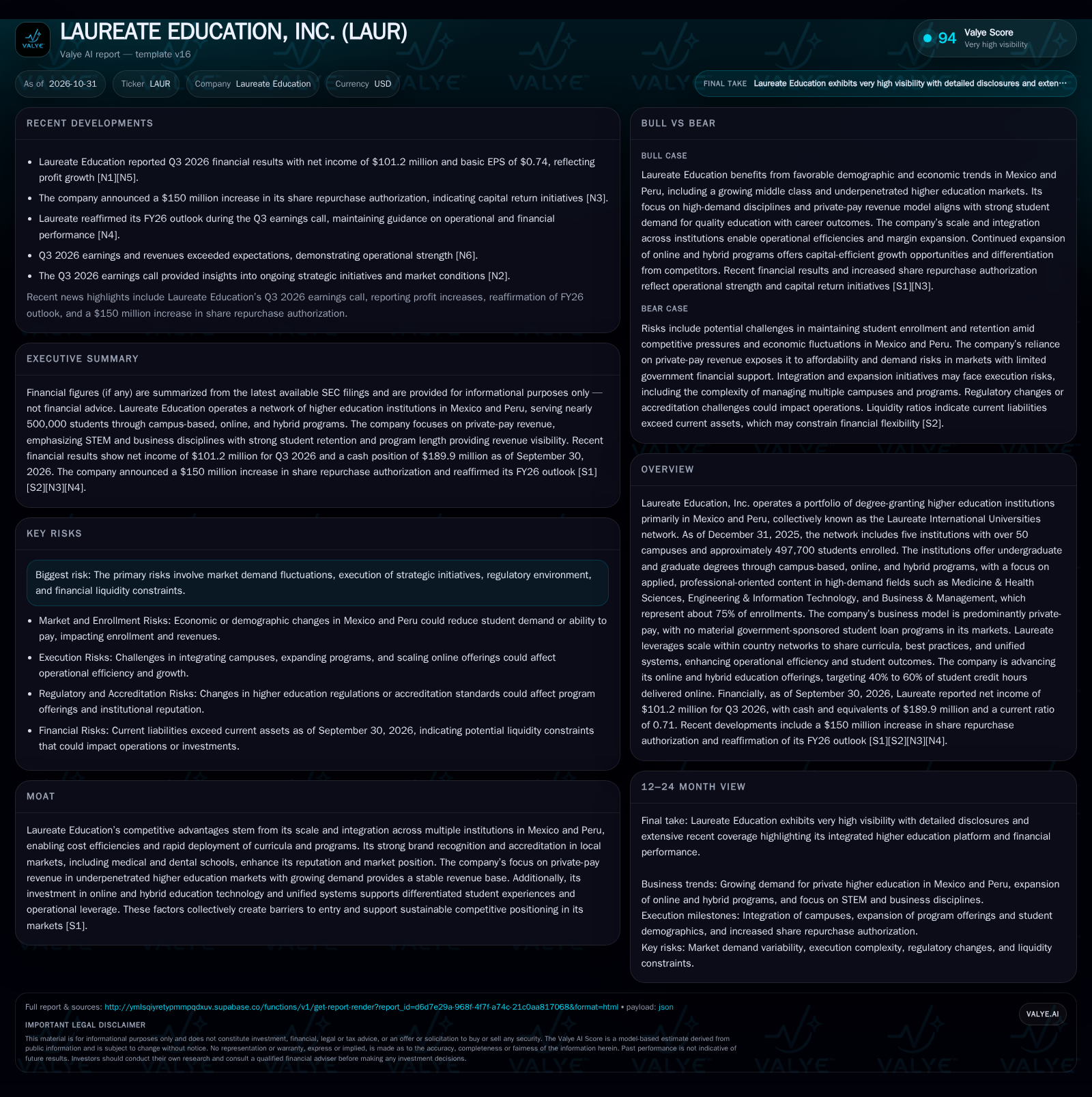
Laureate Education operates one of Latin America’s largest private higher-education networks, serving close to half a million students through five institutions in Mexico and Peru. The company’s private-pay model, emphasis on professional disciplines, and push into online/hybrid delivery underpin revenue visibility and operational leverage. The core question is whether Laureate can sustain enrollment and pricing power in a competitive, economically sensitive market while executing on digital transformation and capital allocation initiatives. [S1] [S2] [N3] [N4]
Laureate Education stands at the intersection of scale, specialization, and digital innovation in Latin American higher education. Anchored by nearly half a million students and a strong footprint in Mexico and Peru, Laureate’s portfolio skews heavily toward professional and STEM fields, targeting the rising demand for career-oriented credentials. The company’s private-pay model and long program durations offer revenue visibility, but also expose it to macroeconomic and competitive risks unique to underpenetrated, price-sensitive markets. With liquidity ratios below 1.0 and a substantial increase in share repurchase authorization, Laureate’s ability to balance capital returns, digital transformation, and enrollment stability will define its next chapter. [S1] [S2] [N3]
Current Operational Scale and Capital Allocation Trends
As of December 31, 2025, Laureate Education serves approximately 497,700 students across five institutions and more than 50 campuses in Mexico and Peru, making it a leading private higher-education operator in the region. The network’s focus on applied, career-oriented content—particularly in STEM and business—accounts for roughly 75% of enrollments, positioning Laureate to capture demand from a growing middle class seeking upward mobility. [S1]
Financially, Laureate reported Q3 2026 net income of $101.2 million, with cash and equivalents at $189.9 million. [S2]
In October 2026, the company announced a $150 million increase in its share repurchase authorization, signaling a willingness to return capital to shareholders despite constrained liquidity metrics. Laureate also reaffirmed its full-year outlook, reflecting confidence in near-term operating performance. [N3] [N4]
How Laureate’s Private-Pay and Digital Strategies Impact Profitability
Laureate’s business model is almost entirely private-pay: students or their families fund tuition out-of-pocket, with no material government-backed loan programs in Mexico or Peru. This structure delivers high revenue visibility when enrollment and retention are stable, as degree programs typically span four to five years and annual student retention has averaged 79% over the past five years. [S1]
Pricing power is inherently limited by household income sensitivity and the absence of broad-based financial aid. In practice, tuition pricing is set locally and must balance quality perception with affordability for the expanding but still price-conscious middle class. The lack of government support also means Laureate’s revenue base is less susceptible to sudden regulatory funding changes, but more exposed to economic downturns affecting students’ ability to pay.
Operationally, Laureate leverages scale to share curricula, centralize procurement, and deploy unified technology systems across its network, reducing per-student delivery costs. The ongoing push to deliver 40% to 60% of student credit hours online or in hybrid formats is designed to further increase fixed-cost leverage, lower marginal costs, and enable capital-light expansion—potentially boosting margins if digital adoption scales and student outcomes remain robust. [S1]
However, the private-pay, multi-campus model also requires ongoing investment in student acquisition, retention, and facilities. [S2]
Maintaining Scale in Fragmented Markets Amid Rising Competitive Threats
Laureate’s principal advantage is its scale and integration within Mexico and Peru, supporting cost efficiencies, best-practice dissemination, and rapid program deployment. Strong local brands, high QS Stars ratings, and accreditation in regulated fields (such as medicine and engineering) bolster reputation and help attract both students and faculty. [S1]
The company’s strategic focus on professional programs aligns with strong labor-market demand and limited public university capacity, offering a competitive edge over smaller private schools and less career-focused alternatives. However, the market remains highly fragmented, with a mix of public universities, local private institutions, and emerging digital-first education providers all competing for students.
Online and hybrid delivery is both an opportunity and a threat: while Laureate’s investment in digital infrastructure could widen its addressable market and lower costs, it also exposes the company to competition from global online providers and new entrants with lower fixed costs and more flexible delivery models. The absence of government funding creates switching frictions primarily around brand, perceived quality, and program relevance, but not around financial aid portability or regulatory barriers.
Ultimately, Laureate’s moat depends on maintaining superior student outcomes, brand equity, and operational efficiency as the market digitizes and becomes more price-competitive.
Potential Margin Improvement from Accelerated Digital Growth Without Enrollment Losses
A favorable scenario for Laureate rests on successfully scaling its online and hybrid offerings to 40–60% of student credit hours while maintaining or growing total enrollments. If digital delivery reduces per-student costs without undermining perceived value or retention, the company could achieve meaningful margin expansion and capital-light growth.
Confirmation would come from rising operating margins, stable or improving student retention rates, and evidence that digital programs are attracting incremental students—particularly from working adults or underserved regions—rather than cannibalizing higher-margin on-campus offerings.
Further, if macroeconomic conditions in Mexico and Peru remain supportive, Laureate’s exposure to high-demand fields could allow for selective tuition increases or mix improvements. Sustained net income growth, an reported liquidity-ratio trends, and continued capital returns would reinforce the bull case.
Falsification would involve flat or declining margins despite digital investment, rising student churn in online cohorts, or evidence of price discounting to maintain volumes.
Enrollment Stability and Digital Growth Drive Modest Margin Improvements
The most plausible scenario is that Laureate maintains stable enrollments and retention near historical averages while gradually increasing the share of online and hybrid credit hours. Incremental efficiency gains are realized, but are partially offset by ongoing investments in technology, marketing, and student support to sustain competitive positioning.
In this scenario, revenue visibility remains high due to long program lengths and private-pay discipline, but pricing power remains capped by affordability constraints and local competition. Margins improve modestly, but liquidity ratios stay below 1.0 as capital returns and working capital needs absorb excess cash.
Confirmation would come from continued net income generation, stable student headcount, modest margin expansion, and no significant deterioration in liquidity metrics. Falsification would involve a sustained drop in enrollments, declining retention, or the need to raise external capital to fund operations or share repurchases.
Liquidity Risks from Enrollment Declines or Economic Downturns Could Trigger Retrenchment
A negative scenario could unfold if economic conditions in Mexico or Peru deteriorate, eroding students’ ability to pay and triggering enrollment declines or higher dropout rates. In a private-pay model without state subsidies, even modest demand shocks can rapidly pressure revenues and cash flow.
If competitive intensity increases—whether from public universities, local private entrants, or global online providers—Laureate may be forced to discount tuition, increase marketing spend, or invest more heavily in student support, compressing margins.
With current liabilities exceeding current assets, a material revenue shortfall could quickly stress liquidity, forcing Laureate to cut capital returns, defer investments, or seek external financing—potentially on unfavorable terms. Evidence of rising student churn, tuition discounting, or covenant pressures would support this downside case.
Falsification would require resilience in enrollments and retention even as macro conditions worsen, and the ability to sustain positive free cash flow without diluting shareholders or taking on expensive debt.
Indicators Reflecting Laureate’s Enrollment Stability and Margin Development
Annual and semester enrollment trends, disaggregated by institution and delivery modality (on-campus vs. online/hybrid), to gauge demand resilience and digital adoption rates.
Student retention and graduation rates, particularly for digitally delivered programs, as indicators of program quality and revenue visibility.
Average tuition per student and scholarship/discount rates, which would clarify pricing power and competitive dynamics—if disclosed.
Operating margin progression and cost per credit hour delivered, especially as the digital mix increases.
Changes in the current ratio, cash ratio, and net working capital, to monitor liquidity headroom and the sustainability of capital returns.
Evidence of tuition increases or changes in program mix (toward higher-value or shorter-duration programs) that could affect revenue per student.
Announced investments in digital infrastructure or partnerships, and their impact on student acquisition or cost structure.
Regulatory or accreditation developments in Mexico or Peru that could affect Laureate’s ability to offer or expand programs.
Disclaimer: This is research-only, informational analysis and not investment advice. It may include AI-generated interpretation and general industry context. Always verify important details using primary sources.

Comments