
Canadian Pacific Kansas City: Cross-Border Rail Scale, Currency Exposures, and the Stakes of Integration
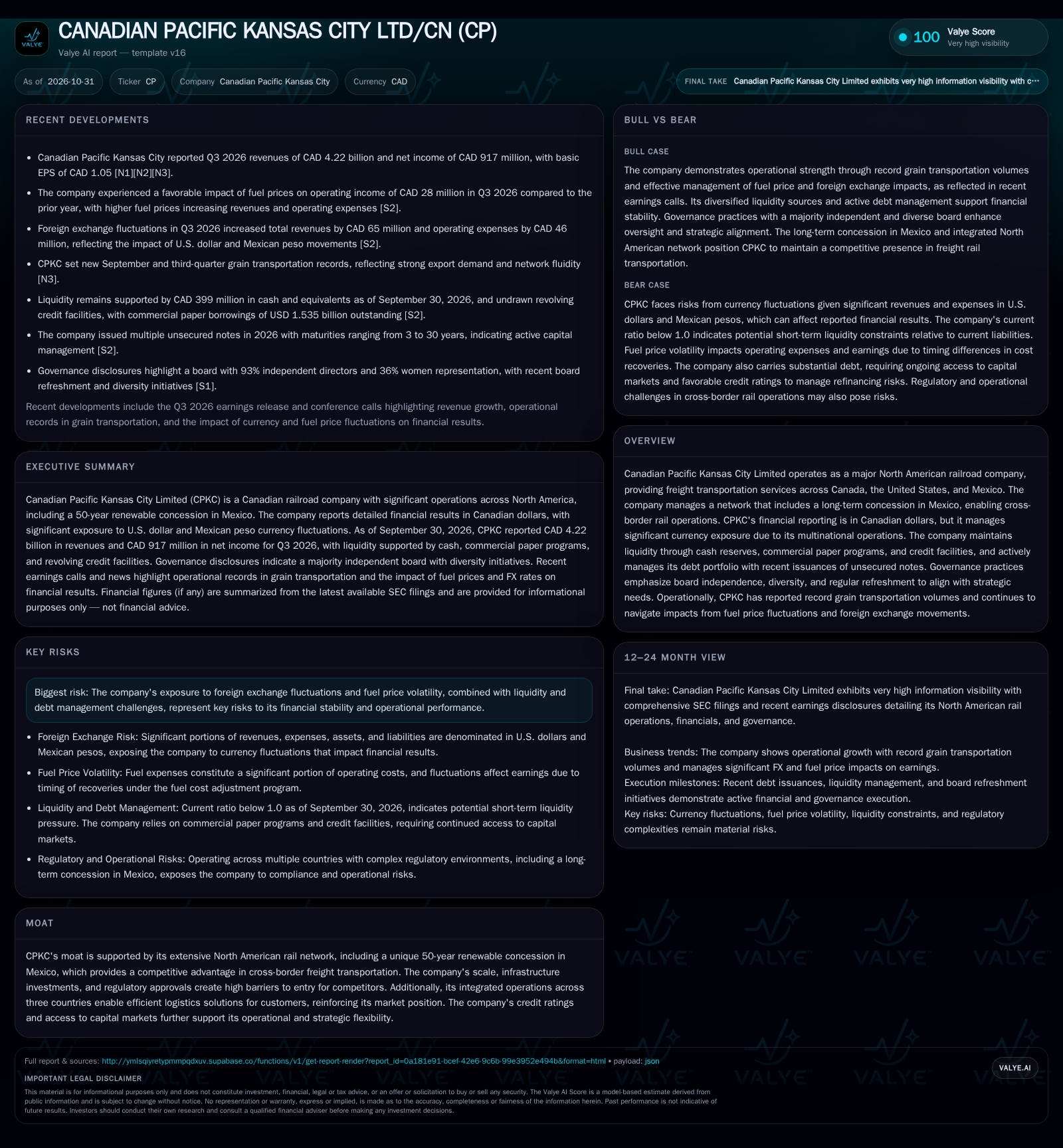
Canadian Pacific Kansas City (CPKC) delivered record Q3 2026 grain transportation and reported CAD 4.22 billion in revenue, but continues to navigate significant FX and fuel price swings, a current ratio of 0.52, and substantial outstanding commercial paper.
Canadian Pacific Kansas City (CPKC) delivered record Q3 2026 grain transportation and reported CAD 4.22 billion in revenue, but continues to navigate significant FX and fuel price swings, a current ratio of 0.52, and substantial outstanding commercial paper. The company’s unique tri-national network and Mexican concession create high barriers to entry, yet FX, fuel, and regulatory risks remain central to the thesis. Effective integration and margin management will determine whether operational scale translates into durable value. [S2] [N1] [N3]
Canadian Pacific Kansas City (CPKC) stands at the nexus of North American rail logistics, operating a uniquely integrated network across Canada, the U.S., and Mexico. With a 50-year renewable concession in Mexico and a diversified revenue base, CPKC’s future will hinge on its ability to translate scale and network advantages into stable margins and cash flows—despite the headwinds of cross-border complexity and macroeconomic uncertainty.
Recent Performance: Record Grain Volumes, FX and Fuel Swings, and Debt Profile
For the third quarter of 2026, Canadian Pacific Kansas City reported revenues of CAD 4.22 billion and net income of CAD 917 million, with basic EPS of CAD 1.05—figures buoyed by operational records in grain transportation and robust export demand. The quarter’s results were shaped by macroeconomic forces: foreign exchange fluctuations increased total revenues by CAD 65 million and operating expenses by CAD 46 million, while fuel price changes favorably impacted operating income by CAD 28 million relative to the prior year. As of September 30, 2026, CPKC’s current ratio stood at 0.52, with CAD 399 million in cash and equivalents, and commercial paper borrowings of USD 1.535 billion outstanding. The company continued to tap debt markets, issuing unsecured notes with maturities from 3 to 30 years, and maintained investment-grade credit ratings. [S2] [N1] [N3]
How CPKC’s Network and Pricing Shape Earnings Power and Risk
At its core, CPKC generates revenue by transporting bulk commodities (notably grain), intermodal containers, automotive products, chemicals, and energy shipments across its tri-national network. Pricing is influenced by long-term contracts, regulatory frameworks, and the company’s ability to recover rising fuel and FX costs through fuel surcharges or contract escalators—though timing mismatches can create short-term margin volatility. The cross-border corridor, anchored by the Mexican concession, enables CPKC to target higher-value north-south trade flows and offer integrated solutions that are difficult for rivals to replicate.
The rail model exhibits high fixed costs—track, rolling stock, labor—so incremental volumes can drive substantial operating leverage. However, this leverage cuts both ways: sharp demand drops or cost shocks (fuel, labor, FX) can rapidly pressure margins. Capital intensity is significant, requiring ongoing infrastructure and equipment investment. The company reported cash and liquidity metrics for the period; these figures do not by themselves establish operating runway, investment capacity, financial flexibility, or financing capacity. In the current macro environment, the company’s mix of diversified revenue sources and exposure to volatile inputs creates both opportunity and risk.
The interplay between fixed and variable costs in CPKC's operations also underscores the importance of capacity management and network optimization. Given the high fixed-cost base, efficient scheduling, asset utilization, and minimizing idle time are critical levers to enhance profitability. If the company can leverage data analytics and predictive maintenance to reduce downtime and optimize routing, it could improve asset turnover and reduce per-unit costs. Conversely, underutilization or operational disruptions could disproportionately erode margins given the capital-intensive nature of the business.
Another dimension shaping earnings power is the regulatory environment's impact on pricing flexibility. While fuel surcharges and contract escalators offer mechanisms to pass through cost increases, their effectiveness depends on contract structures and market competition. In highly competitive segments or with shippers facing alternative transport modes, the ability to fully recover cost inflation may be constrained, leading to margin compression. Moreover, timing mismatches between cost spikes and surcharge implementation can create transient but material earnings volatility, requiring careful working capital and cash flow management.
Cross-Border Rail Integration as a Moat—But Not an Impenetrable One
CPKC’s competitive advantage is anchored in its unique end-to-end rail network spanning Canada, the U.S., and Mexico, a position solidified by its 50-year renewable concession in Mexico. This cross-border reach creates high barriers to entry for new entrants and enables differentiated service offerings, particularly for shippers requiring seamless north-south logistics. Scale, regulatory approvals, and infrastructure investment requirements further reinforce this moat.
Nonetheless, the company operates in a landscape where alternative modes (trucking, maritime, pipelines for specific commodities) and other Class I railroads in North America remain formidable competitors. Regulatory risks, especially in Mexico and at cross-border junctures, could erode advantages if policies shift or concessions face scrutiny. The moat is real, but its durability will depend on sustained operational execution, customer retention, and the ability to adapt service offerings to evolving supply chains.
If Network Integration and Demand Tailwinds Unlock Sustained Margin Expansion
The bullish scenario for CPKC is driven by several reinforcing factors: continued strong demand for grain and cross-border freight, successful pass-through of fuel and FX costs to customers, and incremental share gains as shippers favor integrated, single-line service. Further operational synergies from the merged network could lower unit costs and improve asset utilization, driving operating leverage as volumes rise.
Confirmation would come from sustained double-digit revenue growth in core cross-border segments, expanding operating margins, and evidence that fuel and FX headwinds are being offset by pricing power or efficiency gains. Material increases in long-term customer contracts or evidence of modal shift from trucking to rail on the CPKC corridor would further validate the upside. Falsification would occur if cost inflation consistently outpaces pricing actions, or if regulatory or cross-border bottlenecks prevent network synergies from being realized.
Operational integration across the tri-national network could also unlock value through enhanced service reliability and reduced border crossing delays, which are often significant pain points for shippers. If CPKC successfully harmonizes scheduling, customs processing, and intermodal connections, it could differentiate itself by offering faster, more predictable transit times. This value proposition would justify premium pricing and potentially attract new customers shifting from trucking or maritime alternatives, thereby strengthening the network effect and reinforcing the moat.
Additionally, incremental technology adoption—such as automation in yards, real-time tracking, and advanced analytics—could further improve operational efficiency and customer experience. If these investments lead to measurable improvements in asset utilization and cost per ton-mile, they would support margin expansion even in the face of macroeconomic headwinds. However, realizing these benefits requires successful change management and capital allocation discipline, as technology initiatives in large rail networks can be complex and slow to yield returns.
Integrated Rail Delivers Steady Growth, But Margins Remain Exposed to Macro Forces
The most plausible scenario is one of moderate, GDP-plus revenue growth, reflecting CPKC’s diversified cargo mix and network reach. Operating margins remain healthy but variable, as the company manages but does not fully neutralize fuel and FX volatility. Grain and intermodal volumes continue to drive incremental gains, but pricing power is offset by competitive and regulatory constraints.
Evidence supporting this scenario would include stable (but not expanding) operating margins, continued reliance on short-term funding for working capital, and periodic but manageable bouts of margin compression tied to macro shocks. If CPKC’s credit ratings remain investment grade and access to capital markets is uninterrupted, the company is likely to sustain its capital program and service obligations, but without clear step-change improvement in return on invested capital.
Currency Shocks, Fuel Spikes, or Regulatory Friction Undercut potential Financial Flexibility
The adverse case involves a confluence of external shocks: a sharp depreciation of the Mexican peso or U.S. dollar against the Canadian dollar, a spike in global fuel prices, or regulatory changes that raise costs or disrupt cross-border flows.
Evidence of this scenario would be a marked increase in net interest expense, downgrades to sub-investment-grade credit ratings, or a material widening of the gap between revenue and expense growth. Operationally, a decline in grain or intermodal volumes—whether from competition, trade policy shifts, or supply chain disruptions—would further strain margins. Falsification would require CPKC demonstrating resilience through such shocks with stable access to debt markets and rapid recovery in volumes and earnings.
Factors That Will Determine Whether Network Scale Delivers Lasting Value
Quarterly revenue and operating income trends by segment, with particular focus on cross-border and grain transportation volumes.
Disclosed average fuel cost per gallon/liter and the percentage of fuel expense recovered through surcharges or escalators, if disclosed.
Net foreign exchange impact on both revenue and operating expenses, as reported in quarterly filings.
Updates on credit ratings from S&P and Moody’s, as any downgrade could materially affect funding costs and flexibility.
Disclosure of new long-term customer contracts, cross-border service agreements, or modal shift wins from trucking.
Regulatory developments in the U.S., Canada, or Mexico that could affect concession terms, cross-border operations, or competitive dynamics.
Board refreshment, diversity, and governance changes—especially if tied to strategic pivots or risk oversight enhancements.
Disclaimer: This is research-only, informational analysis and not investment advice. It may include AI-generated interpretation and general industry context. Always verify important details using primary sources.

Comments