
Titan International: Segment Divergence, Margin Pressures, and Strategic Refocusing Shape the Next Chapter
Amid diverging segment trends and persistent cost headwinds, Titan International’s planned exit from the undercarriage business signals a sharper focus on core product lines and margin resilience. Future performance will hinge on the integration of recent acquisitions, the evolution of global demand cycles, and the company’s ability to navigate volatility in commodity and macroeconomic conditions.
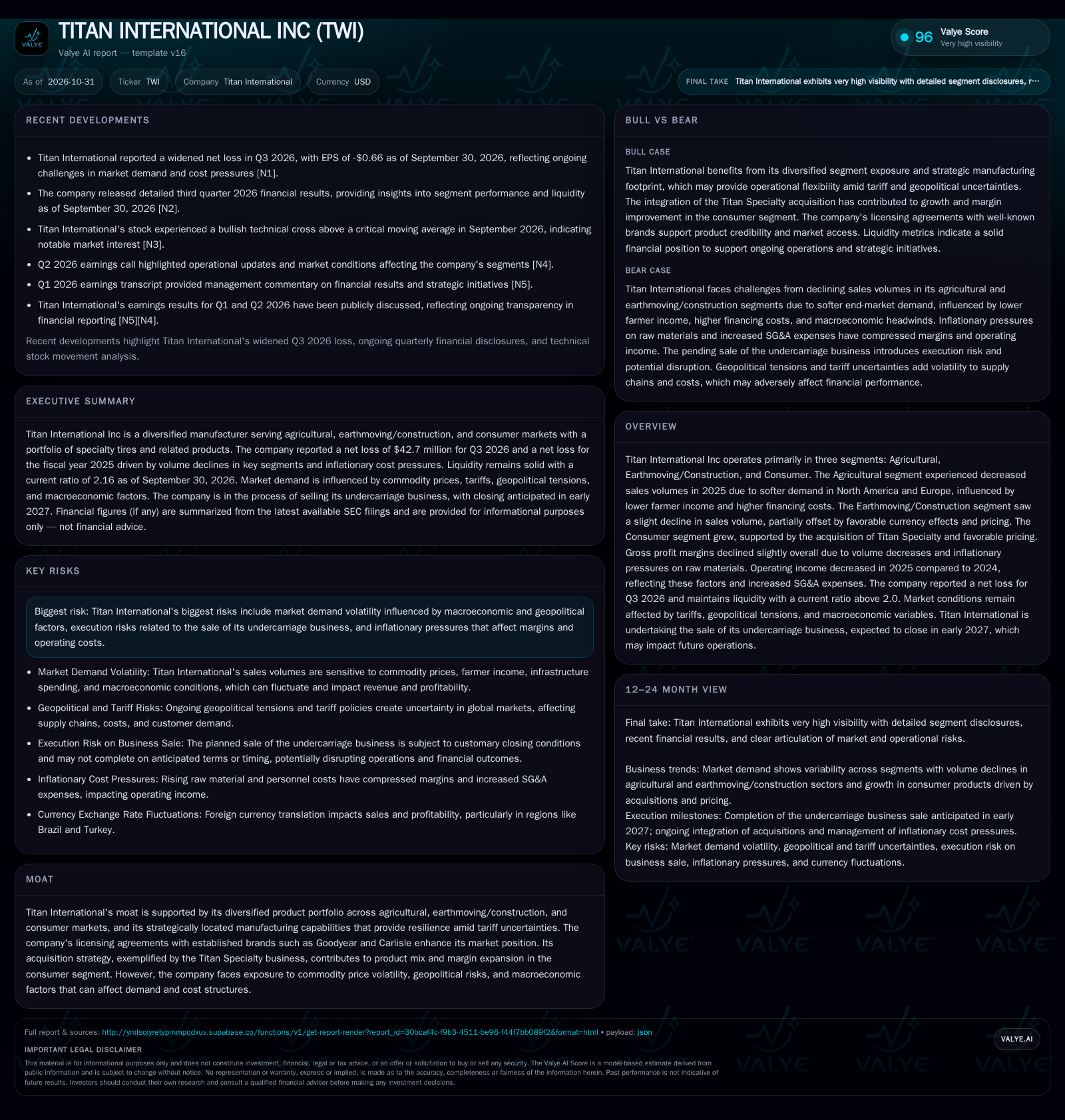
Titan International faces declining sales in its agricultural and earthmoving/construction segments, offset by growth in consumer products following an acquisition. The announced sale of its undercarriage business will reshape its segment mix and strategic focus. Margin pressures from inflation and volume declines are material, and future results will depend on successful execution of restructuring and demand recovery in core markets. [S2] [N2]
Titan International is navigating a period of pronounced internal transition and external volatility. Recent results show declining sales and profit margins in its core agricultural and earthmoving/construction businesses, offset by growth in consumer products following an acquisition. The company’s pending exit from the undercarriage business will reshape its strategic focus, while persistent cost inflation and macroeconomic headwinds threaten to constrain near-term profitability. The next phase for Titan will be defined by its ability to stabilize core operations, realize acquisition synergies, and adapt to global demand cycles across its diversified end markets. [S2] [N2]
Recent Performance Underscores Segment Divergence and Strategic Shift
Titan International’s 2025 results highlight a sharp divergence between its business segments. The Agricultural segment saw a 6.0% drop in net sales due to declining demand in North America and Europe, reflecting lower farmer income, higher financing costs, and OEM inventory reductions. The Earthmoving/Construction segment experienced a marginal 0.3% sales decline, mostly from softer North American demand and undercarriage business weakness. In contrast, the Consumer segment posted a 6.7% net sales increase, benefiting from the integration of Titan Specialty and favorable pricing/product mix. [S2]
Gross profit margins also varied widely: 12.5% for Agricultural, 10.4% for Earthmoving/Construction, and 19.8% for Consumer, resulting in an overall margin of 13.9%. The company reported a net loss for Q3 2026 and for the full year, with operating cash flow dropping to $30.0 million in 2025 from $141.5 million in 2024. [S2] [N2]
Titan International has entered into an agreement to sell its undercarriage business (ITM), with the transaction expected to close in Q1 2027, subject to customary conditions. This divestiture will remove a segment with recent underperformance and alter the company’s geographic and end-market mix. [S2]
How Segment Mix, Pricing Power, and Cost Structure Drive Profitability
Titan International’s economics are shaped by its segment mix, operating leverage, and exposure to commodity and macroeconomic cycles. The company primarily generates revenue through the sale of wheels, tires, and assemblies to OEMs and aftermarket channels in agriculture, construction, and consumer specialty markets. Pricing power is influenced by brand licensing (Goodyear, Carlisle), product mix, and the ability to pass through input cost increases, although this is constrained in price-sensitive end markets.
The Agricultural and Earthmoving/Construction segments tend to be volume-driven and cyclical, with margins compressed when demand softens—especially as fixed costs (manufacturing, SG&A) are spread over fewer units. The Consumer segment, with higher margin (19.8% in 2025), benefits from specialty products and acquired product lines, which may allow for better pricing and mix management.
Rising SG&A expenses (driven by inflation and acquisition costs) and persistent raw material inflation have pressured operating income in 2025. The pending undercarriage business sale could lower overall revenue but may improve average margin and reduce volatility if the segment’s performance continues to lag. Capital intensity remains moderate, but cash flow generation has weakened, reflecting both operational pressures and working capital swings. [S2]
Resilience and Vulnerabilities in a Crowded Global Market
Titan International’s competitive position is supported by its diversified product portfolio, brand licensing arrangements, and a strategically distributed manufacturing footprint. These factors provide some buffer against tariff-driven cost shocks and enable responsiveness to regional demand shifts. However, the company faces intense competition from global tire and wheel manufacturers serving agricultural, construction, and specialty segments, many of which benefit from larger scale, broader distribution, or vertically integrated supply chains.
The integration of Titan Specialty has enhanced the company’s position in consumer/specialty products, potentially deepening customer relationships and improving mix. Brand licensing (Goodyear, Carlisle) aids in customer acquisition and retention, but also introduces royalty costs and potential renewal risk.
Key vulnerabilities include exposure to commodity prices (rubber, steel), end-market cyclicality, and macro factors (interest rates, farmer income, infrastructure spending). The divestiture of ITM will remove a segment with recent underperformance but may reduce product breadth and cross-selling opportunities. Competitive dynamics in core markets are unlikely to ease, and the ability to maintain or grow share will depend on product innovation, cost control, and supply chain agility.
If Demand Recovers and Consumer Growth Persists, Margin Expansion Could Follow
A plausible upside scenario is driven by a rebound in agricultural and construction equipment demand, potentially triggered by improving farmer incomes, easing financing conditions, or renewed infrastructure investment. If Titan can capitalize on such demand with its existing manufacturing footprint and successfully pass through higher input costs, segment volumes and margins could rebound.
Sustained growth in the Consumer segment—especially if the Titan Specialty integration yields further synergies—would boost blended margins, given the 19.8% segment margin in 2025. The completion of the ITM divestiture could further improve average margin and reduce exposure to underperforming end-markets.
Evidence that would confirm this scenario includes a return to positive operating cash flow growth, rising segment sales in Agricultural and Earthmoving/Construction, and further improvement in Consumer segment profitability. Announcements of new OEM relationships, successful price increases, or additional specialty product launches would also support the case.
Stable but Challenged: Core Segments Struggle While Consumer Provides Cushion
The most likely near-term scenario is a continuation of current trends: Agricultural and Earthmoving/Construction segments face ongoing demand headwinds, with limited pricing power and persistent cost pressure, while the Consumer segment provides partial offset through acquisition-driven growth and favorable mix.
The company’s overall margin profile remains under pressure, with SG&A and input inflation offsetting any incremental gains from mix improvement. The sale of the undercarriage business proceeds as planned, reducing complexity but also slightly shrinking the company’s scale.
This scenario would be confirmed by continued modest declines in core segment sales, flat or slowly rising Consumer segment results, and gross margins that remain in the low-to-mid teens.
Prolonged Demand Weakness and Cost Inflation Threaten Profitability
In a more adverse scenario, agricultural and construction end-markets experience deeper or prolonged downturns, driven by continued low commodity prices, high interest rates, or geopolitical shocks. Under these conditions, Titan International may face further volume declines, intensifying operating leverage and pressuring margins below current levels.
If cost inflation persists and cannot be fully offset by pricing or mix, operating income could deteriorate further, and cash flow could turn negative, increasing the risk of covenant issues or the need for external financing. Delays or complications in the ITM divestiture process could further disrupt operations and strategic focus.
Confirmation of this scenario would include accelerating declines in segment sales, further margin compression, negative operating cash flow, and any indication of liquidity stress or restructuring charges. External shocks—such as new tariffs, supply chain disruptions, or adverse currency swings—would exacerbate the situation.
Milestones and Metrics That Will Define Titan’s Post-Divestiture Trajectory
Quarterly segment sales growth rates—especially in Agricultural and Earthmoving/Construction—will reveal whether demand is stabilizing or deteriorating further.
Consumer segment gross margin and operating margin trends, as these will indicate the sustainability of recent acquisition-driven gains.
Operating cash flow and free cash flow generation, which are critical to assessing business resilience amid margin pressure.
Progress and actual closing of the ITM (undercarriage business) divestiture, as delays or changes in terms could materially affect strategic focus and financials.
SG&A expense as a percentage of sales, to track the company’s ability to control costs post-acquisition and amid inflation.
Royalty expense trends and any updates to brand licensing agreements, which could impact both cost structure and market access.
Customer concentration and new OEM wins (if disclosed), as a shift in customer mix could alter revenue visibility and risk.
Disclaimer: This is research-only, informational analysis and not investment advice. It may include AI-generated interpretation and general industry context. Always verify important details using primary sources.

Comments