
Escalade’s Niche Sporting Goods Play: Margin Gains, Portfolio Shifts, and the Stakes of Consumer Demand
Despite recent sales declines, Escalade leans on improved margins, targeted acquisitions, and operational streamlining to defend profitability. The company’s ability to sustain earnings hinges on consumer demand, integration of new product lines, and managing competitive and economic pressures.
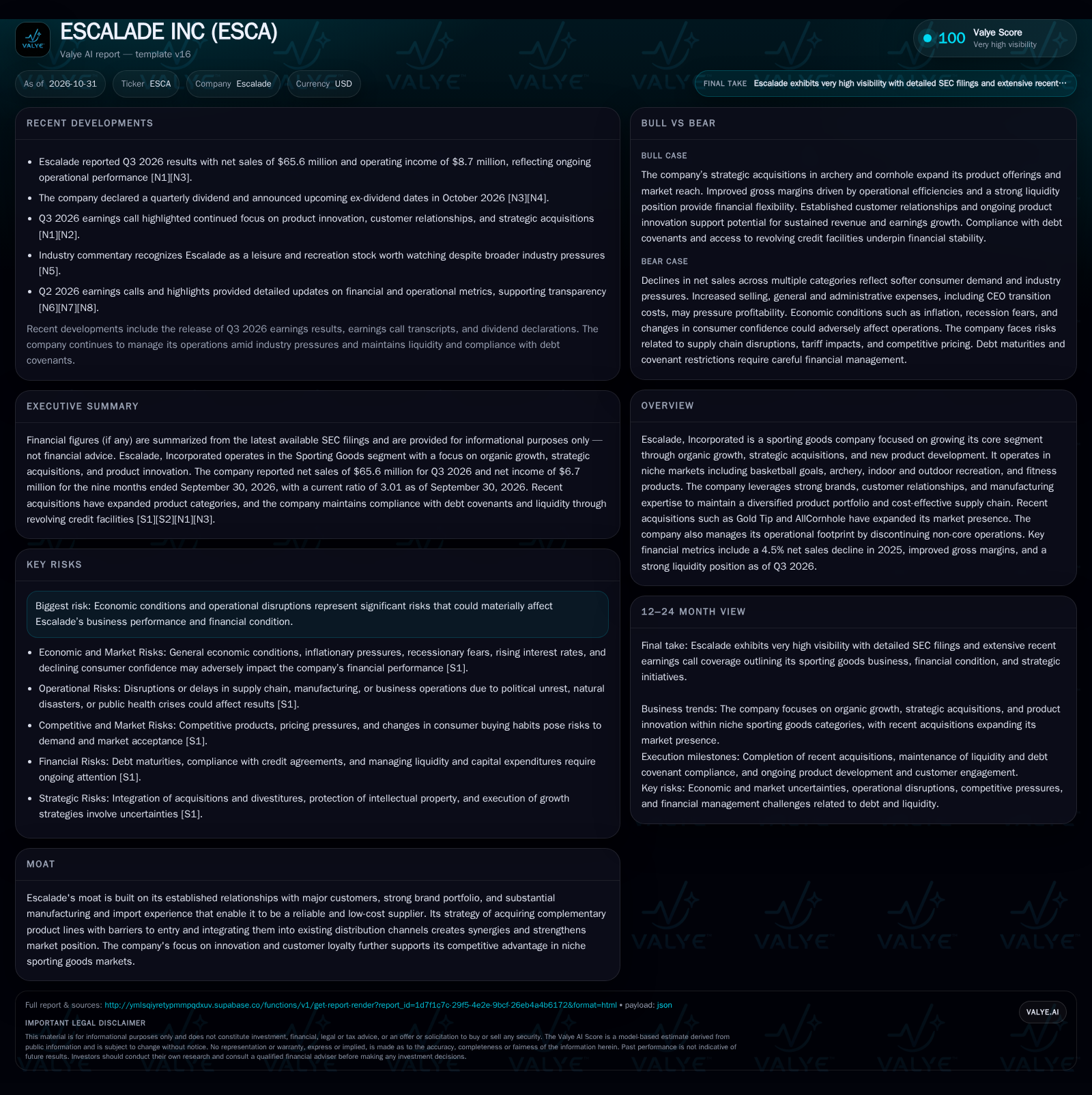
Escalade’s 2025-2026 performance is defined by a 4.5% sales decline, offset by gross margin gains from operational streamlining, and recent acquisitions in archery and cornhole. The company’s reported liquidity position, but future results will depend on consumer demand recovery, successful integration of acquisitions, and continued cost discipline. Watch for evidence of sustainable revenue stabilization, new product traction, and margin retention amid volatile leisure spending. [S1] [S2] [N1] [N3]
Escalade, Incorporated’s recent trajectory reflects the crosscurrents facing niche sporting goods manufacturers: net sales fell by 4.5% in 2025, yet the company expanded gross margins to 26.9% by streamlining operations and exiting underperforming facilities. Strategic acquisitions in archery and cornhole are intended to offset category softness, but their integration and growth will be tested against shifting consumer demand and competitive pressures. [S1] [S2] [N1] [N3]
Recent Sales Decline, Margin Expansion, and Acquisition Activity Define Escalade’s 2026 Position
Escalade reported a 4.5% decrease in net sales for 2025, with declines in several sporting goods categories partially offset by growth in archery, billiards, and fitness. This sales softness coincided with a strategic push to streamline operations, including the discontinuation of certain facilities, which contributed to a notable gross margin improvement to 26.9% from 24.7% the prior year. The company executed two acquisitions in late 2025—Gold Tip (archery) and AllCornhole (cornhole equipment)—broadening its product portfolio and market reach. As of September 30, 2026, Escalade’s liquidity includes $24.5 million in cash and a current ratio of 3.01, while debt covenants remain in compliance. These facts set the stage for a company in financial transition, seeking to defend profitability through operational agility and portfolio expansion. [S1] [S2] [N1] [N3]
How Escalade’s Margin Structure and Portfolio Mix Shape Earnings Power
Escalade’s core economic engine relies on midscale manufacturing and distribution of branded sporting goods, with profitability sensitive to both sales volumes and product mix. The company’s recent gross margin gains were achieved by reducing its operational footprint, suggesting that fixed cost leverage can be significant—shrinking capacity or offloading unprofitable assets quickly boosts margin even amid sales declines. However, this approach has natural limits: further major facility cuts could eventually erode scale advantages and constrain growth.
Pricing power in Escalade’s categories is generally modest, as many products compete in price-sensitive, discretionary consumer segments. The company’s focus on branded, niche offerings (e.g., premium basketball goals, archery equipment) may allow selective premium pricing, especially in enthusiast and specialty channels, but these categories are not immune to demand shocks or competitor promotions.
Recent acquisitions could shift the revenue mix toward higher-margin or faster-growing categories, provided integration is effective and the acquired brands sustain their market positions. On the cost side, Escalade’s import and manufacturing expertise helps manage input costs, but exposure to tariffs, freight rates, and supply chain disruptions remains a risk. Operating leverage is meaningful—incremental sales in existing channels can deliver strong profit conversion, but the reverse is also true if volumes decline further.
The company reported cash and liquidity metrics for the period; these figures do not by themselves establish operating runway, investment capacity, financial flexibility, or financing capacity. The main financial question is whether margin improvements can persist if volumes continue to soften, or if further cost actions would eventually impair the business’s growth capacity.
Defending Share in Fragmented, Price-Sensitive Sporting Goods Niches
Escalade operates in a highly fragmented landscape, where specialty brands, mass-market private labels, and importers all compete for a share of discretionary consumer spending. The company’s strengths—well-known brands, established customer relationships, and manufacturing scale—help it maintain shelf space and access to major retailers. However, these advantages are not insurmountable: larger global sporting goods firms can outspend on marketing and innovation, while low-cost importers can undercut on price.
Switching costs for retailers and consumers remain low in most categories, so ongoing product innovation and brand engagement are critical to retention. Escalade’s ability to introduce new products efficiently, leveraging its distribution relationships, may help mitigate churn, but sustained differentiation is required to defend share.
Recent acquisitions in archery and cornhole target specialized enthusiast segments that may be less commoditized than general fitness or recreational equipment. If Escalade can build a reputation for quality and authenticity in these niches, it could achieve better retention and pricing power than in more generic categories. Nevertheless, the risk of rapid category saturation or shifts in consumer preference remains present, especially if economic headwinds persist.
Acquisitions Drive Category Growth and Margin Durability
In a favorable scenario, Escalade successfully integrates Gold Tip and AllCornhole, capturing cross-selling opportunities and leveraging its distribution muscle to expand these brands’ reach. If consumer demand stabilizes or rebounds—particularly in enthusiast-driven segments like archery and cornhole—the company could offset declines in other categories, restoring overall revenue growth. Margin gains from operational streamlining would be preserved, and incremental sales would drop through to earnings at a high rate due to fixed-cost leverage.
Confirmation of this scenario would require evidence of sustained or accelerating sales in acquired categories, ongoing gross margin stability or improvement, and a return to overall top-line growth. Signals might include strong new product launches, positive channel feedback, or category share gains relative to both large and specialty competitors.
Incremental Gains from Cost Discipline, but Revenue Pressure Persists
The most plausible outcome is that Escalade continues to experience uneven demand across its portfolio. Category softness in discretionary segments could persist, but margin improvement from operational streamlining and selective pricing actions supports stable, if unspectacular, profitability. Acquisitions provide a modest buffer, but integration costs and competitive pushback limit near-term upside.
Evidence supporting this scenario would include flat to slightly declining sales, stable gross margins, and continued management of SG&A expenses. Watch for commentary on channel inventory normalization, consumer sentiment, and the pace of new product adoption—these will indicate whether Escalade is merely defending the status quo or setting up for a new growth phase.
Demand Weakness and Integration Risks Undermine Margin Progress
An adverse chain of events could see discretionary consumer spending weaken further, with additional category declines outpacing gains in acquired or niche segments. Integration of Gold Tip and AllCornhole might stall, leading to cost overruns, channel disruption, or brand dilution. If gross margins begin to erode—due to lost scale, promotional activity, or input cost inflation—Escalade’s earnings power could deteriorate quickly, forcing further cost cuts or asset sales.
Downside signals would include a return to material net sales declines, margin compression, negative operating leverage, or warnings about debt covenant headroom. Disappointing performance from recent acquisitions, especially if accompanied by write-downs or missed synergies, would confirm the risk of failed portfolio expansion.
Thesis-Testing Developments for Escalade: What Could Confirm or Challenge the Margin and Diversification Story
Sustained or improving gross margin above 26% would indicate that operational streamlining and portfolio mix are delivering durable cost benefits.
Sales growth or stabilization in newly acquired categories (archery, cornhole) would support the integration and diversification thesis; a useful metric would be category-level revenue if disclosed.
Overall net sales trajectory—whether declines have bottomed or continue—remains a core test of demand resilience.
Evidence of successful new product launches and channel expansion, such as retailer shelf gains or positive trade feedback, would validate the company’s innovation strategy.
SG&A expense trends, especially in light of CEO transition and acquisition integration, will show whether cost discipline is sustainable.
Maintenance of debt covenant compliance and liquidity, including cash levels and revolver availability, would affirm near-term financial stability.
Management commentary on consumer demand, channel inventory, and competitive pricing will help gauge the risk of further margin compression or share loss.
Disclaimer: This is research-only, informational analysis and not investment advice. It may include AI-generated interpretation and general industry context. Always verify important details using primary sources.

Comments